




Ahmedabad
(Head Office)Address : 506, 3rd EYE THREE (III), Opp. Induben Khakhrawala, Girish Cold Drink Cross Road, CG Road, Navrangpura, Ahmedabad, 380009.
Mobile : 8469231587 / 9586028957
E-mail: dics.upsc@gmail.com

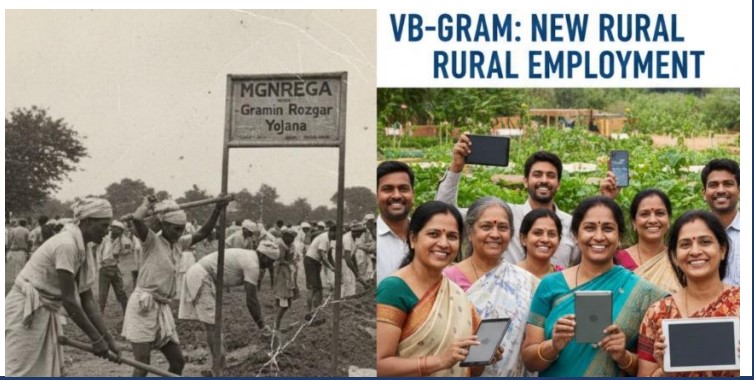
The Mahatma Gandhi National Rural Employment Guarantee Scheme (MGNREGS), recently rebranded as the Viksit Bharat Guarantee for Rozgar and Ajeevika Mission Gramin (VB-GRAM G), witnessed a significant 36% year-on-year decline in work demand this April. This shift reflects a combination of structural transitions, seasonal agricultural cycles, and a strengthening broader economy that is beginning to absorb rural surplus labor.
• Significant Quantitative Dip: Only 17.5 million individuals sought work in April 2026, compared to 27.2 million in April 2025. This downward trend has been consistent since mid 2025, with monthly declines ranging between 11% and 36%, signaling a departure from the high-demand years of the early 2020s.
• The Automatic Stabilizer Effect: Economists view the scheme as an economic cycle tracker. The current decline is largely attributed to a robust 2025 monsoon and a productive Rabi harvest season, which naturally redirected the labor force toward active farm work and away from government-guaranteed manual labor.
• Industrial Absorption: A 4.1% growth in the Index of Industrial Production (IIP) for March 2026, driven by manufacturing and mining, suggests that secondary sector activities are picking up. This revival likely provided alternative employment opportunities, reducing the reliance on the rural safety net.
• Structural Transition Challenges: The rebranding and shift to the VB-GRAM G iteration in April 2026 may have introduced temporary implementation hurdles. As states transition to new digital and administrative frameworks, data reporting and work allocation might experience a stabilization period.
• Demand-Driven Nature: Despite the dip, the government maintains the scheme demand driven character. Officials have instructed states to maintain a shelf of works to ensure that should rural distress resurface, the infrastructure to provide immediate employment remains intact.
Key Definitions
• Automatic Stabilizer: An economic tool or program that naturally offsets fluctuations in an individual or nation economic activity without explicit government intervention.
• Shelf of Works: A pre-approved list of projects (like pond excavation or road building) kept ready by local authorities to be initiated as soon as workers demand employment.
Constitutional & Legal Provisions
• Article 41: Directive Principle of State Policy (DPSP) which mandates the State to secure the right to work, to education, and to public assistance in cases of unemployment.
• Section 3(1) of the MGNREG Act, 2005: Legally guarantees at least 100 days of wage employment in a financial year to every rural household whose adult members volunteer to do unskilled manual work.
• Article 21: The Right to Life has been interpreted by the Judiciary to include the Right to Livelihood, which provides the moral and legal bedrock for such guarantee missions.
Important Key Points
• VB-GRAM G Transition: The new iteration focuses on transforming the scheme from simple work provision to Ajeevika (Livelihood) mission, emphasizing asset creation that leads to long-term income.
• Seasonality Factor: Historically, demand for MGNREGS/VB-GRAM G peaks during the lean period (summer) but dips during the sowing and harvesting seasons (Kharif and Rabi).
Conclusion: The 36% drop in rural job demand should be interpreted as a sign of rural economic resilience rather than a failure of the scheme. As the labor force moves toward farm activities and the industrial sector, the VB-GRAM G is performing its intended role as a fallback mechanism. However, ensuring that the administrative transition to the new mission format does not exclude genuine seekers remains the primary challenge for the Rural Development Ministry.
UPSC Relevance
• GS Paper II: Government policies and interventions for development in various sectors and issues arising out of their design and implementation; Welfare schemes for vulnerable sections.
• GS Paper III: Indian Economy and issues relating to planning, mobilization of resources, growth, development, and employment; Poverty and Unemployment.
• Prelims: Features of MGNREGS/VB-GRAM G, Index of Industrial Production (IIP), and the concept of Demand-driven schemes.


Address : 506, 3rd EYE THREE (III), Opp. Induben Khakhrawala, Girish Cold Drink Cross Road, CG Road, Navrangpura, Ahmedabad, 380009.
Mobile : 8469231587 / 9586028957
E-mail: dics.upsc@gmail.com
Address: A-306, The Landmark, Urjanagar-1, Opp. Spicy Street, Kudasan – Por Road, Kudasan, Gandhinagar – 382421
Mobile : 9723832444 / 9723932444
E-mail: dics.gnagar@gmail.com
Address: 2nd Floor, 9 Shivali Society, L&T Circle, opp. Ratri Bazar, Karelibaugh, Vadodara, 390018
Mobile : 9725692037 / 9725692054
E-mail: dics.vadodara@gmail.com
Address: 403, Raj Victoria, Opp. Pal Walkway, Near Galaxy Circle, Pal, Surat-394510
Mobile : 8401031583 / 8401031587
E-mail: dics.surat@gmail.com
Address: 303,305 K 158 Complex Above Magson, Sindhubhavan Road Ahmedabad-380059
Mobile : 9974751177 / 8469231587
E-mail: dicssbr@gmail.com
Address: 57/17, 2nd Floor, Old Rajinder Nagar Market, Bada Bazaar Marg, Delhi-60
Mobile : 9104830862 / 9104830865
E-mail: dics.newdelhi@gmail.com