



Ahmedabad
(Head Office)Address : 506, 3rd EYE THREE (III), Opp. Induben Khakhrawala, Girish Cold Drink Cross Road, CG Road, Navrangpura, Ahmedabad, 380009.
Mobile : 8469231587 / 9586028957
E-mail: dics.upsc@gmail.com

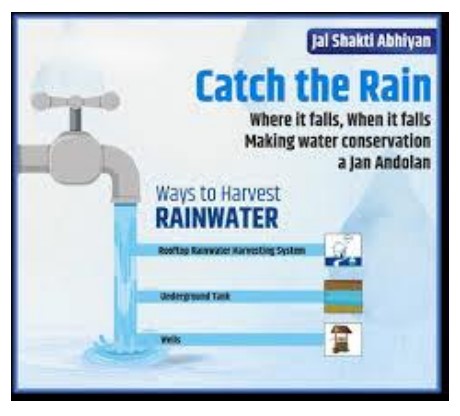
• Strategic Launch: The Government of Delhi, through the Delhi Jal Board, has initiated the Catch the Rain 2026 campaign to combat the escalating water crisis caused by rapid urbanization and a growing population.
• Public Symbolism: The campaign introduced Neera, the official water mascot, designed to simplify the concept of water conservation and foster a sense of individual ownership among citizens.
• Decisive Climate Action: The initiative emphasizes that water scarcity is no longer a theoretical concern but an immediate threat requiring decentralized solutions like localized rainwater harvesting (RWH) and groundwater recharge.
• Collective Responsibility: A key pillar of the campaign is the shift from government-led infrastructure to community participation, urging every household and residential society to install RWH systems.
• Focus on Groundwater: With traditional water sources reaching their limits, the campaign prioritizes replenishing depleted aquifers to ensure long-term sustainability for the capital’s water table.
• Urban Resilience: The drive aligns with broader urban planning goals to create Sponge Cities that can effectively manage monsoon runoff to prevent urban flooding while storing water for the lean season.
Key Definitions & Concepts
• Rainwater Harvesting (RWH): The process of collecting and storing rainwater from rooftops, parks, or open grounds for future use or for recharging groundwater.
• Groundwater Recharge: A hydrologic process where water moves downward from surface water to groundwater, essentially refilling the underground aquifers.
• Sponge City Concept: An urban construction model that prioritizes nature-based solutions to absorb, store, and purify rainwater, reducing runoff and heat island effects.
Constitutional & Legal Provisions
• Article 21: The Right to Life includes the Right to Clean Water. The Supreme Court has repeatedly held that access to safe and sufficient water is a fundamental human right.
• Article 48A (DPSP): Mandates the State to endeavor to protect and improve the environment.
• Article 51A(g) (Fundamental Duties): Casts a duty upon every citizen to protect and improve the natural environment, including lakes and rivers.
• Entry 17 (State List): Water, including water supplies, irrigation, and canals, falls primarily under the jurisdiction of State governments.
• Model Bill for Groundwater Management: Suggested by the Centre to states to regulate and control the development and management of groundwater resources.
Additional Key Points for Analysis
• Institutional Integration: Success depends on the convergence of departments like the Municipal Corporation (MCD), Public Works Department (PWD), and Water Boards to ensure RWH compliance in building bylaws.
• Data-Driven Conservation: Implementing smart meters and GIS mapping of water bodies can help in identifying critical zones for artificial recharge.
• Traditional Knowledge: Incorporating ancient Indian water management techniques (like Johads or Baolis) into modern urban landscapes can enhance efficiency.
Conclusion
The Catch the Rain 2026 campaign serves as a critical intervention for Delhi water-stressed landscape. By moving beyond policy discussions into active public engagement, the government aims to bridge the demand-supply gap. However, the long-term success of such drives rests on strict enforcement of building codes, regular maintenance of harvesting pits, and a sustained behavioral change towards water as a finite, shared resource.
UPSC Relevance
• General Studies I: Urbanization, their problems, and their remedies; Geographical features and their location-changes in critical geographical features (water-bodies).
• General Studies II: Government policies and interventions for development in various sectors; Issues relating to the management of social sector/Services relating to Health and Water.
• General Studies III: Conservation, environmental pollution, and degradation; Disaster management (Urban Flooding).
• Prelims: Major government schemes (Jal Jeevan Mission, Atal Bhujal Yojana), basic hydrology, and Mascot-related current affairs.


Address : 506, 3rd EYE THREE (III), Opp. Induben Khakhrawala, Girish Cold Drink Cross Road, CG Road, Navrangpura, Ahmedabad, 380009.
Mobile : 8469231587 / 9586028957
E-mail: dics.upsc@gmail.com
Address: A-306, The Landmark, Urjanagar-1, Opp. Spicy Street, Kudasan – Por Road, Kudasan, Gandhinagar – 382421
Mobile : 9723832444 / 9723932444
E-mail: dics.gnagar@gmail.com
Address: 2nd Floor, 9 Shivali Society, L&T Circle, opp. Ratri Bazar, Karelibaugh, Vadodara, 390018
Mobile : 9725692037 / 9725692054
E-mail: dics.vadodara@gmail.com
Address: 403, Raj Victoria, Opp. Pal Walkway, Near Galaxy Circle, Pal, Surat-394510
Mobile : 8401031583 / 8401031587
E-mail: dics.surat@gmail.com
Address: 303,305 K 158 Complex Above Magson, Sindhubhavan Road Ahmedabad-380059
Mobile : 9974751177 / 8469231587
E-mail: dicssbr@gmail.com
Address: 57/17, 2nd Floor, Old Rajinder Nagar Market, Bada Bazaar Marg, Delhi-60
Mobile : 9104830862 / 9104830865
E-mail: dics.newdelhi@gmail.com