









Ahmedabad
(Head Office)Address : 506, 3rd EYE THREE (III), Opp. Induben Khakhrawala, Girish Cold Drink Cross Road, CG Road, Navrangpura, Ahmedabad, 380009.
Mobile : 8469231587 / 9586028957
E-mail: dics.upsc@gmail.com

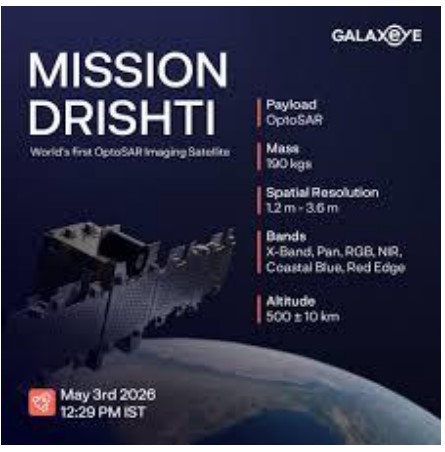
The Indian space startup GalaxEye has achieved a global milestone by launching Drishti, the world first satellite capable of capturing simultaneous optical and radar images of the same location. Launched via a SpaceX Falcon 9 rocket from California, this satellite addresses a critical gap in Earth observation by integrating two distinct imaging technologies onto a single platform.
• The OptoSAR Innovation: Drishti is the first satellite equipped with OptoSAR technology, which synchronizes optical sensors and Synthetic Aperture Radar (SAR). While optical sensors provide intuitive, high-resolution photos, they are limited by clouds and darkness; SAR uses microwave signals to penetrate these barriers but produces complex images that are difficult to interpret.
• Overcoming Tropical Challenges: Most global satellite companies cater to Western nations with clearer skies. Drishti is specifically engineered for tropical conditions like India, where frequent cloud cover and monsoon weather often blind traditional optical satellites, ensuring consistent data availability.
• Simultaneous Data Synchronization: Previously, users had to manually align data from different satellites taken at different times, often leading to inaccuracies due to groundlevel changes. Drishti eliminates this by taking both image types at the exact same instant, providing a comprehensive and real-time view of any location.
• AI-Driven Image Synthesis: GalaxEye utilizes Artificial Intelligence to translate SAR data into optical-like images. This allows users to understand what is happening on the ground even when the optical sensor is blinded by smoke or heavy cloud cover, making space imagery accessible to nonexperts.
• Private Sector Prowess: Developed by alumni of IIT Madras, this is the largest privately built satellite in India. It joins a growing list of Indian space-tech achievements by startups like Pixxel, Skyroot, and Agnikul Cosmos, reflecting the success of the government space sector reforms.
Key Definitions
• Synthetic Aperture Radar (SAR): An active data collection method where a sensor transmits its own microwave signals and measures the reflection to create images, unaffected by weather or light.
• OptoSAR: A proprietary technology stack that allows optical and radar sensors to operate in perfect sync on the same satellite platform.
Constitutional & Legal Provisions
• Article 51A(h): Part of the Fundamental Duties, it mandates every citizen to develop the scientific temper, humanism, and the spirit of inquiry and reform, which is exemplified by indigenous space-tech innovation.
• Space Policy 2023: The legal framework that opened the space sector to private players (Non-Government Entities), facilitating startups like GalaxEye to lead missions previously reserved for ISRO.
• The Geospatial Data Guidelines (2021): Liberalized the acquisition and production of geospatial data, allowing Indian startups to operate Earth observation satellites with greater autonomy.
Important Key Points
• Strategic Utility: Simultaneous imaging is vital for disaster management (floods/cyclones), defense surveillance (border monitoring through clouds), and precision agriculture.
• Global First: While SAR and optical sensors exist separately, the technological feat of putting them on one satellite and making them look at the same spot simultaneously is a first in global space history.
Conclusion: The launch of Drishti marks the transition of the Indian space sector from a state-led model to a vibrant, startup-driven ecosystem. By solving the cloud cover problem inherent to tropical geographies, GalaxEye has created a globally competitive product that enhances India strategic and commercial capabilities in Earth observation.
UPSC Relevance
• GS Paper III: Science and Technology—developments and their applications and effects in everyday life; Achievements of Indians in science & technology; Indigenization of technology and developing new technology; Awareness in the fields of Space.
• Prelims: Understanding of SAR vs. Optical sensors, OptoSAR technology, and major private players in the Indian space sector (GalaxEye, Skyroot, Pixxel).


Address : 506, 3rd EYE THREE (III), Opp. Induben Khakhrawala, Girish Cold Drink Cross Road, CG Road, Navrangpura, Ahmedabad, 380009.
Mobile : 8469231587 / 9586028957
E-mail: dics.upsc@gmail.com
Address: A-306, The Landmark, Urjanagar-1, Opp. Spicy Street, Kudasan – Por Road, Kudasan, Gandhinagar – 382421
Mobile : 9723832444 / 9723932444
E-mail: dics.gnagar@gmail.com
Address: 2nd Floor, 9 Shivali Society, L&T Circle, opp. Ratri Bazar, Karelibaugh, Vadodara, 390018
Mobile : 9725692037 / 9725692054
E-mail: dics.vadodara@gmail.com
Address: 403, Raj Victoria, Opp. Pal Walkway, Near Galaxy Circle, Pal, Surat-394510
Mobile : 8401031583 / 8401031587
E-mail: dics.surat@gmail.com
Address: 303,305 K 158 Complex Above Magson, Sindhubhavan Road Ahmedabad-380059
Mobile : 9974751177 / 8469231587
E-mail: dicssbr@gmail.com
Address: 57/17, 2nd Floor, Old Rajinder Nagar Market, Bada Bazaar Marg, Delhi-60
Mobile : 9104830862 / 9104830865
E-mail: dics.newdelhi@gmail.com