




Ahmedabad
(Head Office)Address : 506, 3rd EYE THREE (III), Opp. Induben Khakhrawala, Girish Cold Drink Cross Road, CG Road, Navrangpura, Ahmedabad, 380009.
Mobile : 8469231587 / 9586028957
E-mail: dics.upsc@gmail.com

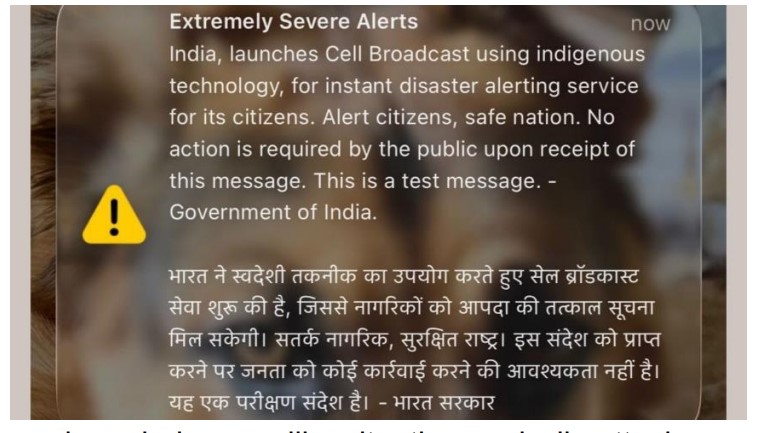
India recently conducted a massive trial of its indigenous emergency alert system, reaching nearly 14 crore mobile users within seconds. Developed by the Centre for Development of Telematics (C-DOT), this multilingual broadcast technology aims to revolutionize the country disaster management and public safety communication infrastructure.
• Mechanism of Cell Broadcast: Unlike traditional SMS, which delivers messages individually and can clog networks, Cell Broadcast sends a single message simultaneously to all handsets connected to specific mobile towers. This one-to-many approach ensures near-instantaneous delivery without being affected by network congestion or the absence of internet connectivity.
• Core Features and Overrides: The system is designed to bypass silent modes and user settings, emitting a loud, distinct buzz followed by a voice message. Its multilingual capability allows authorities to send alerts in local languages on the fly, ensuring the message is understood by diverse populations during critical windows of time.
• Strategic Utility: Beyond natural calamities like earthquakes, cyclones, and floods handled by the NDMA and IMD, the system serves strategic purposes. It is equipped to provide rapid warnings during war-like situations, missile attacks, or other national security threats, similar to systems used in Israel and Ukraine.
• Technological Sovereignty: India has opted for an indigenously developed system by C-DOT rather than relying on global vendors. This ensures better data security, customization for Indian conditions (like regional language support), and lower long-term operational costs.
• Future Roadmap: The government plans to evolve this into a two-way communication tool, enabling users to request help via weblinks or Interactive Voice Response (IVR) systems. Plans are also underway to integrate this emergency alert technology into television broadcasting for wider reach.
Key Definitions
• Cell Broadcast Service (CBS): A mobile technology feature that allows a mobile network operator to send messages to all mobile phone users in a specific geographical area.
• Model Code of Conduct (MCC): A set of guidelines issued by the Election Commission of India to regulate the conduct of political parties and candidates during elections, which led to the exclusion of certain states from the recent alert trial.
Constitutional & Legal Provisions
• Disaster Management Act, 2005: Provides the legal framework for disaster management in India. The new alert system directly supports the mandate of the National Disaster Management Authority (NDMA) to ensure timely early warnings.
• Article 21 (Right to Life): The state has a constitutional obligation to protect the lives of its citizens. Providing timely alerts during life-threatening disasters is a functional extension of this right.
• Indian Telegraph Act, 1885: Regulates the use of telegraphs and telecommunications in India, providing the government with powers to take over or monitor networks during public emergencies.
Important Key Points
• Global Precedents: India joins a select group of nations like Japan (earthquake alerts), the US (Wireless Emergency Alerts), and Israel (missile warnings) that utilize broadcast tech for civilian safety.
• Eliminating Panic: While the loud buzz caused temporary panic among some users, the government emphasized that pre-trial SMS notifications and press releases are crucial for public sensitization to avoid chaos during real emergencies.
Conclusion:
The rollout of the Cell Broadcast Alert System marks a shift from reactive to proactive disaster management in India. By leveraging indigenous technology to overcome the limitations of SMS and internet-dependent apps, India is building a robust digital fortress. The success of this system will ultimately depend on its seamless integration with state-level disaster agencies and the continuous upgrading of older mobile handsets to support this protocol.
UPSC Relevance
• GS Paper II: Governance and Role of Government Agencies (NDMA/C-DOT); Issues relating to development and management of Social Sector/Services.
• GS Paper III: Disaster Management (Early Warning Systems); Science and Technologydevelopments and their applications and effects in everyday life; Internal Security challenges.
• Prelims: Awareness of C-DOT, NDMA, and the technical difference between SMS and Cell Broadcasting.


Address : 506, 3rd EYE THREE (III), Opp. Induben Khakhrawala, Girish Cold Drink Cross Road, CG Road, Navrangpura, Ahmedabad, 380009.
Mobile : 8469231587 / 9586028957
E-mail: dics.upsc@gmail.com
Address: A-306, The Landmark, Urjanagar-1, Opp. Spicy Street, Kudasan – Por Road, Kudasan, Gandhinagar – 382421
Mobile : 9723832444 / 9723932444
E-mail: dics.gnagar@gmail.com
Address: 2nd Floor, 9 Shivali Society, L&T Circle, opp. Ratri Bazar, Karelibaugh, Vadodara, 390018
Mobile : 9725692037 / 9725692054
E-mail: dics.vadodara@gmail.com
Address: 403, Raj Victoria, Opp. Pal Walkway, Near Galaxy Circle, Pal, Surat-394510
Mobile : 8401031583 / 8401031587
E-mail: dics.surat@gmail.com
Address: 303,305 K 158 Complex Above Magson, Sindhubhavan Road Ahmedabad-380059
Mobile : 9974751177 / 8469231587
E-mail: dicssbr@gmail.com
Address: 57/17, 2nd Floor, Old Rajinder Nagar Market, Bada Bazaar Marg, Delhi-60
Mobile : 9104830862 / 9104830865
E-mail: dics.newdelhi@gmail.com