Ahmedabad
(Head Office)Address : 506, 3rd EYE THREE (III), Opp. Induben Khakhrawala, Girish Cold Drink Cross Road, CG Road, Navrangpura, Ahmedabad, 380009.
Mobile : 8469231587 / 9586028957
E-mail: dics.upsc@gmail.com

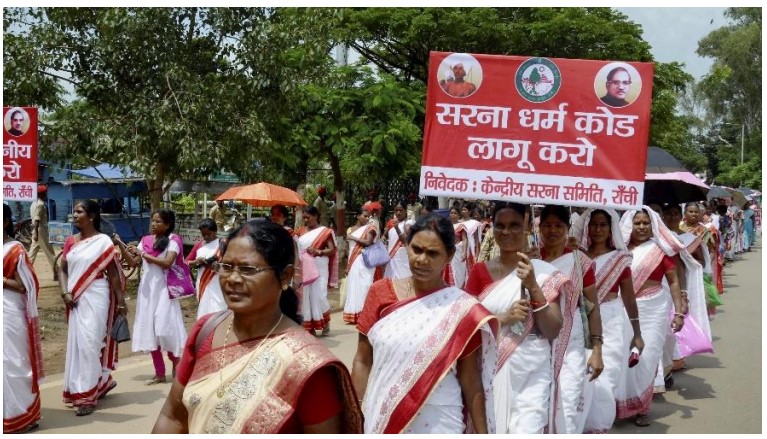
The Jharkhand government has formally urged the Union to include a separate Sarna religious code in the Census 2027. This demand seeks to provide a distinct identity to tribal communities who practice nature worship, ensuring their socio-religious uniqueness is reflected in official data for better policy targeting.
• Core Demand and Context: Chief Minister Hemant Soren has requested the President and Prime Minister to include a dedicated column for the Sarna faith in the upcoming Census. This follows the Jharkhand Assembly 2020 resolution seeking a separate code to distinguish tribal practitioners from other organized religions.
• Demographic Evidence: According to the 2011 Census, approximately 50 lakh people across 21 states manually identified themselves as Sarna in the religion column despite the absence of a dedicated code. This highlights a significant population seeking a distinct religious identity.
• Distinctive Features of Sarna Faith: The faith is characterized by Nature Worship rather than idol worship. It centers on the protection of Jal, Jangal, Jameen (Water, Forest, Land) and revolves around sacred groves (Sarnas), village deities, and rituals deeply tied to the ecological cycle.
• Rationale for the Code: The primary argument is that clubbing tribals under other religious categories (like Hindu or Christian) leads to the erosion of their unique cultural heritage and inaccurate demographic data. A separate code is viewed as essential for fact-based policymaking and balanced development.
• Protection of Tribal Rights: Proponents argue that a distinct identity is necessary to protect constitutional rights and ensure that welfare benefits reach the intended beneficiaries without religious ambiguity. It is also seen as a safeguard against forced or incentivized religious conversions.
• Administrative Challenges: While the state acknowledges that new classifications could complicate Census operations, it maintains that the long-term benefits of accurate socioreligious data outweigh these procedural hurdles, especially given the delay of the 2021 Census to 2027.
Key Definitions
• Sarnaism: An indigenous religious system practiced by several tribal groups (such as Munda, Oraon, Ho, and Santhal) in India, centered on the worship of nature and sacred groves.
• Census Code: A numerical identifier used during data collection to classify respondents into specific categories like religion, occupation, or language for statistical analysis.
Constitutional & Legal Provisions
• Article 25: Grants freedom of conscience and the right to freely profess, practice, and propagate religion. Tribal groups argue this includes the right to be recognized under their own distinct faith.
• Article 29: Mandates the protection of the interests of minorities, specifically those having a distinct language, script, or culture. Sarna followers seek protection under this cultural mandate.
• Fifth & Sixth Schedules: Provide for the administration of tribal areas. Accurate demographic data is vital for the effective functioning of Tribes Advisory Councils and the allocation of funds under these schedules.
• The Census Act, 1948: Provides the legal framework for conducting the Census. The Union Government holds the power to decide the format and categories included in the census questionnaire.
Important Key Points
• Identity vs. Benefits: While many tribals are categorized as Scheduled Tribes (ST) for reservation benefits, the Sarna code is specifically about religious and cultural identity, which they feel is missing in the current Hindu/Muslim/Christian/Sikh/Buddhist/Jain framework.
• National Implications: Though the movement is strongest in Jharkhand, it has resonance in Odisha, Chhattisgarh, West Bengal, and Bihar, making it a pan-Indian tribal identity issue.
Conclusion:
The demand for a Sarna code represents a transition from tribal identity to religious identity. While the administrative machinery fears fragmentation of data, the constitutional promise of pluralism supports the recognition of distinct cultural identities. A balanced approach would involve scientific data collection that respects the self-identification of indigenous communities while maintaining the integrity of the national census.
UPSC Relevance
• GS Paper I: Indian Society and Diversity; Salient features of Indian Society; Social Empowerment.
• GS Paper II: Welfare schemes for vulnerable sections; Functions and responsibilities of the Union and the States; Issues relating to the development and management of Social Sector/Services.
• GS Paper IV: Ethics in administration and the importance of inclusive data for distributive justice.


Address : 506, 3rd EYE THREE (III), Opp. Induben Khakhrawala, Girish Cold Drink Cross Road, CG Road, Navrangpura, Ahmedabad, 380009.
Mobile : 8469231587 / 9586028957
E-mail: dics.upsc@gmail.com
Address: A-306, The Landmark, Urjanagar-1, Opp. Spicy Street, Kudasan – Por Road, Kudasan, Gandhinagar – 382421
Mobile : 9723832444 / 9723932444
E-mail: dics.gnagar@gmail.com
Address: 2nd Floor, 9 Shivali Society, L&T Circle, opp. Ratri Bazar, Karelibaugh, Vadodara, 390018
Mobile : 9725692037 / 9725692054
E-mail: dics.vadodara@gmail.com
Address: 403, Raj Victoria, Opp. Pal Walkway, Near Galaxy Circle, Pal, Surat-394510
Mobile : 8401031583 / 8401031587
E-mail: dics.surat@gmail.com
Address: 303,305 K 158 Complex Above Magson, Sindhubhavan Road Ahmedabad-380059
Mobile : 9974751177 / 8469231587
E-mail: dicssbr@gmail.com
Address: 57/17, 2nd Floor, Old Rajinder Nagar Market, Bada Bazaar Marg, Delhi-60
Mobile : 9104830862 / 9104830865
E-mail: dics.newdelhi@gmail.com