

Ahmedabad
(Head Office)Address : 506, 3rd EYE THREE (III), Opp. Induben Khakhrawala, Girish Cold Drink Cross Road, CG Road, Navrangpura, Ahmedabad, 380009.
Mobile : 8469231587 / 9586028957
E-mail: dics.upsc@gmail.com

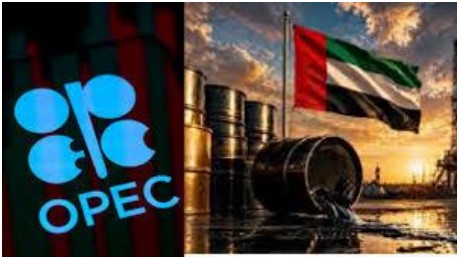
• Decisive Withdrawal: On April 28, 2026, the United Arab Emirates (UAE) officially announced its exit from the Organization of the Petroleum Exporting Countries (OPEC) and the OPEC+ alliance, effective May 1, 2026. This move, providing only three days notice, surprised the global market and coincided with the GCC Consultative Summit.
• Production Quota Tensions: Despite holding the world sixth-largest oil reserves (approx. 113 billion barrels), the UAE’s production was capped at 3.45 mbpd by OPEC quotas. This created a significant grouse, as the country has invested $150 billion to raise its capacity to 5 mbpd, leaving nearly 1.5 mbpd of capacity unutilized.
• The Peak Oil Strategy: Emirati strategists believe global oil demand is nearing its Peak Oil moment. By exiting the cartel, Abu Dhabi aims to unfetter itself from restrictions to maximize sales and market share before the long-term decline in crude value begins.
• Geopolitical Maneuvering: The exit is seen as a reassertion of regional autonomy amidst a deepening rivalry with Saudi Arabia and the backdrop of the Iran-Israel conflict. It allows the UAE to independently navigate the double blockade of the Strait of Hormuz using its Habshan-Fujairah pipeline.
• Economic Transformation: To fund its ambitious transition toward a post-oil economy— focused on AI and data centers—the UAE requires immediate high oil revenues, which was hindered by OPEC production cuts intended to stabilize global prices.
• Market Impact: As OPEC third-largest producer, the UAE departure significantly weakens the cartel\'s collective grip on global supply, potentially shifting the balance of power toward independent producers like the U.S., Brazil, and Norway.
Key Definitions & Concepts
• Peak Oil: The hypothetical point in time when the global production or demand for oil reaches its maximum rate, after which it enters a terminal decline.
• OPEC+: A loosely affiliated entity consisting of the 13 OPEC members and 10 non-OPEC oil producing nations (led by Russia) that coordinate to regulate global oil supply.
• Swing Producer: A supplier or a close-knit group of suppliers that possesses enough spare capacity to significantly influence global markets by increasing or decreasing production at will.
Constitutional & Legal Provisions
• Article 73 (Union List): In the Indian context, Mineral oil and resources; petroleum and petroleum products fall under Entry 53 of the Union List, giving the Central Government exclusive power over energy diplomacy.
• International Law of Treaties: The withdrawal process from international organizations like OPEC is governed by the specific statutes of the organization and the Vienna Convention on the Law of Treaties.
• Strategic Ties: India and the UAE are bound by a Comprehensive Strategic Partnership (2017), which provides a legal and diplomatic framework for joint investments in Strategic Petroleum Reserves (SPR).
Additional Key Points for Analysis
• Regional Rivalry: The move highlights a growing cleavage within the GCC, where the UAE is increasingly pursuing a nationalistic foreign policy independent of the traditional Saudi-led consensus.
• Market Volatility: While the exit might lead to lower prices in the long run due to increased supply, short-term geopolitical risk premiums (due to the Iran war) may keep prices volatile.
• Infrastructure Advantage: The Abu Dhabi (Habshan)-Fujairah pipeline allows the UAE to bypass the vulnerable Strait of Hormuz, giving it a strategic export advantage over peers who remain blockaded.
Conclusion
The UAE departure from OPEC marks a structural break in the global energy order. By choosing national interest over cartel discipline, Abu Dhabi has signaled that the era of unified Gulf oil policy is waning. For a world transitioning toward renewables, this move accelerates the scramble for market share, potentially turning the oil cartel into a relic of the 20th century while empowering large consumers to seek more flexible, bilateral energy security arrangements.
UPSC Relevance
• General Studies II: Effect of policies and politics of developed and developing countries on India’s interests; Bilateral, regional, and global groupings involving India.
• General Studies III: Energy security, Infrastructure, and the impact of global supply chain disruptions on the Indian economy.
• Prelims: Locations of the Strait of Hormuz and Fujairah; OPEC vs. OPEC+ membership; Concept of Peak Oil and Strategic Petroleum Reserves (SPR).


Address : 506, 3rd EYE THREE (III), Opp. Induben Khakhrawala, Girish Cold Drink Cross Road, CG Road, Navrangpura, Ahmedabad, 380009.
Mobile : 8469231587 / 9586028957
E-mail: dics.upsc@gmail.com
Address: A-306, The Landmark, Urjanagar-1, Opp. Spicy Street, Kudasan – Por Road, Kudasan, Gandhinagar – 382421
Mobile : 9723832444 / 9723932444
E-mail: dics.gnagar@gmail.com
Address: 2nd Floor, 9 Shivali Society, L&T Circle, opp. Ratri Bazar, Karelibaugh, Vadodara, 390018
Mobile : 9725692037 / 9725692054
E-mail: dics.vadodara@gmail.com
Address: 403, Raj Victoria, Opp. Pal Walkway, Near Galaxy Circle, Pal, Surat-394510
Mobile : 8401031583 / 8401031587
E-mail: dics.surat@gmail.com
Address: 303,305 K 158 Complex Above Magson, Sindhubhavan Road Ahmedabad-380059
Mobile : 9974751177 / 8469231587
E-mail: dicssbr@gmail.com
Address: 57/17, 2nd Floor, Old Rajinder Nagar Market, Bada Bazaar Marg, Delhi-60
Mobile : 9104830862 / 9104830865
E-mail: dics.newdelhi@gmail.com