





Ahmedabad
(Head Office)Address : 506, 3rd EYE THREE (III), Opp. Induben Khakhrawala, Girish Cold Drink Cross Road, CG Road, Navrangpura, Ahmedabad, 380009.
Mobile : 8469231587 / 9586028957
E-mail: dics.upsc@gmail.com

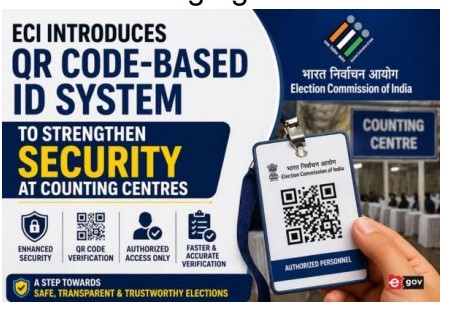
• Introduction of QR-Based Identification: The Election Commission (EC) has launched a QR code-based photo identity card system designed to prevent unauthorized entry into counting centres. This technological intervention aims to bolster the security of the counting process by ensuring only verified personnel gain access to sensitive areas.
• Three-Tier Security Mechanism: A comprehensive three-tier verification process has been established. While the first two tiers involve manual checks of photo IDs issued by the Returning Officer (RO), the third and innermost cordon requires successful QR code scanning for entry into the counting hall.
• Phased Implementation: The system will debut during the May 4 counting for Assembly elections in Assam, Kerala, Tamil Nadu, West Bengal, and Puducherry, as well as several byelections. Following this pilot, it will be mandated for all future Lok Sabha and Legislative Assembly elections.
• Broad Coverage of Personnel: The new identity cards apply to all authorized categories, including Returning Officers (ROs), Assistant Returning Officers (AROs), counting staff, technical personnel, candidates, and their respective election and counting agents.
• Digital Integration via ECINET 2.0: To manage the issuance and verification of these secure cards, the EC has introduced a dedicated module on the ECINET 2.0 platform. This ensures a centralized and standardized digital audit trail for access control.
• Media Facilitation and Compliance: Authorized media persons will continue to enter based on EC authority letters, with dedicated media centres established for their use. Chief Electoral Officers and District Election Officers (DEOs) are strictly mandated to ensure trained personnel are deployed for seamless implementation.
Key Definitions
• Returning Officer (RO): An officer designated by the Election Commission for a specific constituency, responsible for overseeing the conduct of elections and the counting of votes.
• ECINET 2.0: A secure internal portal of the Election Commission used for communication, data management, and the implementation of digital electoral tools.
• Counting Agent: A person appointed by a candidate to oversee the counting process at a specific table within the counting hall to ensure transparency.
Constitutional & Legal Provisions
• Article 324: Grants the Election Commission the power of superintendence, direction, and control of elections, which includes the authority to secure counting centres through such technological measures.
• Representation of the People Act, 1951: The primary legislation governing the conduct of elections; Section 128 emphasizes the Maintenance of secrecy of voting during the counting process.
• Conduct of Election Rules, 1961: Rule 53 outlines the categories of persons allowed into the place fixed for counting, which the EC is now standardizing via QR-based identification.
Additional Keypoints
• Transparency and Efficiency: By automating the final verification stage, the EC reduces human error and potential confrontations at the counting hall entrance.
• Technological Transformation: This move follows the EC broader strategy of utilizing digital tools (like C-Vigil or ENCORE) to modernize Indian electoral administration.
• Strict Compliance: The deployment of trained personnel at designated checkpoints is prioritized to prevent bottlenecks during the high-pressure environment of counting day.
Conclusion
The integration of QR code technology into the access control framework of counting centres represents a vital evolution in India electoral security. By moving beyond manual verification at the innermost security cordon, the Election Commission has added a robust layer of protection against unauthorized interference. This measure reinforces public trust in the sanctity of the vote-counting process and ensures that the final stage of the democratic exercise is conducted with maximum transparency and safety.
UPSC Relevance
• GS Paper II: Functions and responsibilities of the Union and the States; Election Commission of India; Salient features of the Representation of People\'s Act.
• Significance: For the Civil Services Exam, this topic illustrates the application of EGovernance in electoral reforms and the EC proactive role in maintaining the free and fair nature of Indian democracy under Article 324.


Address : 506, 3rd EYE THREE (III), Opp. Induben Khakhrawala, Girish Cold Drink Cross Road, CG Road, Navrangpura, Ahmedabad, 380009.
Mobile : 8469231587 / 9586028957
E-mail: dics.upsc@gmail.com
Address: A-306, The Landmark, Urjanagar-1, Opp. Spicy Street, Kudasan – Por Road, Kudasan, Gandhinagar – 382421
Mobile : 9723832444 / 9723932444
E-mail: dics.gnagar@gmail.com
Address: 2nd Floor, 9 Shivali Society, L&T Circle, opp. Ratri Bazar, Karelibaugh, Vadodara, 390018
Mobile : 9725692037 / 9725692054
E-mail: dics.vadodara@gmail.com
Address: 403, Raj Victoria, Opp. Pal Walkway, Near Galaxy Circle, Pal, Surat-394510
Mobile : 8401031583 / 8401031587
E-mail: dics.surat@gmail.com
Address: 303,305 K 158 Complex Above Magson, Sindhubhavan Road Ahmedabad-380059
Mobile : 9974751177 / 8469231587
E-mail: dicssbr@gmail.com
Address: 57/17, 2nd Floor, Old Rajinder Nagar Market, Bada Bazaar Marg, Delhi-60
Mobile : 9104830862 / 9104830865
E-mail: dics.newdelhi@gmail.com