




Ahmedabad
(Head Office)Address : 506, 3rd EYE THREE (III), Opp. Induben Khakhrawala, Girish Cold Drink Cross Road, CG Road, Navrangpura, Ahmedabad, 380009.
Mobile : 8469231587 / 9586028957
E-mail: dics.upsc@gmail.com

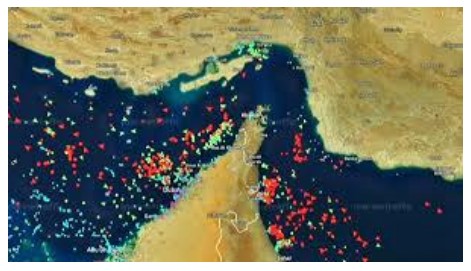
• Strategic Shift: For decades, Iran bypassed financial pressure through shadow ships selling oil to China. However, the current U.S. Navy blockade of all Iranian ports has effectively neutralized this dark fleet, cutting off the primary source of Tehran foreign exchange.
• Economic Strangulation: The blockade has caused the Iranian Rial to plummet to 1.81 million per dollar, fueled soaring food prices, and led to massive unemployment. The Iranian Shipping Association admits that only 40% of trade can be diverted via land routes through the Caucasus or Pakistan, which are insufficient to sustain the economy.
• Internal Political Schism: The crisis has fractured Iran leadership. Moderates, led by President Masoud Pezeshkian, favor a negotiated deal to prevent political collapse, while hardliners under Saeed Jalili advocate for military escalation to drive up global oil prices and pressure the U.S. administration.
• Threat to Global Infrastructure: In a desperate bid to break the deadlock, the Islamic Revolutionary Guard Corps (IRGC) has threatened to target undersea internet cables in the Strait of Hormuz, which could disrupt global telecommunications and financial markets.
• Asymmetric Warfare Risks: With 90% of its conventional navy destroyed, Iran is signaling the use of unconventional maritime assets, including submarines and mine-carrying mammals, to target U.S. warships and enforce its own crisis of market confidence.
• The Nuclear Linkage: The U.S. administration has signaled that the blockade will remain 100% foolproof until Iran accedes to comprehensive nuclear demands, turning a maritime tactical operation into a tool for ultimate diplomatic leverage.
Key Definitions & Concepts
• Shadow Ships/Dark Fleet: A network of older tankers with obscured ownership that turn off their Automatic Identification Systems (AIS) to clandestinely transport sanctioned oil.
• Naval Blockade: An act of war where a belligerent prevents all vessels from entering or leaving the ports of an enemy state to cut off its international trade.
• Strait of Hormuz: A strategic chokepoint between the Persian Gulf and the Gulf of Oman, through which approximately 20% of the world’s total oil and liquefied natural gas (LNG) consumption passes.
Constitutional & Legal Provisions
• Article 51 of the UN Charter: Deals with the inherent right of individual or collective self defense if an armed attack occurs against a Member of the United Nations.
• UN Convention on the Law of the Sea (UNCLOS): While the U.S. is not a signatory, it follows its customary laws. UNCLOS governs innocent passage through territorial waters and transit passage through international straits like Hormuz.
• Sanctions vs. Blockade: Legally, sanctions are economic restrictions (often authorized by UN Security Council or domestic law), whereas a physical blockade is traditionally considered an act of war under international law (San Remo Manual).
Additional Key Points for Analysis
• Succession Crisis: The death of Ali Khamenei and the rise of Mojtaba Khamenei has added a layer of domestic instability, making the regime response to the blockade more unpredictable as the new Supreme Leader seeks to consolidate power.
• China Dilemma: As the primary buyer of Iranian oil, the total cessation of these shipments forces China to seek more expensive alternatives, potentially shifting the dynamics of the China-Iran-U.S. triangular relationship.
• Domestic Resilience: The Iranian regime is betting on American domestic pressure regarding high gasoline prices, while the U.S. is betting on the total collapse of the Iranian economy to force a surrender.
Conclusion
The U.S. naval blockade represents a transition from maximum pressure via sanctions to direct kinetic containment. By successfully sealing off Iran’s maritime trade, the U.S. has forced Tehran into a desperate corner where the cost of endurance may soon outweigh the cost of direct military conflict. The situation remains a powder keg where a single miscalculation in the Strait of Hormuz could trigger a global energy and telecommunications crisis.
UPSC Relevance
• General Studies II: India and its neighborhood-relations; Effect of policies and politics of developed and developing countries on India interests (West Asia crisis and energy security).
• General Studies III: Security challenges and their management in border areas; Impact of global conflicts on the Indian economy (Import inflation and Diaspora safety).
• Prelims: Mapping of the Strait of Hormuz and Caucasus region; UNCLOS provisions; Major undersea cable routes and their importance to the digital economy.


Address : 506, 3rd EYE THREE (III), Opp. Induben Khakhrawala, Girish Cold Drink Cross Road, CG Road, Navrangpura, Ahmedabad, 380009.
Mobile : 8469231587 / 9586028957
E-mail: dics.upsc@gmail.com
Address: A-306, The Landmark, Urjanagar-1, Opp. Spicy Street, Kudasan – Por Road, Kudasan, Gandhinagar – 382421
Mobile : 9723832444 / 9723932444
E-mail: dics.gnagar@gmail.com
Address: 2nd Floor, 9 Shivali Society, L&T Circle, opp. Ratri Bazar, Karelibaugh, Vadodara, 390018
Mobile : 9725692037 / 9725692054
E-mail: dics.vadodara@gmail.com
Address: 403, Raj Victoria, Opp. Pal Walkway, Near Galaxy Circle, Pal, Surat-394510
Mobile : 8401031583 / 8401031587
E-mail: dics.surat@gmail.com
Address: 303,305 K 158 Complex Above Magson, Sindhubhavan Road Ahmedabad-380059
Mobile : 9974751177 / 8469231587
E-mail: dicssbr@gmail.com
Address: 57/17, 2nd Floor, Old Rajinder Nagar Market, Bada Bazaar Marg, Delhi-60
Mobile : 9104830862 / 9104830865
E-mail: dics.newdelhi@gmail.com