
Ahmedabad
(Head Office)Address : 506, 3rd EYE THREE (III), Opp. Induben Khakhrawala, Girish Cold Drink Cross Road, CG Road, Navrangpura, Ahmedabad, 380009.
Mobile : 8469231587 / 9586028957
Telephone : 079-40098991
E-mail: dics.upsc@gmail.com

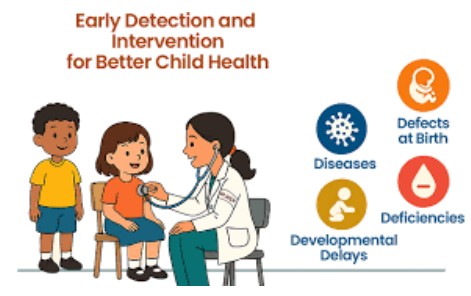
• Expansion of the 4Ds Framework: RBSK 2.0 broadens the traditional 4Ds (Defects at birth, Deficiencies, Diseases, Developmental delays) to include New-Age challenges such as noncommunicable diseases (NCDs), mental health conditions, and behavioral concerns, ensuring the program evolves with India’s changing epidemiological profile.
• Comprehensive Continuum of Care: The guidelines transition from simple screening to a preventive, promotive, and curative model, reinforcing a lifecycle-based approach that supports children from birth to 18 years through integrated service delivery.
• Enhanced Digital Infrastructure: Central to the update is the introduction of digital health cards and real-time data tracking systems, aimed at minimizing referral dropouts and ensuring every child identified with a condition receives timely facility-based treatment.
• Multi-Sectoral Convergence: The framework mandates synchronized action between the Ministry of Health, Ministry of Education, and Ministry of Women and Child Development, utilizing Anganwadi Centres and schools as primary touchpoints for universal outreach.
• Strengthened Referral Linkages: It establishes a robust, closed-loop referral tracking system that maps the journey from community-level identification by Mobile Health Teams (MHTs) to specialized Tertiary Care, ensuring no child is lost in the transition of care.
• Focus on Holistic Development: Beyond mere survival, RBSK 2.0 prioritizes Thriving by incorporating screening for developmental disorders and risk factors like childhood hypertension and diabetes, which were previously under-addressed.
Key Definitions
• 4Ds Approach: A systematic screening tool used to identify Defects at birth, Deficiencies (like Anemia), Diseases (like Skin conditions), and Developmental delays (including disabilities).
• Continuum of Care: A concept where healthcare is provided as a seamless transition of services from the household/community level to the hospital, throughout all stages of life.
Constitutional & Legal Provisions
• Article 21: The Right to Life includes the right to health; RBSK 2.0 acts as a mechanism to fulfill this fundamental right for the pediatric population.
• Article 39(f): A Directive Principle of State Policy (DPSP) that mandates the State to ensure children are given opportunities to develop in a healthy manner and in conditions of freedom and dignity.
• Article 47: Obligates the State to raise the level of nutrition and the standard of living and to improve public health.
• UN Convention on the Rights of the Child (UNCRC): As a signatory, India is committed to providing the highest attainable standard of health for children, which RBSK 2.0 directly supports.
Additional Key Points for Examination
• Mobile Health Teams (MHTs): These are the backbone of the program, consisting of AYUSH doctors, nurses, and pharmacists who conduct on-site screenings.
• District Early Intervention Centres (DEIC): The crucial link where children flagged by MHTs receive specialized diagnostic and therapy services (e.g., speech therapy, occupational therapy).
• NCD Screening: Inclusion of NCD risk factors marks a shift toward addressing the growing double burden of malnutrition and lifestyle diseases in adolescents.
Conclusion The launch of RBSK 2.0 signifies a paradigm shift from a detect and refer model to a monitor and manage ecosystem. By integrating mental health and digitalization, the government is addressing the complexities of modern childhood. If implemented with precision, it will not only reduce Out-ofPocket Expenditure (OOPE) for vulnerable families but also ensure that India demographic dividend is built on a foundation of robust physical and mental health.
UPSC Relevance
• General Studies II (Social Justice & Governance): Issues relating to development and management of Social Sector/Services relating to Health and Education.
• General Studies IV (Ethics): State moral obligation toward vulnerable sections (children).
• Prelims: Direct questions on the 4Ds, the age bracket of RBSK (0-18 years), and the implementing agencies.


Address : 506, 3rd EYE THREE (III), Opp. Induben Khakhrawala, Girish Cold Drink Cross Road, CG Road, Navrangpura, Ahmedabad, 380009.
Mobile : 8469231587 / 9586028957
Telephone : 079-40098991
E-mail: dics.upsc@gmail.com
Address: A-306, The Landmark, Urjanagar-1, Opp. Spicy Street, Kudasan – Por Road, Kudasan, Gandhinagar – 382421
Mobile : 9723832444 / 9723932444
E-mail: dics.gnagar@gmail.com
Address: 2nd Floor, 9 Shivali Society, L&T Circle, opp. Ratri Bazar, Karelibaugh, Vadodara, 390018
Mobile : 9725692037 / 9725692054
E-mail: dics.vadodara@gmail.com
Address: 403, Raj Victoria, Opp. Pal Walkway, Near Galaxy Circle, Pal, Surat-394510
Mobile : 8401031583 / 8401031587
E-mail: dics.surat@gmail.com
Address: 303,305 K 158 Complex Above Magson, Sindhubhavan Road Ahmedabad-380059
Mobile : 9974751177 / 8469231587
E-mail: dicssbr@gmail.com
Address: 57/17, 2nd Floor, Old Rajinder Nagar Market, Bada Bazaar Marg, Delhi-60
Mobile : 9104830862 / 9104830865
E-mail: dics.newdelhi@gmail.com