




Ahmedabad
(Head Office)Address : 506, 3rd EYE THREE (III), Opp. Induben Khakhrawala, Girish Cold Drink Cross Road, CG Road, Navrangpura, Ahmedabad, 380009.
Mobile : 8469231587 / 9586028957
Telephone : 079-40098991
E-mail: dics.upsc@gmail.com

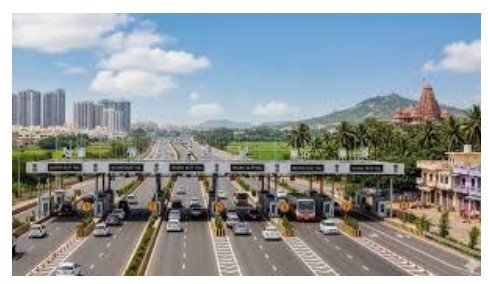
• Transition to Barrier-less Tolling: The MLFF system, launched at the Chorayasi Toll Plaza in Gujarat, eliminates physical barriers and toll booths, allowing vehicles to maintain highway speeds while toll is deducted automatically, ensuring seamless traffic movement.
• Integration of ANPR and FASTag: The system utilizes a dual-technology approach combining Automatic Number Plate Recognition (ANPR) cameras with existing RFID-based FASTag technology to identify vehicles and process payments without human intervention.
• Enforcement through E-Notices: To manage non-compliance (such as insufficient balance or invalid tags), NHAI has introduced a digital enforcement mechanism where E-Notices are issued via the Parivahan portal, allowing a 72-hour window for standard payment before penalties apply.
• Impact on Logistics and Environment: By removing idling time at plazas, the system significantly reduces fuel consumption, lowers vehicular emissions, and improves the overall Ease of Doing Business by speeding up freight movement across National Highways.
• Digital Integration with VAHAN: The MLFF framework is linked with the national VAHAN database; persistent non-payment of toll notices can lead to the blacklisting of FASTags and restriction of vehicle-related services, ensuring high accountability.
• Operational Efficiency: MLFF reduces the heavy capital and operational expenditure required for traditional toll plaza infrastructure, such as physical booths, large manpower deployment, and extensive land acquisition for multiple lanes.
Key Definitions
• Multi-Lane Free Flow (MLFF): An electronic toll collection system that allows vehicles to pass through tolling points at cruising speed without stopping or slowing down.
• Automatic Number Plate Recognition (ANPR): A technology that uses optical character recognition on images to read vehicle registration plates, used here as a redundant or primary identification layer alongside FASTag.
Constitutional & Legal Provisions
• Entry 23, Union List (Seventh Schedule): The Union Government has the exclusive power to legislate on National Highways.
• National Highways Act, 1956: Provides the legal framework for the declaration, development, and maintenance of National Highways, including the authority to levy and collect fees (tolls).
• National Highways Fee (Determination of Rates and Collection) Rules, 2008: The primary secondary legislation that governs how tolls are calculated and collected, recently amended to accommodate electronic and GPS-based tolling mechanisms.
• Article 301: Guarantees freedom of trade, commerce, and intercourse throughout the territory of India; MLFF supports this by removing physical bottlenecks to interstate movement.
Additional Key Points for Examination
• Global Benchmarking: MLFF is a standard practice in advanced economies (e.g., Singapore’s ERP or Dubai’s Salik); its implementation marks India\'s shift toward Intelligent Transport Systems (ITS).
• The 72-Hour Rule: A critical procedural detail for aspirants—users must pay the standard fee within 72 hours of an E-Notice to avoid a 2x penalty (double the normal rate).
• Satellite-Based Tolling Vision: MLFF is considered a bridge technology toward the eventual implementation of GNSS (Global Navigation Satellite System) based tolling, which will charge users based on the actual distance traveled.
Conclusion The successful pilot of the MLFF system in Gujarat represents a paradigm shift from traditional Stopand-Go tolling to a sophisticated digital ecosystem. While it promises to revolutionize highway travel by saving time and fuel, its nationwide success will depend on the robustness of the ANPR technology in diverse weather conditions and the seamless integration of digital dispute redressal mechanisms. This initiative aligns perfectly with the Gati Shakti National Master Plan, aiming for integrated and frictionless multi-modal connectivity.
UPSC Relevance
• General Studies III (Infrastructure): Important for questions regarding National Highways, investment models, and the role of technology in infrastructure development.
• General Studies III (Environment): Relevant to topics on reducing carbon footprints and vehicular pollution through smart city/transport initiatives.
• Prelims: Focus on the specific technologies (ANPR, RFID), the implementing agency (NHAI), and the legal penalties associated with the new E-Notice system.


Address : 506, 3rd EYE THREE (III), Opp. Induben Khakhrawala, Girish Cold Drink Cross Road, CG Road, Navrangpura, Ahmedabad, 380009.
Mobile : 8469231587 / 9586028957
Telephone : 079-40098991
E-mail: dics.upsc@gmail.com
Address: A-306, The Landmark, Urjanagar-1, Opp. Spicy Street, Kudasan – Por Road, Kudasan, Gandhinagar – 382421
Mobile : 9723832444 / 9723932444
E-mail: dics.gnagar@gmail.com
Address: 2nd Floor, 9 Shivali Society, L&T Circle, opp. Ratri Bazar, Karelibaugh, Vadodara, 390018
Mobile : 9725692037 / 9725692054
E-mail: dics.vadodara@gmail.com
Address: 403, Raj Victoria, Opp. Pal Walkway, Near Galaxy Circle, Pal, Surat-394510
Mobile : 8401031583 / 8401031587
E-mail: dics.surat@gmail.com
Address: 303,305 K 158 Complex Above Magson, Sindhubhavan Road Ahmedabad-380059
Mobile : 9974751177 / 8469231587
E-mail: dicssbr@gmail.com
Address: 57/17, 2nd Floor, Old Rajinder Nagar Market, Bada Bazaar Marg, Delhi-60
Mobile : 9104830862 / 9104830865
E-mail: dics.newdelhi@gmail.com