



Ahmedabad
(Head Office)Address : 506, 3rd EYE THREE (III), Opp. Induben Khakhrawala, Girish Cold Drink Cross Road, CG Road, Navrangpura, Ahmedabad, 380009.
Mobile : 8469231587 / 9586028957
Telephone : 079-40098991
E-mail: dics.upsc@gmail.com

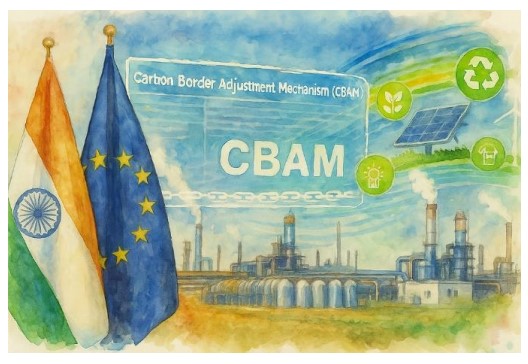
On January 1, 2026, the European Union’s Carbon Border Adjustment Mechanism (CBAM) became fully operational, imposing carbon-based charges on energy-intensive imports like steel, aluminum, and cement. While framed as a measure for fair competition, the mechanism creates a significant disadvantage for Indian exporters who lack the heavy decarbonization subsidies and free allowances enjoyed by their European counterparts.
• The Level Playing Field Imbalance: European producers benefit from subsidized public finance and free emission allowances under the EU Emissions Trading System (ETS) until 2034. In contrast, Indian exporters face the full weight of CBAM charges, a tilt that challenges the spirit of GATT Article III, which prohibits using internal charges to protect domestic industries.
• India-EU FTA and Annex 14-A: The India-EU Free Trade Agreement, concluded on January 27, 2026, provides no specific exemption for India from CBAM. However, Annex 14-A establishes a formal technical dialogue to determine how carbon prices paid in India can be credited at the EU border, alongside a Most-Favoured-Nation commitment regarding any future flexibilities.
• Climate Justice and Revenue Sovereignty: A core concern is that CBAM shifts the burden of Europe’s decarbonization onto developing nations while keeping the collected revenue in European hands. This risks turning India into a ruletaker in the global green transition rather than a sovereign rule-maker that directs its own carbon revenues.
• Leveraging CCTS and CBAM Article 9: India Carbon Credit Trading Scheme (CCTS), notified in 2023, provides the legal basis for offsetting CBAM charges. Under Article 9 of the CBAM Regulation, EU importers can deduct carbon prices already paid in the country of origin, making India\'s domestic carbon market a critical tool for international compliance.
• The IBAM the CBAM Strategy: India is exploring an India Border Adjustment Mechanism (IBAM) to collect carbon charges at the point of export. By coordinating this through the FTA technical dialogue, India can ensure these domestic payments are recognized as offsets by the EU, effectively keeping carbon tax revenues at home to fund indigenous green projects.
Key Definitions
• Carbon Border Adjustment Mechanism (CBAM): A landmark EU tool that puts a fair price on the carbon emitted during the production of carbon-intensive goods entering the EU, encouraged to prevent carbon leakage.
• Carbon Credit Trading Scheme (CCTS): India domestic compliance-grade market where industries hold tradable certificates against measured emissions, establishing a rupeedenominated carbon price.
Constitutional & Legal Provisions
• GATT Article III: A foundational principle of international trade law that requires National Treatment, barring countries from applying internal taxes or regulations to imports in a way that protects domestic production.
• CBAM Regulation Article 9: A legal provision allowing for the reduction of CBAM certificates based on the carbon price already effectively paid in the country of origin.
• Article 253 of the Indian Constitution: Empowers Parliament to make any law for the whole or any part of India for implementing any treaty, agreement, or convention with any other country, which would govern the implementation of the India-EU FTA and any reciprocal carbon measures.
Important Key Points
• Ring-fenced Revenues: Any funds raised through an Indian counter-adjustment (IBAM) would be restricted to green projects, such as modernizing blast furnaces and scaling hydrogenbased steelmaking.
• Technical Dialogue: Annex 14-A is the primary lever for India to negotiate the monitoring, verification, and exchange-rate conversion of its domestic carbon prices to ensure they are fully credited by the EU.
Conclusion: India strategy must evolve from protesting CBAM to constructively internalizing it through domestic mechanisms like IBAM and CCTS. By ensuring that carbon payments made by Indian producers stay within the country to finance its own green transition, India can maintain its economic sovereignty and climate justice principles while engaging with a carbon-priced global trade order.
UPSC Relevance
• GS Paper II: Bilateral, regional, and global groupings and agreements involving India and/or affecting India’s interests; Effect of policies and politics of developed and developing countries on India’s interests.
• GS Paper III: Conservation, environmental pollution and degradation, environmental impact assessment; Indian Economy and issues relating to mobilization of resources.
• Prelims: Understanding CBAM, CCTS, GATT Article III, and the role of the 15th Finance Commission in green financing


Address : 506, 3rd EYE THREE (III), Opp. Induben Khakhrawala, Girish Cold Drink Cross Road, CG Road, Navrangpura, Ahmedabad, 380009.
Mobile : 8469231587 / 9586028957
Telephone : 079-40098991
E-mail: dics.upsc@gmail.com
Address: A-306, The Landmark, Urjanagar-1, Opp. Spicy Street, Kudasan – Por Road, Kudasan, Gandhinagar – 382421
Mobile : 9723832444 / 9723932444
E-mail: dics.gnagar@gmail.com
Address: 2nd Floor, 9 Shivali Society, L&T Circle, opp. Ratri Bazar, Karelibaugh, Vadodara, 390018
Mobile : 9725692037 / 9725692054
E-mail: dics.vadodara@gmail.com
Address: 403, Raj Victoria, Opp. Pal Walkway, Near Galaxy Circle, Pal, Surat-394510
Mobile : 8401031583 / 8401031587
E-mail: dics.surat@gmail.com
Address: 303,305 K 158 Complex Above Magson, Sindhubhavan Road Ahmedabad-380059
Mobile : 9974751177 / 8469231587
E-mail: dicssbr@gmail.com
Address: 57/17, 2nd Floor, Old Rajinder Nagar Market, Bada Bazaar Marg, Delhi-60
Mobile : 9104830862 / 9104830865
E-mail: dics.newdelhi@gmail.com