





Ahmedabad
(Head Office)Address : 506, 3rd EYE THREE (III), Opp. Induben Khakhrawala, Girish Cold Drink Cross Road, CG Road, Navrangpura, Ahmedabad, 380009.
Mobile : 8469231587 / 9586028957
E-mail: dics.upsc@gmail.com

• Primacy of Later Legislation: The Allahabad High Court reaffirmed a fundamental legal principle that all provisions in earlier laws or court orders inconsistent with a subsequent law are null and void.
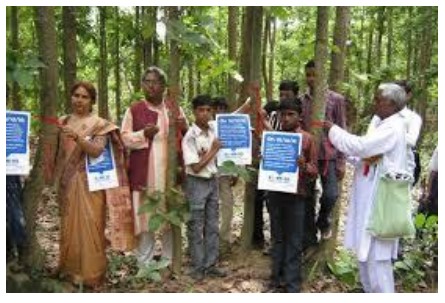
• Tharu Community Rights Restored: The court struck down a March 2021 decision by the District Level Committee (DLC) that had rejected the forest rights claims of the Tharu tribal community in Lakhimpur, Uttar Pradesh.
• Supremacy of FRA 2006: The ruling highlights that the Forest Rights Act (FRA) 2006 explicitly recognizes and vests rights in forest dwellers notwithstanding anything contained in any other law for the time being in force.
• Protection Against Eviction: Under the FRA, forest dwellers cannot be evicted or removed from their land until the entire recognition and verification procedure of their claims is complete.
• Central vs. State Law Hierarchy: The FRA, being a central law, overrides state-level legislations such as the Tamil Nadu Forest Act 1882, particularly regarding grazing rights in tiger reserves and sanctuaries.
• Non-coercive Mandate: High Courts, including the Uttarakhand High Court, have recently reinforced that authorities must refrain from any coercive action or interference with agricultural activities until claims are finally adjudicated.
Key Definitions
• District Level Committee (DLC): A statutory body headed by the District Collector, including the Divisional Forest Officer and Tribal Welfare Officer, responsible for the final decision on forest rights claims.
• Gram Sabha: A statutory authority under the FRA empowered to initiate the process of determining forest rights and authorized to proceed against violating authorities after a 60-day notice.
Constitutional & Legal Provisions
• Forest Rights Act (FRA), 2006: Formally known as the Scheduled Tribes and Other Traditional Forest Dwellers (Recognition of Forest Rights) Act, it aims to redress historical injustices by recognizing forest land rights.
• Article 13: The constitutional principle that laws inconsistent with or in derogation of the fundamental rights are void; by extension, later statutes like FRA override inconsistent prior laws.
• Section 57 of the Tamil Nadu Forest Act: A state provision used to prohibit cattle grazing, which the court noted is now overridden by the rights recognized under the central FRA.
Additional Key Points for Examination
• Administrative Accountability: The DLC violation of the notwithstanding clause in the FRA is technically a punishable offense, though courts often opt for reconsidering decisions rather than immediate sanctions.
• Judicial Consistency: The ruling serves as a corrective measure against various High Court decisions (e.g., Madras High Court) that have historically dismissed FRA claims by labeling dwellers as encroachers.
• Grazing Rights: The FRA recognizes grazing rights in all forests, including overlapping protected areas like National Parks and Wildlife Sanctuaries, which cannot be arbitrarily banned.
Conclusion
The Allahabad High Court intervention serves as a critical breath of fresh air for forest-dwelling communities. By reaffirming that the FRA 2006 supersedes outdated colonial-era forest laws and inconsistent interim court orders, the judiciary has re-established the statutory shield against premature evictions. However, the reluctance to invoke the FRA specific penal mechanisms against erring officials suggests that while the legal principle is clear, administrative enforcement remains a hurdle for tribal empowerment.
UPSC Relevance
• General Studies II (Social Justice): Welfare schemes for vulnerable sections; mechanisms, laws, and institutions for the protection and betterment of these sections.
• General Studies II (Polity): Statutory and regulatory bodies (DLC/Gram Sabha); center-state relations regarding overlapping legislations.
• General Studies III (Environment): Conservation and forest management; the balance between wildlife protection and the rights of indigenous communities.


Address : 506, 3rd EYE THREE (III), Opp. Induben Khakhrawala, Girish Cold Drink Cross Road, CG Road, Navrangpura, Ahmedabad, 380009.
Mobile : 8469231587 / 9586028957
E-mail: dics.upsc@gmail.com
Address: A-306, The Landmark, Urjanagar-1, Opp. Spicy Street, Kudasan – Por Road, Kudasan, Gandhinagar – 382421
Mobile : 9723832444 / 9723932444
E-mail: dics.gnagar@gmail.com
Address: 2nd Floor, 9 Shivali Society, L&T Circle, opp. Ratri Bazar, Karelibaugh, Vadodara, 390018
Mobile : 9725692037 / 9725692054
E-mail: dics.vadodara@gmail.com
Address: 403, Raj Victoria, Opp. Pal Walkway, Near Galaxy Circle, Pal, Surat-394510
Mobile : 8401031583 / 8401031587
E-mail: dics.surat@gmail.com
Address: 303,305 K 158 Complex Above Magson, Sindhubhavan Road Ahmedabad-380059
Mobile : 9974751177 / 8469231587
E-mail: dicssbr@gmail.com
Address: 57/17, 2nd Floor, Old Rajinder Nagar Market, Bada Bazaar Marg, Delhi-60
Mobile : 9104830862 / 9104830865
E-mail: dics.newdelhi@gmail.com