




Ahmedabad
(Head Office)Address : 506, 3rd EYE THREE (III), Opp. Induben Khakhrawala, Girish Cold Drink Cross Road, CG Road, Navrangpura, Ahmedabad, 380009.
Mobile : 8469231587 / 9586028957
E-mail: dics.upsc@gmail.com

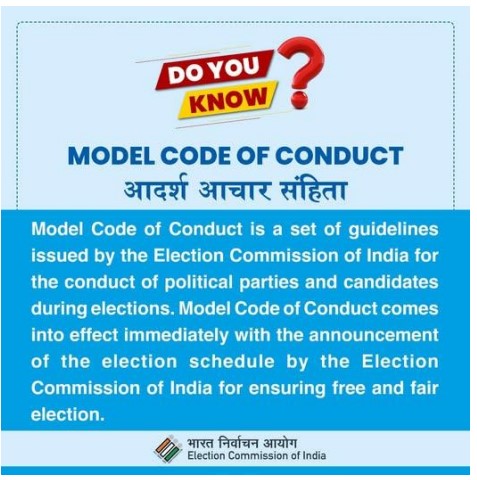
• Historical Origins and Formalization: The MCC originated in 1960 as a draft by the Kerala government, followed by formalization by the Election Commission (EC) in 1968 and a critical 1979 revision that added Part VII specifically governing the party in power.
• Expansion of Regulatory Scope: While initially a voluntary set of guidelines, the MCC gained unprecedented regulatory teeth in 1991 under Chief Election Commissioner T.N. Seshan, who enforced the code with rigorous discipline to ensure a level playing field.
• Judicial Backing and Article 324: The Supreme Court in Mohinder Singh Gill (1978) identified Article 324 as a reservoir of power, granting the EC the authority to act via the MCC in areas where specific parliamentary legislation is absent.
• Trigger for Implementation: Legal precedents, such as Harbans Singh Jalal v. Union of India (1997), have settled that the MCC comes into force immediately upon the announcement of the election schedule by the EC.
• Restrictions on the Incumbent: Part VII of the MCC explicitly prohibits the party in power from using government machinery, combining official visits with electioneering, or utilizing publicly funded mass media (like Doordarshan or AIR) for partisan coverage.
• Sanctions and Penalties: Violations of the MCC can lead to severe consequences, ranging from official censure to the suspension of a political party recognition under the Election Symbols (Reservation and Allotment) Order, 1968.
Key Definitions
• Corrupt Practice: Specific illegal acts defined under Section 123 of the Representation of the People Act, 1951, which can lead to the voiding of an election.
• Open Texture: A legal concept referring to the deliberate flexibility in the drafting of the MCC, allowing the EC to address novel forms of misconduct not explicitly listed in statutes.
Constitutional & Legal Provisions
• Article 324: Grants the Election Commission the power of superintendence, direction, and control of elections.
• Section 123(3), RPA 1951: Prohibits appeals to voters based on the candidate (or voter) religion, race, caste, community, or language.
• Section 123(7), RPA 1951: Categorizes obtaining assistance from government servants (including gazetted officers and potentially public broadcasters) for furthering electoral prospects as a corrupt practice.
Additional Key Points for Examination
• The His Interpretation: In Abhiram Singh (2017), the Supreme Court ruled that the term his in Section 123(3) refers to the identity of both the candidate and the voter, broadening the bar on sectarian appeals.
• Media Neutrality: Recent controversies highlight the tension between the Prime Minister official capacity and the use of state-funded channels like Sansad TV and Doordarshan for addresses perceived as electioneering.
• EC Discretionary Silence: The current debate underscores the EC choice in exercising its open-textured powers, where silence on potential Part VII violations may test the existing architecture of electoral regulation.
Conclusion
The Model Code of Conduct remains a unique instrument in Indian democracy, designed to be more flexible and responsive than rigid statutes. While the Representation of the People Act focuses on specific nouns like caste or religion, the MCC Part VII focuses on the broader ethical use of public resources. The effectiveness of the MCC ultimately rests not just on its drafting, but on the willingness of the Election Commission to act as an impartial arbiter when the party in power is accused of leveraging state machinery for electoral gain.
UPSC Relevance
• General Studies II (Governance & Polity): Salient features of the Representation of the People Act; Appointment to various Constitutional posts, powers, functions, and responsibilities of various Constitutional Bodies (Election Commission).
• General Studies IV (Ethics): Ethical issues in international relations and funding; Corporate governance (applied to political ethics and the use of public resources).
• Prelims: Evolution of MCC, landmark judgments (Mohinder Singh Gill, Abhiram Singh), and specific sections of the RPA 1951.


Address : 506, 3rd EYE THREE (III), Opp. Induben Khakhrawala, Girish Cold Drink Cross Road, CG Road, Navrangpura, Ahmedabad, 380009.
Mobile : 8469231587 / 9586028957
E-mail: dics.upsc@gmail.com
Address: A-306, The Landmark, Urjanagar-1, Opp. Spicy Street, Kudasan – Por Road, Kudasan, Gandhinagar – 382421
Mobile : 9723832444 / 9723932444
E-mail: dics.gnagar@gmail.com
Address: 2nd Floor, 9 Shivali Society, L&T Circle, opp. Ratri Bazar, Karelibaugh, Vadodara, 390018
Mobile : 9725692037 / 9725692054
E-mail: dics.vadodara@gmail.com
Address: 403, Raj Victoria, Opp. Pal Walkway, Near Galaxy Circle, Pal, Surat-394510
Mobile : 8401031583 / 8401031587
E-mail: dics.surat@gmail.com
Address: 303,305 K 158 Complex Above Magson, Sindhubhavan Road Ahmedabad-380059
Mobile : 9974751177 / 8469231587
E-mail: dicssbr@gmail.com
Address: 57/17, 2nd Floor, Old Rajinder Nagar Market, Bada Bazaar Marg, Delhi-60
Mobile : 9104830862 / 9104830865
E-mail: dics.newdelhi@gmail.com