





Ahmedabad
(Head Office)Address : 506, 3rd EYE THREE (III), Opp. Induben Khakhrawala, Girish Cold Drink Cross Road, CG Road, Navrangpura, Ahmedabad, 380009.
Mobile : 8469231587 / 9586028957
Telephone : 079-40098991
E-mail: dics.upsc@gmail.com

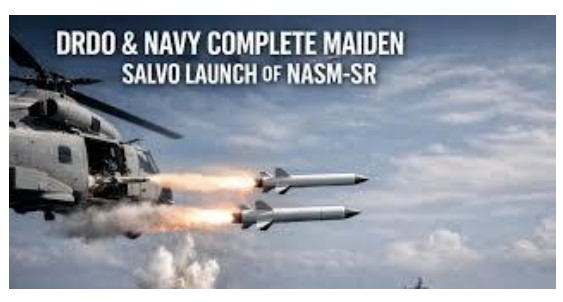
The Defence Research and Development Organisation (DRDO) and the Indian Navy recently achieved a milestone by successfully test-launching a salvo of Naval Anti-Ship Missiles Short Range (NASM-SR) from a helicopter off the Odisha coast. This indigenously developed system is designed to replace aging foreign stockpiles, providing the Navy with a highly adaptable and lethal edge in littoral warfare.
• Successful Salvo Capability: The recent test involved a salvo launch, where two missiles were fired in quick succession from the same helicopter. This capability is critical in modern naval combat to overwhelm the sophisticated air defense systems of hostile vessels through sheer volume and precision.
• Superiority over Sea Eagle: The NASM-SR is set to replace the British-origin Sea Eagle missiles currently used on Sea King helicopters. While a single Sea Eagle weighs 580 kg, the NASM-SR is significantly lighter at 380 kg, allowing helicopters to carry a higher number of missiles and strike from a safer standoff range of 55 km.
• Advanced Man-in-the-Loop Tech: Unlike older fire-and-forget missiles, the NASM-SR features a two-way data link that allows a human operator to adjust the missile path mid-flight. This minimizes the risk of collateral damage in crowded maritime corridors and ensures the missile can hit moving or decoyed targets effectively.
• Lethal Waterline Hit Precision: The missile is designed for a waterline hit, striking a vessel at the point where the hull meets the water. Damage at this vulnerable location causes rapid flooding, which can quickly disable or sink a ship, a capability that was largely absent in the previous generation of short-range naval missiles.
• Sophisticated Subsystems: The missile utilizes a solid propulsion booster for initial thrust and a long-burn sustainer engine for extended flight. It is equipped with an advanced seeker for target tracking, a radio altimeter for sea-skimming, and a proximity fuse that detonates when the missile is at an optimal distance from the target.
• Collaborative Development: The project highlights the strength of the domestic defense ecosystem, with premier DRDO labs in Hyderabad, Pune, and Chandigarh partnering with private sector entities, MSMEs, and startups to ensure the mass production of these high-tech assets.
Key Definitions
• Salvo Launch: The firing of multiple missiles or projectiles in rapid succession at a single target or multiple targets to saturate enemy defenses.
• Sea-Skimming: A flight profile where a missile flies at a very low altitude, just above the water surface, to evade enemy radar and point-defense systems.
Constitutional & Legal Provisions
• Seventh Schedule (Entry 1, Union List): Defence of India is an exclusive Union subject, mandating the Central Government to ensure the modernization and self-reliance of the Armed Forces.
• Article 51A(d): Fundamental Duty of every citizen to defend the country and render national service when called upon to do so, which is supported by the development of indigenous defense technology.
• Defence Acquisition Procedure (DAP) 2020: The policy framework that prioritizes Make in India (IDDM - Indigenously Designed, Developed, and Manufactured) categories for defense procurement.
Important Key Points
• Standoff Range: The missile 55-km range allows Navy helicopters to engage hostile fastattack crafts or smaller vessels without entering the effective range of their surface-to-air defenses.
• Strategic Autonomy: By replacing 1980s-era British missiles with homegrown technology, India reduces its dependence on foreign Original Equipment Manufacturers (OEMs) for spares and upgrades during conflict.
Conclusion: The NASM-SR is not just a technological upgrade but a strategic necessity for the Indian Navy ship-borne aviation wing. Its lighter weight, man-in-the-loop flexibility, and specific waterline hit capability transform standard utility helicopters into potent anti-access/area-denial (A2/AD) platforms. This success reinforces India commitment to Aatmanirbharta in high-end missile technology.
UPSC Relevance
• GS Paper III: Science and Technology—developments and their applications; Achievements of Indians in science & technology; Indigenization of technology; Security challenges and their management in border areas.
• GS Paper II: Government policies and interventions for development in various sectors.
• Prelims: Features of NASM-SR, understanding Man-in-the-loop vs. Fire-and-forget, and the role of DRDO in naval indigenization.


Address : 506, 3rd EYE THREE (III), Opp. Induben Khakhrawala, Girish Cold Drink Cross Road, CG Road, Navrangpura, Ahmedabad, 380009.
Mobile : 8469231587 / 9586028957
Telephone : 079-40098991
E-mail: dics.upsc@gmail.com
Address: A-306, The Landmark, Urjanagar-1, Opp. Spicy Street, Kudasan – Por Road, Kudasan, Gandhinagar – 382421
Mobile : 9723832444 / 9723932444
E-mail: dics.gnagar@gmail.com
Address: 2nd Floor, 9 Shivali Society, L&T Circle, opp. Ratri Bazar, Karelibaugh, Vadodara, 390018
Mobile : 9725692037 / 9725692054
E-mail: dics.vadodara@gmail.com
Address: 403, Raj Victoria, Opp. Pal Walkway, Near Galaxy Circle, Pal, Surat-394510
Mobile : 8401031583 / 8401031587
E-mail: dics.surat@gmail.com
Address: 303,305 K 158 Complex Above Magson, Sindhubhavan Road Ahmedabad-380059
Mobile : 9974751177 / 8469231587
E-mail: dicssbr@gmail.com
Address: 57/17, 2nd Floor, Old Rajinder Nagar Market, Bada Bazaar Marg, Delhi-60
Mobile : 9104830862 / 9104830865
E-mail: dics.newdelhi@gmail.com