





Ahmedabad
(Head Office)Address : 506, 3rd EYE THREE (III), Opp. Induben Khakhrawala, Girish Cold Drink Cross Road, CG Road, Navrangpura, Ahmedabad, 380009.
Mobile : 8469231587 / 9586028957
Telephone : 079-40098991
E-mail: dics.upsc@gmail.com

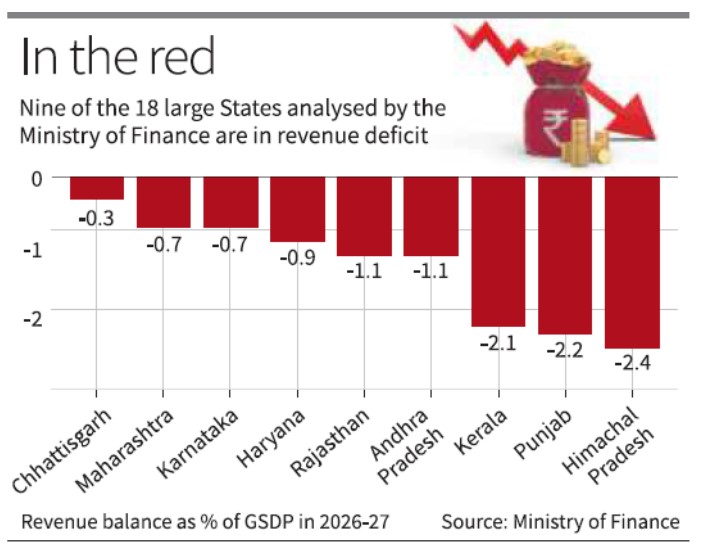
• Emergence of Fiscal Vulnerability: The Union Finance Ministry has flagged that States grappling with revenue deficits and high debt burdens are increasingly vulnerable to external shocks, such as the West Asia crisis. These fiscal shocks jeopardize the stability of subnational finances, potentially forcing a choice between cutting productive capital expenditure or seeking additional central assistance.
• Widening Revenue Gap: Out of 18 large States analyzed for the 2026-27 period, nine are projected to remain in revenue deficit. Notably, Himachal Pradesh (-2.4%), Punjab (-2.2%), and Kerala (-2.1%) lead the deficit charts as a percentage of their GSDP, indicating that their recurring earnings are insufficient to cover basic operational costs.
• The Debt-Servicing Trap: Revenue-deficit States are often caught in a cycle where a significant portion of their revenue receipts—frequently exceeding 15%—is swallowed by interest payments. This high debt-servicing obligation leaves little room for discretionary spending on social welfare or infrastructure.
• Crowding Out Productive Investment: When recurring expenses (salaries, pensions, subsidies) outpace income, States often reprioritize by slashing capital outlay. This shift away from productive areas hinders long-term economic growth and asset creation at the state level.
• Central Consolidation Constraints: The Centre warning comes at a time when the Union Government is actively pursuing its own fiscal consolidation path. This limits the Centre capacity to provide a safety net for States that fail to maintain fiscal discipline, emphasizing the need for state-level self-reliance.
• Asymmetric Fiscal Health: The analysis reveals a stark divergence in fiscal management; while nine States face deficits, seven are projected to maintain a revenue surplus, and one is in revenue balance, suggesting that fiscal stress is not universal but tied to specific state-level policy choices.
Key Definitions
• Revenue Deficit: A situation where the government total revenue expenditure (spending that does not create assets, e.g., salaries, subsidies) exceeds its total revenue receipts (tax and non-tax income).
• Gross State Domestic Product (GSDP): The sum total of the value of all finished goods and services produced within the boundaries of a State during a specific period.
• Fiscal Consolidation: Policies aimed at reducing government deficits and debt accumulation to ensure long-term financial sustainability. Constitutional & Legal Provisions
• Article 293: Empowers the Union Government to set limits on the borrowing powers of States, especially if a State has outstanding loans from the Centre.
• Article 280: Mandates the Finance Commission to recommend the distribution of net proceeds of taxes between the Union and the States and the principles governing grants-in-aid (including Revenue Deficit Grants).
• FRBM Act (2003): While federal, most States have enacted their own Fiscal Responsibility and Budget Management Acts to mandate targets for reducing revenue and fiscal deficits.
Additional Keypoints
• Sectoral Impact: High interest burdens often result in expenditure compression in vital sectors like education and healthcare.
• Contingent Liabilities: States often face hidden risks through guarantees provided to State Public Sector Undertakings (SPSUs), which can worsen the debt-to-GSDP ratio.
• Revenue Deficit Grants: The 15th Finance Commission recommended specific transition grants for States to move toward a revenue-neutral position, though reliance on these is meant to be temporary.
Conclusion
The fiscal health of States is pivotal to India’s overall macroeconomic stability. Persistent revenue deficits signify structural imbalances where consumption is funded through borrowing. To mitigate fiscal stress, States must focus on enhancing their own tax revenue (OTR) and rationalizing non-merit subsidies to ensure that debt remains sustainable and does not impede future developmental goals.
UPSC Relevance
• GS Paper II: Federalism, Centre-State financial relations, and the role of the Finance Commission.
• GS Paper III: Indian Economy, Government Budgeting, Fiscal Policy, and challenges related to inclusive growth.
• Significance: Understanding the fiscal health of States is crucial for questions regarding Cooperative Federalism and the impact of sub-national debt on national economic indicators.


Address : 506, 3rd EYE THREE (III), Opp. Induben Khakhrawala, Girish Cold Drink Cross Road, CG Road, Navrangpura, Ahmedabad, 380009.
Mobile : 8469231587 / 9586028957
Telephone : 079-40098991
E-mail: dics.upsc@gmail.com
Address: A-306, The Landmark, Urjanagar-1, Opp. Spicy Street, Kudasan – Por Road, Kudasan, Gandhinagar – 382421
Mobile : 9723832444 / 9723932444
E-mail: dics.gnagar@gmail.com
Address: 2nd Floor, 9 Shivali Society, L&T Circle, opp. Ratri Bazar, Karelibaugh, Vadodara, 390018
Mobile : 9725692037 / 9725692054
E-mail: dics.vadodara@gmail.com
Address: 403, Raj Victoria, Opp. Pal Walkway, Near Galaxy Circle, Pal, Surat-394510
Mobile : 8401031583 / 8401031587
E-mail: dics.surat@gmail.com
Address: 303,305 K 158 Complex Above Magson, Sindhubhavan Road Ahmedabad-380059
Mobile : 9974751177 / 8469231587
E-mail: dicssbr@gmail.com
Address: 57/17, 2nd Floor, Old Rajinder Nagar Market, Bada Bazaar Marg, Delhi-60
Mobile : 9104830862 / 9104830865
E-mail: dics.newdelhi@gmail.com