





Ahmedabad
(Head Office)Address : 506, 3rd EYE THREE (III), Opp. Induben Khakhrawala, Girish Cold Drink Cross Road, CG Road, Navrangpura, Ahmedabad, 380009.
Mobile : 8469231587 / 9586028957
E-mail: dics.upsc@gmail.com

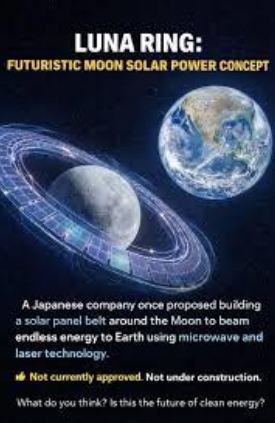
Space-Based Solar Power (SBSP) is an emerging technological concept aimed at capturing solar energy in outer space and transmitting it to Earth. Unlike terrestrial solar plants, which are limited by the diurnal cycle and atmospheric conditions, SBSP facilities—such as Japan’s proposed \'Lunar Ring\'—can collect high-intensity sunlight 24/7. The Lunar Ring concept involves an 11,000 km belt of solar collectors along the Moon\'s equator, constructed by autonomous robots using lunar regolith. While theoretically revolutionary for achieving \'Net Zero\' targets, the transition from science fiction to reality faces immense barriers, including the prohibitive cost of launching heavy hardware, energy loss during microwave transmission, and the persistent threat of orbital debris. • Constant Energy Harvest: SBSP operates above the atmosphere, bypassing the 50% energy loss caused by clouds and air, and avoids the \'night-time\' limitation, providing a true baseload power source. • The Lunar Ring Concept: Proposed by Japan’s Shimizu Corporation, this involves building a solar belt on the Moon’s equator using lunar soil to generate energy, which is then beamed to Earth via microwaves or lasers. • Transmission Mechanisms: Energy is converted into microwaves or laser beams and transmitted to \'rectennas\' (rectifying antennas) on Earth, which convert the radiation back into electricity for the grid. • Logistical and Economic Hurdles: The primary challenge is the \'Mass-to-Orbit\' cost; transporting thousands of tonnes of construction material remains economically unviable compared to cheapening terrestrial solar and battery storage. • Orbital Hazards: Systems in Earth\'s orbit face significant risks from Space Debris (Kessler Syndrome), where a single collision could trigger a chain reaction, destroying multi-billion dollar energy assets. • Efficiency Losses: While solar collection is higher in space, significant energy is lost as heat during the wireless power transmission (WPT) process through Earth\'s atmosphere. Key Definitions & Technical Terms • Lunar Regolith: The layer of loose, fragmented material covering solid rock on the Moon; proposed as a primary building material for lunar structures via 3D printing or robotic assembly. • Microwave Beaming: A method of wireless power transfer where energy is converted into electromagnetic waves in the microwave spectrum for long-distance transmission. • Rectenna: A special type of receiving antenna used for converting electromagnetic energy (microwaves) into direct current (DC) electricity. • Kessler Syndrome: A theoretical scenario where the density of objects in Low Earth Orbit (LEO) is high enough that collisions cause a cascade, rendering space activities and satellites unusable for generations. Constitutional & Legal Provisions • Article 51A(h): The Fundamental Duty to develop \'scientific temper, humanism and the spirit of inquiry\' supports the exploration of frontier technologies like SBSP. • Outer Space Treaty (1967): Principles governing the activities of States in the exploration and use of outer space, including the Moon, stipulating that space is the \'province of all mankind\' and cannot be claimed by any nation. • The Moon Agreement (1979): Establishes that the Moon and its natural resources are the \'common heritage of mankind\' and that an international regime should govern exploitation—though major space powers like the US, Russia, and China have not ratified it. • Space Liability Convention (1972): Holds a launching state absolutely liable to pay compensation for damage caused by its space objects on the surface of the Earth or to aircraft. Additional Key Points for Examination • Environmental Impact: While \'clean,\' the long-term effects of high-intensity microwave beams on the ionosphere and migratory birds remain a subject of environmental impact assessment (EIA). • Technological Convergence: Success in SBSP requires breakthroughs in three fields: Low-cost reusable rockets (like SpaceX Starship), Wireless Power Transfer (WPT), and In-situ Resource Utilization (ISRU). • Strategic Competence: Countries like Japan, China, and the UK are currently leading the research, viewing SBSP as a way to achieve energy independence and a technological edge in the \'New Space\' race. Conclusion Space-Based Solar Power represents the ultimate frontier of renewable energy, offering an inexhaustible power supply that could solve the global climate crisis. However, its current status is hampered by \'poor economics\' and the rapid advancement of terrestrial alternatives. Until launch costs drop by an order of magnitude and robotic lunar manufacturing becomes feasible, the Lunar Ring remains a visionary blueprint rather than an immediate solution. UPSC Relevance • GS Paper III (Science & Technology): Developments and their applications and effects in everyday life; Achievements of Indians in science & technology; Indigenization of technology. • GS Paper III (Energy/Environment): Renewable energy resources; Conservation and environmental pollution. • Prelims: Outer Space Treaty, Types of Orbits (GEO/LEO), Wireless Power Transmission, and Major Global Space Missions (Artemis, Lunar Ring).


Address : 506, 3rd EYE THREE (III), Opp. Induben Khakhrawala, Girish Cold Drink Cross Road, CG Road, Navrangpura, Ahmedabad, 380009.
Mobile : 8469231587 / 9586028957
E-mail: dics.upsc@gmail.com
Address: A-306, The Landmark, Urjanagar-1, Opp. Spicy Street, Kudasan – Por Road, Kudasan, Gandhinagar – 382421
Mobile : 9723832444 / 9723932444
E-mail: dics.gnagar@gmail.com
Address: 2nd Floor, 9 Shivali Society, L&T Circle, opp. Ratri Bazar, Karelibaugh, Vadodara, 390018
Mobile : 9725692037 / 9725692054
E-mail: dics.vadodara@gmail.com
Address: 403, Raj Victoria, Opp. Pal Walkway, Near Galaxy Circle, Pal, Surat-394510
Mobile : 8401031583 / 8401031587
E-mail: dics.surat@gmail.com
Address: 303,305 K 158 Complex Above Magson, Sindhubhavan Road Ahmedabad-380059
Mobile : 9974751177 / 8469231587
E-mail: dicssbr@gmail.com
Address: 57/17, 2nd Floor, Old Rajinder Nagar Market, Bada Bazaar Marg, Delhi-60
Mobile : 9104830862 / 9104830865
E-mail: dics.newdelhi@gmail.com