Ahmedabad
(Head Office)Address : 506, 3rd EYE THREE (III), Opp. Induben Khakhrawala, Girish Cold Drink Cross Road, CG Road, Navrangpura, Ahmedabad, 380009.
Mobile : 8469231587 / 9586028957
E-mail: dics.upsc@gmail.com

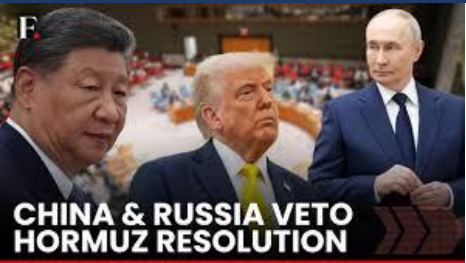
The United Nations Security Council (UNSC) recently witnessed a significant diplomatic deadlock as Russia and China exercised their veto power to block a resolution aimed at reopening the Strait of Hormuz. The draft, sponsored by Bahrain, sought international consensus to restore navigation in the world’s most critical oil transit chokepoint, which has been obstructed due to escalating regional hostilities. Despite the text being moderated to exclude explicit authorization for the use of military force—a concession made to address the concerns of nonaligned members—the \'Big Two\' of the East rejected the proposal. This move underscores the deep-seated rift within the P5 (Permanent Five) members, where Western efforts to secure maritime routes are being countered by a Sino-Russian bloc that emphasizes state sovereignty and opposes what they perceive as Western-led interventionism in the Middle East. • Diplomatic Deadlock: The resolution received 11 votes in favor but was defeated by the dual veto of Russia and China, highlighting the paralysis of the UNSC in managing high-stakes maritime crises. • Diluted Mandate: In an attempt to secure a pass, the draft was stripped of provisions that would have granted a \'green light\' for military intervention, yet it still failed to satisfy the opposing permanent members. • Global Energy Security: The Strait of Hormuz carries approximately 1/5th of the world\'s total oil consumption; its continued closure poses a direct threat to global energy price stability and supply chains. • Sovereignty vs. Intervention: Russia and China’s stance reflects their consistent policy of opposing unilateral or Western-backed \'police actions\' in the Persian Gulf, favoring instead a regional security architecture. • Impact on Gulf Nations: The failure of the resolution leaves Gulf exporters in a precarious position, as they lack a formal UN-backed security umbrella to protect their primary economic lifeline. • Regional Tensions: The veto is perceived as a strategic win for Tehran, as it prevents a coordinated international legal basis for naval operations within the strait, which Iran considers its territorial waters. Key Definitions & Concepts • Veto Power: The power of the five permanent members of the UNSC (US, UK, France, Russia, China) to unilaterally block any \'substantive\' resolution, regardless of the level of international support. • Maritime Chokepoint: A narrow sea route, such as a strait, where high volumes of traffic pass through and which can be easily blocked to disrupt global trade. • P5 vs. E10: The P5 refers to the five permanent members with veto power, while the E10 refers to the ten non-permanent members elected for two-year terms. • Freedom of Navigation: A principle of international law that ships flagged under any state shall not suffer interference from other states, apart from the exceptions provided for in international law. Constitutional & Legal Provisions • UN Charter, Article 27: Outlines the voting procedure in the Security Council, establishing the requirement for \'concurring votes of the permanent members\' on all non-procedural matters. • UNCLOS (United Nations Convention on the Law of the Sea): Specifically Part III, which deals with \'Straits Used for International Navigation\' and the right of \'Transit Passage\' for all ships and aircraft. • Article 51 (UN Charter): The right of individual or collective self-defense, which states often invoke when UN resolutions fail to provide security. • Entry 10, List I (Seventh Schedule): In the Indian context, the Union government has exclusive jurisdiction over \'Foreign affairs; all matters which bring the Union into relation with any foreign country,\' including stances taken at the UN. Additional Key Points for Examination • Strategic Autonomy: For India, the UNSC failure necessitates a delicate balancing act—protecting its energy interests in the Gulf while maintaining its \'multi-aligned\' relationships with both the US and the Sino-Russian bloc. • Alternate Routes: The closure of Hormuz increases the strategic importance of the International NorthSouth Transport Corridor (INSTC) and alternate pipelines bypassing the strait, such as the East-West Pipeline in Saudi Arabia. • UNSC Reform: This incident adds momentum to the global demand for UNSC expansion and reform, as the current veto system is increasingly seen as an impediment to addressing 21st-century security challenges. Conclusion The dual veto by Russia and China serves as a stark reminder of the \'New Cold War\' dynamics currently shaping international relations. By blocking the reopening of the Strait of Hormuz via the UN framework, the permanent members have inadvertently shifted the theatre of resolution from the diplomatic halls of New York to the volatile waters of the Persian Gulf. For the global economy, this implies a prolonged period of energy uncertainty and a potential rise in \'coalition-based\' naval missions outside of UN auspices. UPSC Relevance • GS Paper II (International Relations): Important International institutions, agencies and fora—their structure, mandate; Effect of policies and politics of developed and developing countries on India’s interests. • GS Paper III (Internal Security): Maritime security and the protection of Sea Lines of Communication (SLOCs).


Address : 506, 3rd EYE THREE (III), Opp. Induben Khakhrawala, Girish Cold Drink Cross Road, CG Road, Navrangpura, Ahmedabad, 380009.
Mobile : 8469231587 / 9586028957
E-mail: dics.upsc@gmail.com
Address: A-306, The Landmark, Urjanagar-1, Opp. Spicy Street, Kudasan – Por Road, Kudasan, Gandhinagar – 382421
Mobile : 9723832444 / 9723932444
E-mail: dics.gnagar@gmail.com
Address: 2nd Floor, 9 Shivali Society, L&T Circle, opp. Ratri Bazar, Karelibaugh, Vadodara, 390018
Mobile : 9725692037 / 9725692054
E-mail: dics.vadodara@gmail.com
Address: 403, Raj Victoria, Opp. Pal Walkway, Near Galaxy Circle, Pal, Surat-394510
Mobile : 8401031583 / 8401031587
E-mail: dics.surat@gmail.com
Address: 303,305 K 158 Complex Above Magson, Sindhubhavan Road Ahmedabad-380059
Mobile : 9974751177 / 8469231587
E-mail: dicssbr@gmail.com
Address: 57/17, 2nd Floor, Old Rajinder Nagar Market, Bada Bazaar Marg, Delhi-60
Mobile : 9104830862 / 9104830865
E-mail: dics.newdelhi@gmail.com