Ahmedabad
(Head Office)Address : 506, 3rd EYE THREE (III), Opp. Induben Khakhrawala, Girish Cold Drink Cross Road, CG Road, Navrangpura, Ahmedabad, 380009.
Mobile : 8469231587 / 9586028957
E-mail: dics.upsc@gmail.com

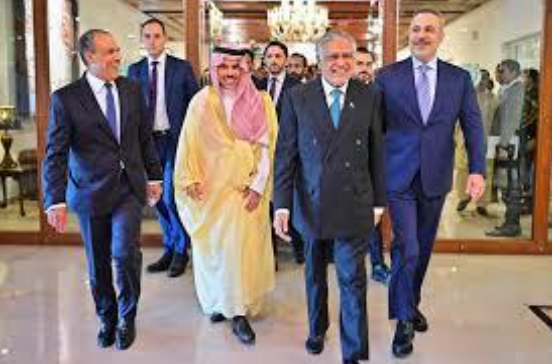
The geopolitical landscape in West Asia has reached a critical juncture as Iran issues stern warnings against a potential U.S. ground invasion, while Pakistan emerges as a central mediator hosting a multi-nation diplomatic summit in Islamabad.
Key Summary Points for UPSC
• Iran’s Deterrence Posture: Iranian Parliament Speaker Mohammad Bagher Ghalibaf has warned of severe retaliation against any U.S. ground entry, labeling regional partners of the U.S. as potential targets.
• Islamabad Diplomatic Hub: Pakistan is facilitating highlevel talks involving Foreign Ministers from Egypt, Saudi Arabia, and Turkiye to broker a ceasefire and stabilize the region.
• Proposed U.S.-Iran Dialogue: Pakistan’s Foreign Minister Ishaq Dar announced that Islamabad will host upcoming talks between Washington and Tehran, signaling a rare opening for de-escalation.
• Skepticism and Military Reality: Despite diplomatic efforts, Iran views the regional meetings as a \'cover\' for further U.S. troop deployments, reflecting a deep trust deficit.
• Ongoing Kinetic Conflict: The diplomatic push coincides with active hostilities, including Israeli-U.S. strikes on Iranian interests and Tehran’s retaliatory drone and missile operations.
• Strategic Autonomy of Regional Players: The involvement of Turkiye and Saudi Arabia underscores a shift toward regional solutions for Middle Eastern conflicts, independent of direct Israeli or U.S. participation in the initial stages.
Additional Important Keypoints
• Non-Alignment vs. Mediation: Pakistan’s role highlights its attempt to balance its strategic ties with the U.S. while maintaining a functional relationship with its neighbor, Iran.
• The \'Ground Invasion\' Threshold: Iran’s specific warning against ground troops suggests a \'red line\' that, if crossed, could transition the current proxy war into a full-scale regional conflagration.
• Impact on Global Energy: Prolonged instability in West Asia directly threatens the Strait of Hormuz, a critical chokepoint for India’s energy security.
Constitutional & Legal Provisions (International Context)
• Article 2(4) of the UN Charter: Prohibits the threat or use of force against the territorial integrity or political independence of any state; central to Iran\'s warning against invasion.
• Article 51 of the UN Charter: Relates to the inherent right of individual or collective self-defense if an armed attack occurs, often cited by both Iran and the U.S. to justify military actions.
• Vienna Convention on Diplomatic Relations (1961): Governs the conduct of the Foreign Ministers meeting in Islamabad and the protection of diplomatic channels during conflict.
Definition of Key Words
• Ground Invasion: A military offensive where armed forces enter and attempt to control the territory of another state using land-based troops.
• De-escalation: A reduction in the intensity or magnitude of a conflict through diplomatic negotiation or military withdrawal.
• Shuttle Diplomacy: Negotiations conducted by an intermediary (in this case, Pakistan) who travels between different locations to facilitate communication between parties who do not meet directly.
Conclusion
The current situation in West Asia represents a volatile mix of \'brinkmanship\' and \'diplomacy.\' While the Islamabad meet offers a glimmer of hope for a negotiated settlement, the rhetoric from Tehran and the continued military exchanges suggest that the risk of miscalculation remains high. For a lasting peace, the underlying security concerns of both the U.S. and Iran must be addressed through the proposed Islamabad channel.
UPSC Relevance
• GS Paper II (International Relations): Effect of policies and politics of developed and developing countries on India’s interests; Indian Diaspora (West Asia is home to millions of Indians).
• GS Paper III (Security): Regional security implications and the impact of West Asian instability on India’s maritime trade and energy corridors.
• Strategic Importance: This topic is vital for understanding \'India\'s Look West Policy\' and the challenges of maintaining neutrality in a polarized global order.


Address : 506, 3rd EYE THREE (III), Opp. Induben Khakhrawala, Girish Cold Drink Cross Road, CG Road, Navrangpura, Ahmedabad, 380009.
Mobile : 8469231587 / 9586028957
E-mail: dics.upsc@gmail.com
Address: A-306, The Landmark, Urjanagar-1, Opp. Spicy Street, Kudasan – Por Road, Kudasan, Gandhinagar – 382421
Mobile : 9723832444 / 9723932444
E-mail: dics.gnagar@gmail.com
Address: 2nd Floor, 9 Shivali Society, L&T Circle, opp. Ratri Bazar, Karelibaugh, Vadodara, 390018
Mobile : 9725692037 / 9725692054
E-mail: dics.vadodara@gmail.com
Address: 403, Raj Victoria, Opp. Pal Walkway, Near Galaxy Circle, Pal, Surat-394510
Mobile : 8401031583 / 8401031587
E-mail: dics.surat@gmail.com
Address: 303,305 K 158 Complex Above Magson, Sindhubhavan Road Ahmedabad-380059
Mobile : 9974751177 / 8469231587
E-mail: dicssbr@gmail.com
Address: 57/17, 2nd Floor, Old Rajinder Nagar Market, Bada Bazaar Marg, Delhi-60
Mobile : 9104830862 / 9104830865
E-mail: dics.newdelhi@gmail.com