




Ahmedabad
(Head Office)Address : 506, 3rd EYE THREE (III), Opp. Induben Khakhrawala, Girish Cold Drink Cross Road, CG Road, Navrangpura, Ahmedabad, 380009.
Mobile : 8469231587 / 9586028957
E-mail: dics.upsc@gmail.com

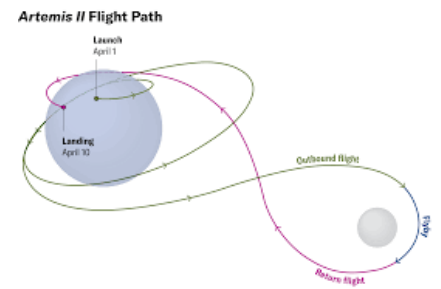
On April 6, 2026, NASA’s Artemis II mission set a new milestone in human spaceflight by traveling 4,06,771 km away from Earth, surpassing the 1970 record held by Apollo-13. This mission represents the first crewed lunar voyage in over five decades and serves as a critical test for the Orion spacecraft and its life support systems in deep space. Unlike previous lunar missions that aimed for orbit or landing, Artemis II utilized a \'free-return trajectory,\' a highly efficient flight path that uses lunar gravity to slingshot the vehicle back to Earth. This achievement marks a pivotal step toward establishing a long-term human presence on the Moon and eventually Mars, proving that modern spacecraft can safely sustain life at unprecedented distances from our home planet. • Record-Breaking Distance: The Artemis II crew traveled 4,06,771 km from Earth, breaking the previous human spaceflight record of 4,00,171 km set by the Apollo-13 mission in 1970. • Free-Return Trajectory: The mission employs a figureeight \'free-return\' path, which uses the Moon\'s gravity to naturally whip the spacecraft back toward Earth without requiring a massive engine burn for the return journey. • High-Earth Orbit (HEO) Phase: Before heading to the Moon, Orion spent 42 hours in a 74,000 km elliptical Earth orbit to verify environmental control and life support systems while still within reach of an emergency abort. • Lunar Slingshot Mechanism: The spacecraft aimed for a point 10,300 km beyond the lunar far side, allowing gravity to act as a tether to redirect the craft toward Earth\'s atmosphere for re-entry. • Fuel and Mass Efficiency: By avoiding a circular lunar orbit—which requires fuel-heavy deceleration and acceleration—the mission significantly reduced the required propellant, allowing the Space Launch System (SLS) to lift a lighter overall mass. • Safety as Priority: The looping flight plan serves as an inherent safety mechanism; in the event of an engine failure after leaving Earth\'s orbit, the spacecraft\'s momentum and lunar gravity ensure the crew is not stranded in deep space. Key Definitions & Technical Terms • Free-Return Trajectory: A spacecraft trajectory that uses the gravity of a secondary body (the Moon) to return the craft to its point of origin (Earth) with minimal engine use. • Far Side of the Moon: The hemisphere of the Moon that always faces away from Earth due to synchronous rotation; Artemis II traveled behind this region to achieve its record distance. • Orion Spacecraft: NASA\'s next-generation crew vehicle designed for deep space missions, capable of carrying four astronauts for up to 21 days. • European Service Module (ESM): The \'powerhouse\' of the Orion craft, provided by ESA, which supplies electricity, propulsion, thermal control, air, and water to the crew. Constitutional & Legal Provisions • Article 51(h): Part of the Fundamental Duties in the Indian Constitution, which mandates that citizens \'develop the scientific temper, humanism and the spirit of inquiry and reform.\' • Outer Space Treaty, 1967: The foundational framework of international space law, which declares that space exploration shall be carried out for the benefit of all countries and that the Moon is not subject to national appropriation. • Artemis Accords: A non-binding set of principles led by the US (with India as a signatory since 2023) to guide sustainable and transparent civil space exploration in the 21st century. • Space Policy 2023 (India): While the mission is led by NASA, India’s own space policy encourages international collaboration in deep space exploration and human spaceflight missions (Gaganyaan). Additional Key Points for Examination • Comparison with Apollo: While Apollo-8 followed a circular orbit at a fixed distance, Artemis II’s elliptical path was designed specifically to test the structural and life-support limits of the new Orion hardware. • Radiation Protection: A major objective of traveling this far is to assess the efficacy of Orion’s radiation shielding against solar particles and cosmic rays outside the protection of Earth’s Van Allen belts. • Gateway to Mars: The Artemis program is viewed as a \'Moon to Mars\' initiative, where lunar missions serve as a testing ground for the technologies needed for multi-year interplanetary voyages. Conclusion The Artemis II mission is more than a record-breaking distance feat; it is a masterclass in gravitational physics and mission safety. By mastering the free-return trajectory, space agencies can conduct high-stakes deep space testing while maintaining a \'fail-safe\' return path. For the global scientific community, the success of this mission confirms that the return to the Moon is no longer a matter of \'if,\' but \'when,\' paving the way for the Artemis III landing. UPSC Relevance • GS Paper III (Science & Technology): Awareness in the fields of Space; Achievements of Indians in science & technology; Indigenization of technology and developing new technology. • GS Paper II (IR): Important International institutions and agreements (Artemis Accords, UNCOPUOS).


Address : 506, 3rd EYE THREE (III), Opp. Induben Khakhrawala, Girish Cold Drink Cross Road, CG Road, Navrangpura, Ahmedabad, 380009.
Mobile : 8469231587 / 9586028957
E-mail: dics.upsc@gmail.com
Address: A-306, The Landmark, Urjanagar-1, Opp. Spicy Street, Kudasan – Por Road, Kudasan, Gandhinagar – 382421
Mobile : 9723832444 / 9723932444
E-mail: dics.gnagar@gmail.com
Address: Tithi Commercial Complex, 401/402 Productivity Road, Opp. Productivity House, Alkapuri, Vadodara, Gujarat – 390007
Mobile : 9725692037 / 9725692054
E-mail: dics.vadodara@gmail.com
Address: 403, Raj Victoria, Opp. Pal Walkway, Near Galaxy Circle, Pal, Surat-394510
Mobile : 8401031583 / 8401031587
E-mail: dics.surat@gmail.com
Address: 303,305 K 158 Complex Above Magson, Sindhubhavan Road Ahmedabad-380059
Mobile : 9974751177 / 8469231587
E-mail: dicssbr@gmail.com
Address: 57/17, 2nd Floor, Old Rajinder Nagar Market, Bada Bazaar Marg, Delhi-60
Mobile : 9104830862 / 9104830865
E-mail: dics.newdelhi@gmail.com