






Ahmedabad
(Head Office)Address : 506, 3rd EYE THREE (III), Opp. Induben Khakhrawala, Girish Cold Drink Cross Road, CG Road, Navrangpura, Ahmedabad, 380009.
Mobile : 8469231587 / 9586028957
Telephone : 079-40098991
E-mail: dics.upsc@gmail.com

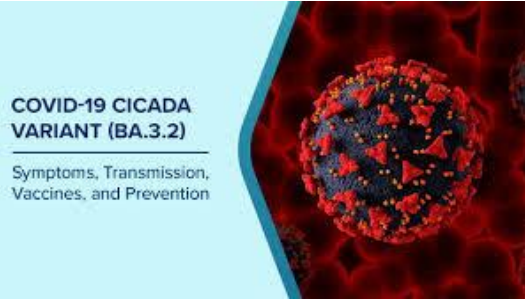
The SARS-CoV-2 virus continues its evolutionary trajectory with the emergence of BA.3.2, a sub-lineage of the Omicron strain. Dubbed \'Cicada\' due to its period of dormancy followed by a sudden rise in detection, this variant has drawn global attention due to its highly divergent genetic profile. While it exhibits significant mutations in the spike protein, which theoretically enhance cell entry and immune evasion, early clinical data suggests symptoms remain consistent with previous Omicron sub-variants. Global health bodies, including the WHO and CDC, are currently maintaining a status of heightened surveillance without escalating it to a highpriority threat, emphasizing that existing hybrid immunity and updated vaccines continue to offer substantial protection against severe disease. • Evolutionary Origin: BA.3.2 is a descendant of the Omicron lineage, first identified in South Africa in 2024; it remained largely inactive before surfacing globally in early 2026, leading to its \'Cicada\' moniker. • Genetic Divergence: The variant is characterized as \'highly divergent,\' possessing a significantly higher number of mutations in the spike protein compared to the LP.8.1 strain used for the 2025-26 vaccine formulations. • Transmission and Evasion: High spike protein mutations are critical as they dictate the virus\'s ability to bind to human ACE2 receptors and potentially bypass antibodies generated from prior infections or older vaccine doses. • Geographic Spread: As of early 2026, the variant has been detected in over 23 countries and 29 US states, primarily identified through advanced genomic surveillance and traveler-based screening programs. • Clinical Severity: Current reports indicate that BA.3.2 symptoms—including fever, fatigue, and upper respiratory issues—align with earlier Omicron descendants, with no current evidence of increased virulence or mortality. • Global Response: The WHO has classified BA.3.2 as a \'Variant Under Monitoring\' (VUM), signaling the need for robust data collection while maintaining that it does not yet meet the criteria for a \'Variant of Concern\' (VOC). Key Definitions & Concepts • Spike Protein: The protrusion on the virus surface that facilitates entry into host cells; it is the primary target for most neutralizing antibodies and vaccines. • Genomic Surveillance: The process of monitoring pathogens by sequencing their genetic material to identify mutations and track the spread of specific variants. • Variant Under Monitoring (VUM): A WHO category for variants with genetic changes suspected to affect virus characteristics, requiring close monitoring and repeated assessment. • Immune Evasion: The ability of a virus to remain undetected or un-neutralized by the host\'s immune system, often due to structural changes in its antigens. Constitutional & Legal Provisions (India) • Entry 29, List III (Concurrent List): The Constitution of India empowers both the Union and States to legislate on the \'Prevention of the extension from one State to another of infectious or contagious diseases.\' • Epidemic Diseases Act, 1897: Provides the legal framework for the government to take special measures and prescribe regulations to prevent the outbreak or spread of dangerous epidemic diseases. • Disaster Management Act, 2005: Utilized during the pandemic to provide a hierarchical structure for disaster response, including the management of biological disasters and health emergencies. • Article 21: The Right to Life includes the Right to Health, placing an obligation on the State to ensure public health safety through vaccination and surveillance. Additional Key Points • Vaccine Efficacy: While BA.3.2 is divergent, T-cell immunity (cellular immunity) often remains robust even when antibody-mediated (humoral) immunity is challenged by new mutations. • INSACOG Role: In India, the Indian SARS-CoV-2 Genomics Consortium (INSACOG) is the nodal agency responsible for sequencing samples to detect the entry of such variants like BA.3.2. • Global Meeting: The WHO Vaccine Composition Group is scheduled to discuss BA.3.2 in May 2026 to determine if future booster shots require further adjustment. Conclusion The emergence of BA.3.2 highlights the \'Red Queen Hypothesis\' in virology, where the virus must constantly mutate to survive against increasing global immunity. While its high mutation rate warrants scientific vigilance, the lack of increased clinical severity suggests that the shift from a pandemic to an endemic phase remains stable. Public health strategy must prioritize sustained genomic surveillance and \'vaccine realism\' rather than alarmism. UPSC Relevance • Prelims: Science & Technology (Virus structure, Mutations, Vaccination), International Bodies (WHO classifications), and Government Acts (Epidemic Diseases Act). • Mains (GS Paper II & III): Issues relating to development and management of Social Sector/Health; Science and Technology- developments and their applications; Role of international organizations in global health governance.


Address : 506, 3rd EYE THREE (III), Opp. Induben Khakhrawala, Girish Cold Drink Cross Road, CG Road, Navrangpura, Ahmedabad, 380009.
Mobile : 8469231587 / 9586028957
Telephone : 079-40098991
E-mail: dics.upsc@gmail.com
Address: A-306, The Landmark, Urjanagar-1, Opp. Spicy Street, Kudasan – Por Road, Kudasan, Gandhinagar – 382421
Mobile : 9723832444 / 9723932444
E-mail: dics.gnagar@gmail.com
Address: 2nd Floor, 9 Shivali Society, L&T Circle, opp. Ratri Bazar, Karelibaugh, Vadodara, 390018
Mobile : 9725692037 / 9725692054
E-mail: dics.vadodara@gmail.com
Address: 403, Raj Victoria, Opp. Pal Walkway, Near Galaxy Circle, Pal, Surat-394510
Mobile : 8401031583 / 8401031587
E-mail: dics.surat@gmail.com
Address: 303,305 K 158 Complex Above Magson, Sindhubhavan Road Ahmedabad-380059
Mobile : 9974751177 / 8469231587
E-mail: dicssbr@gmail.com
Address: 57/17, 2nd Floor, Old Rajinder Nagar Market, Bada Bazaar Marg, Delhi-60
Mobile : 9104830862 / 9104830865
E-mail: dics.newdelhi@gmail.com