



Ahmedabad
(Head Office)Address : 506, 3rd EYE THREE (III), Opp. Induben Khakhrawala, Girish Cold Drink Cross Road, CG Road, Navrangpura, Ahmedabad, 380009.
Mobile : 8469231587 / 9586028957
Telephone : 079-40098991
E-mail: dics.upsc@gmail.com

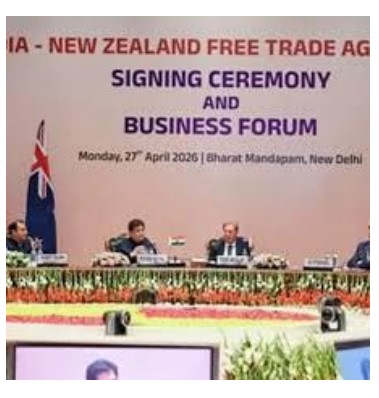
• Transition to High-Velocity Diplomacy: Concluded in December 2025, the India-New Zealand FTA marks a shift from a cautious slow burn model to a strategic, high-velocity approach, with negotiations finished in just nine months. This rapid execution provides India with a first-mover advantage in Oceania and demonstrates its ability to compress complex negotiation cycles.
• Human Capital and Talent Mobility: The pact introduces Yoga and Māori reciprocity, embedding talent mobility as a core economic pillar. It provides a dedicated annual quota of 5,000 professional visas for Indian IT, engineering, and healthcare experts, alongside 1,000 work-and-holiday visas for youth.
• Recognition of Traditional Medicine: In a landmark provision, the FTA establishes bilateral reciprocity for the international recognition of India AYUSH system (Ayurveda, Yoga, Unani, Siddha, and Homoeopathy) alongside New Zealand’s native Māori health practices.
• Investment and Technological Inflow: New Zealand has committed to a capital inflow of approximately $20 billion over 15 years. These investments will target high-priority sectors including agri-tech, renewable energy, and healthcare management, acting as a catalyst for the Make in India initiative.
• Balanced Dairy Protection: India successfully navigated the dairy red line by excluding fluid milk, cheese, and yogurt from duty concessions. To boost downstream processing, a Ring Fenced Value Addition Framework was introduced, allowing duty-free imports for manufacturing provided 100% of the final products are exported.
• Geopolitical Foothold in Oceania: Beyond economics, the agreement serves as a geopolitical hedge, establishing New Zealand as a gateway for India into the Pacific Island Countries (PICs). By meeting high regulatory norms, India sets a precedent for its ability to engage in global supply chains while maintaining domestic safeguards.
Key Definitions
• Free Trade Agreement (FTA): A pact between two or more nations to reduce barriers to imports and exports among them while maintaining individual trade barriers for non-members.
• Tariff Rate Quota (TRQ): A trade policy tool that combines protective tariffs with import quotas, allowing a set quantity of a product to be imported at a lower duty rate.
• Geographical Indication (GI): A sign used on products that have a specific geographical origin and possess qualities or a reputation that are due to that origin (e.g., Darjeeling tea).
Constitutional & Legal Provisions
• Article 73: Specifies the extent of the executive power of the Union, which includes the power to enter into treaties and agreements with foreign countries.
• Article 253: Grants Parliament the power to make any law for the whole or any part of the territory of India for implementing any treaty, agreement, or convention with any other country.
• Seventh Schedule (Entry 41, Union List): Grants the Central Government exclusive jurisdiction over Trade and commerce with foreign countries; import and export across customs frontiers.
Additional Keypoints
• GI Protection: New Zealand has pledged to align its legislation within 18 months to offer Indian GI products protection equivalent to European Union standards.
• Seasonal Constraints: To protect local farmers, the pact uses minimum import prices and seasonal constraints on commodities like apples, honey, and kiwifruit.
• Regulatory Reference Point: The deal helps India align with OECD-level trade standards, facilitating smoother future negotiations with other developed economies.
Conclusion
The India-New Zealand FTA represents a sophisticated evolution in India trade policy. By successfully ring-fencing sensitive sectors like dairy while opening doors for human capital and hightech investment, India has demonstrated that strategic autonomy and global integration can coexist. This agreement not only secures a logistical center in the South Pacific but also serves as a blueprint for Viksit Bharat by 2047.
UPSC Relevance
• GS Paper II: Bilateral, regional, and global groupings and agreements involving India and or affecting India interests; Effect of policies and politics of developed and developing countries on India’s interests.
• GS Paper III: Indian Economy and issues relating to planning, mobilization of resources, growth, development, and employment; Effects of liberalization on the economy.
Prelims: Specifics of the visa quotas, AYUSH-Māori reciprocity, and the status of dairy products under the 2025 FTA


Address : 506, 3rd EYE THREE (III), Opp. Induben Khakhrawala, Girish Cold Drink Cross Road, CG Road, Navrangpura, Ahmedabad, 380009.
Mobile : 8469231587 / 9586028957
Telephone : 079-40098991
E-mail: dics.upsc@gmail.com
Address: A-306, The Landmark, Urjanagar-1, Opp. Spicy Street, Kudasan – Por Road, Kudasan, Gandhinagar – 382421
Mobile : 9723832444 / 9723932444
E-mail: dics.gnagar@gmail.com
Address: 2nd Floor, 9 Shivali Society, L&T Circle, opp. Ratri Bazar, Karelibaugh, Vadodara, 390018
Mobile : 9725692037 / 9725692054
E-mail: dics.vadodara@gmail.com
Address: 403, Raj Victoria, Opp. Pal Walkway, Near Galaxy Circle, Pal, Surat-394510
Mobile : 8401031583 / 8401031587
E-mail: dics.surat@gmail.com
Address: 303,305 K 158 Complex Above Magson, Sindhubhavan Road Ahmedabad-380059
Mobile : 9974751177 / 8469231587
E-mail: dicssbr@gmail.com
Address: 57/17, 2nd Floor, Old Rajinder Nagar Market, Bada Bazaar Marg, Delhi-60
Mobile : 9104830862 / 9104830865
E-mail: dics.newdelhi@gmail.com