





Ahmedabad
(Head Office)Address : 506, 3rd EYE THREE (III), Opp. Induben Khakhrawala, Girish Cold Drink Cross Road, CG Road, Navrangpura, Ahmedabad, 380009.
Mobile : 8469231587 / 9586028957
E-mail: dics.upsc@gmail.com

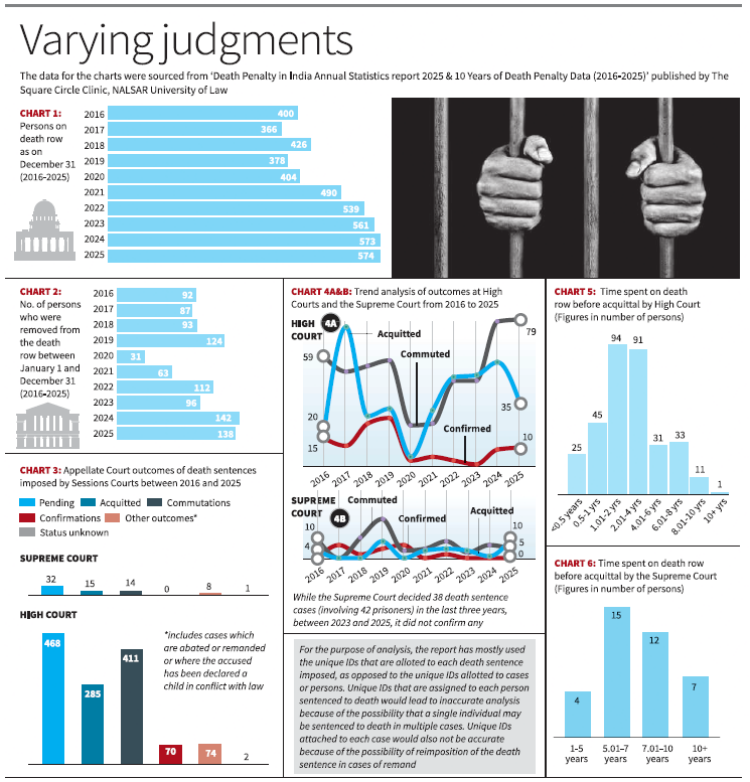
The latest \'Death Penalty in India: Annual Statistics Report (2016-2025)\' by the Square Circle Clinic at NALSAR reveals a widening chasm between trial court convictions and appellate scrutiny. While Sessions Courts continue to impose death sentences at a high frequency, the higher judiciary has shown unprecedented restraint, with the Supreme Court not confirming a single death sentence for three consecutive years (2023- 2025). This trend highlights systemic concerns regarding procedural fairness, the quality of investigation, and the strict application of the \'rarest of rare\' doctrine. • Rising Death Row Population: As of December 31, 2025, India’s death row population stood at 574 (550 men and 24 women), the highest since 2016. This is largely attributed to the prolific sentencing by trial courts, which outpaces the rate of disposal and commutations in higher courts.• The Confirmation-Acquittal Paradox: Over the last decade, High Courts confirmed only 8.31% of the death sentences referred to them. In stark contrast, 34.65% of cases resulted in full acquittals, suggesting that nearly one in three death sentences handed down by trial courts involved wrongful convictions or unsustainable evidence. • Supreme Court Restraint: The apex court has not upheld a death penalty since 2022. In 2025 alone, it acquitted 10 death row prisoners—the highest in a decade—citing \'procedural failures\' and \'lack of proof beyond reasonable doubt.\' • Non-Compliance with Sentencing Guidelines: Despite the landmark Manoj v. State of MP (2022) judgment, which mandated \'mitigation investigations\' (psychological and social profiles of the convict), nearly 95% of trial court death sentences in 2025 were imposed without following these constitutional safeguards. • Regional Disparities in Acquittals: Significant variations exist across states; for instance, the Patna High Court recorded an acquittal rate of 78.31% in death penalty cases over the decade, highlighting a severe crisis of evidence appreciation at the lower levels in certain jurisdictions. • Evolution of Alternative Sentences: There is a growing judicial preference for \'Life Imprisonment without Remission\' as a distinct sentencing category. Appellate courts are increasingly choosing this as a middle path to ensure public safety without resorting to the irreversible nature of the gallows. Key Definitions • Rarest of Rare Doctrine: A judicial principle established in Bachan Singh v. State of Punjab (1980), stating that the death penalty should be imposed only when the alternative of life imprisonment is unquestionably foreclosed. • Mitigation Investigation: A comprehensive study of the convict’s upbringing, socio-economic background, and mental health to determine if there is any possibility of reformation. • Confirmation Proceeding: Under Section 366 of the CrPC, a death sentence passed by a Sessions Court must be submitted to the High Court for mandatory confirmation before it can be executed. Constitutional & Legal Provisions • Article 21: Guarantees the right to life, stipulating that no person shall be deprived of it except according to \'procedure established by law.\' • Article 72/161: Grants the President and Governors the power to pardon or commute death sentences. • Section 354(3) of CrPC: Requires judges to provide \'special reasons\' for awarding a death sentence instead of life imprisonment. • Vasanta Sampat Dupare v. Union of India (2025): A recent landmark ruling where the SC elevated the right to a meaningful sentencing hearing to the status of a Fundamental Right under Articles 14 and 21. Additional Key Points• Socio-Economic Bias: Empirical data from the Death Penalty India Report consistently shows that over 74% of death row inmates are from economically vulnerable backgrounds, often lacking access to highquality legal representation at the trial stage. • Offence Trends: Murder simpliciter and murder involving sexual offences constitute the vast majority (over 80%) of capital cases, indicating that the death penalty is increasingly being concentrated in specific crime categories. • Collective Conscience: The judiciary has recently cautioned against using \'public outcry\' or \'collective conscience\' as the sole basis for sentencing, emphasizing that judicial discretion must remain anchored in legal principles. Conclusion The current decade marks a significant \'judicial retrenchment\' regarding capital punishment in India. While the legislative ambit of the death penalty has expanded through new laws like the Bharatiya Nyaya Sanhita (BNS) and the POCSO Act, the higher judiciary is increasingly acting as a sentinel against wrongful executions. The high acquittal rates suggest that the crisis is not just one of sentencing, but of the very integrity of the criminal investigation process in India’s lower courts. UPSC Relevance • GS Paper II: Structure, organization, and functioning of the Judiciary; Welfare schemes for vulnerable sections; Issues relating to the development and management of Social Sector/Services. • GS Paper IV (Ethics): Ethical dilemmas in capital punishment; Retributive vs. Reformative justice; Human rights and the \'Right to Life.\' • Mains Context: Often forms a core part of questions on Criminal Justice Reforms, the Law Commission’s recommendations (262nd Report), and judicial activism vs. restraint.


Address : 506, 3rd EYE THREE (III), Opp. Induben Khakhrawala, Girish Cold Drink Cross Road, CG Road, Navrangpura, Ahmedabad, 380009.
Mobile : 8469231587 / 9586028957
E-mail: dics.upsc@gmail.com
Address: A-306, The Landmark, Urjanagar-1, Opp. Spicy Street, Kudasan – Por Road, Kudasan, Gandhinagar – 382421
Mobile : 9723832444 / 9723932444
E-mail: dics.gnagar@gmail.com
Address: 2nd Floor, 9 Shivali Society, L&T Circle, opp. Ratri Bazar, Karelibaugh, Vadodara, 390018
Mobile : 9725692037 / 9725692054
E-mail: dics.vadodara@gmail.com
Address: 403, Raj Victoria, Opp. Pal Walkway, Near Galaxy Circle, Pal, Surat-394510
Mobile : 8401031583 / 8401031587
E-mail: dics.surat@gmail.com
Address: 303,305 K 158 Complex Above Magson, Sindhubhavan Road Ahmedabad-380059
Mobile : 9974751177 / 8469231587
E-mail: dicssbr@gmail.com
Address: 57/17, 2nd Floor, Old Rajinder Nagar Market, Bada Bazaar Marg, Delhi-60
Mobile : 9104830862 / 9104830865
E-mail: dics.newdelhi@gmail.com