







Ahmedabad
(Head Office)Address : 506, 3rd EYE THREE (III), Opp. Induben Khakhrawala, Girish Cold Drink Cross Road, CG Road, Navrangpura, Ahmedabad, 380009.
Mobile : 8469231587 / 9586028957
Telephone : 079-40098991
E-mail: dics.upsc@gmail.com

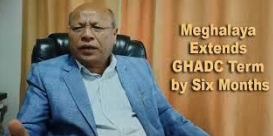
Context: The Meghalaya State Cabinet has extended the tenure of the Garo Hills Autonomous District Council (GHADC) by six months (April 18 to October 18, 2026). This decision follows large-scale violence in Tura and surrounding areas triggered by a notification barring non-tribals from participating in the council elections, leading to the postponement of the polls originally scheduled for April 10, 2026. • Emergency Tenure Extension: Under the Sixth Schedule of the Constitution, the Governor (acting on Cabinet advice) can extend the five-year term of a District Council during a state of emergency or specialized circumstances where elections cannot be held. In this case, the breakdown of law and order and the resignation of the Chief Executive Member (CEM) necessitated the delay. • The \'Non-Tribal\' Participation Dispute: The core of the unrest lies in the eligibility of non-tribals to vote or contest in tribal council elections. While the Sixth Schedule aims to protect tribal interests, the demographic reality of the region has led to legal and social friction regarding the democratic rights of non-tribal residents. • Political Transition Amidst Unrest: The extension coincided with a leadership change within the GHADC. Albinush R. Marak resigned as CEM facing a no-confidence motion by 21 members, leading to the election of Dhormonath Ch. Sangma as the new head of the Executive Committee. • Consultative Resolution Strategy: The state government has committed to a six-month \'consultation window\' with various stakeholders. The objective is to refine candidate eligibility rules and election provisions to prevent further communal or ethnic polarization in the sensitive Garo Hills region. • Security and Infrastructure Impact: The violence resulted in the loss of life and significant damage to both private and \'critical infrastructure.\' The postponement highlights the challenge of balancing ethnic protectionism with inclusive governance in Sixth Schedule areas. Key Definitions and Legal Provisions • Sixth Schedule (Articles 244(2) and 275(1)): Provides for the administration of tribal areas in Assam, Meghalaya, Tripura, and Mizoram. It creates \'States within a State\' by granting legislative, judicial, and administrative autonomy to Autonomous District Councils (ADCs). • Chief Executive Member (CEM): The head of the Executive Committee of an ADC, functioning similarly to a Chief Minister at the district level. • No-Confidence Motion: A parliamentary motion moved in the Council to demonstrate that the existing executive no longer enjoys the majority support of the House. • Para 2(1) of the Sixth Schedule: Stipulates that there shall be a District Council for each autonomous district consisting of not more than 30 members, where the term of the Council is five years unless dissolved earlier. Additional Key Points • Governor’s Discretionary Powers: Unlike regular districts, the Governor of Meghalaya holds significant discretionary powers over ADCs, including the power to assent to laws passed by the council regarding land, forests, and inheritance. • Inner Line Permit (ILP) Context: The demand for restricting non-tribal participation in local governance often overlaps with the broader regional demand for the implementation of the ILP to regulate the entry of outsiders. • Conflict of Laws: A recurring issue in Meghalaya is the overlapping jurisdiction between the State Legislative Assembly and the ADCs. Under Para 12A of the Sixth Schedule, if a law made by the ADC is repugnant to a state law, the state law prevails. Conclusion The extension of the GHADC’s tenure is a pragmatic use of constitutional provisions to prevent a power vacuum during ethnic volatility. However, it underscores a deeper constitutional challenge: reconciling the \'exclusionary\' protections granted to Scheduled Tribes with the universal adult franchise and \'inclusionary\' rights of non-tribal citizens living within these autonomous zones. UPSC Relevance • GS Paper II: Indian Constitution—historical underpinnings, evolution, features, amendments, significant provisions and basic structure; Functions and responsibilities of the Union and the States, issues and challenges pertaining to the federal structure. • Mains Perspective: Effectiveness of the Sixth Schedule in preserving tribal identity vs. administrative efficiency; The role of ADCs in local self-governance; Ethnic conflict and internal security in Northeast India. • Prelims: Specifics of the 6th Schedule (States involved); Power of the Governor in tribal areas; Composition of ADCs.


Address : 506, 3rd EYE THREE (III), Opp. Induben Khakhrawala, Girish Cold Drink Cross Road, CG Road, Navrangpura, Ahmedabad, 380009.
Mobile : 8469231587 / 9586028957
Telephone : 079-40098991
E-mail: dics.upsc@gmail.com
Address: A-306, The Landmark, Urjanagar-1, Opp. Spicy Street, Kudasan – Por Road, Kudasan, Gandhinagar – 382421
Mobile : 9723832444 / 9723932444
E-mail: dics.gnagar@gmail.com
Address: 2nd Floor, 9 Shivali Society, L&T Circle, opp. Ratri Bazar, Karelibaugh, Vadodara, 390018
Mobile : 9725692037 / 9725692054
E-mail: dics.vadodara@gmail.com
Address: 403, Raj Victoria, Opp. Pal Walkway, Near Galaxy Circle, Pal, Surat-394510
Mobile : 8401031583 / 8401031587
E-mail: dics.surat@gmail.com
Address: 303,305 K 158 Complex Above Magson, Sindhubhavan Road Ahmedabad-380059
Mobile : 9974751177 / 8469231587
E-mail: dicssbr@gmail.com
Address: 57/17, 2nd Floor, Old Rajinder Nagar Market, Bada Bazaar Marg, Delhi-60
Mobile : 9104830862 / 9104830865
E-mail: dics.newdelhi@gmail.com