





Ahmedabad
(Head Office)Address : 506, 3rd EYE THREE (III), Opp. Induben Khakhrawala, Girish Cold Drink Cross Road, CG Road, Navrangpura, Ahmedabad, 380009.
Mobile : 8469231587 / 9586028957
Telephone : 079-40098991
E-mail: dics.upsc@gmail.com

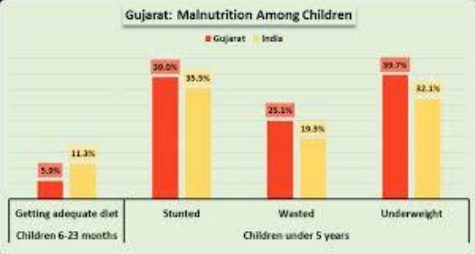
Context: A recent debate in the Gujarat Legislative Assembly has highlighted significant discrepancies between different nutrition monitoring datasets. While government officials cite a 11.4% malnutrition rate based on realtime monitoring, independent surveys and historical data suggest the figure remains close to 40%, particularly within the state\'s tribal belt. • Data Conflict (NFHS vs. Poshan Tracker): The National Family Health Survey (NFHS-5) indicates that 39.7% of children in Gujarat are underweight, aligning with the \'40 out of 100\' claim. Conversely, the government\'s Poshan Tracker reports only 11.4%. This gap arises because NFHS is a representative household sample, while the Poshan Tracker relies on Anganwadi self-reporting, which may suffer from incomplete enrollment or data entry pressures. • Prevalence of Stunting and Wasting: According to July 2025 Poshan Tracker data, Gujarat faces a \'triple burden\' with 32.7% stunting (chronic undernutrition), 7.2% wasting (acute undernutrition), and 18.4% underweight children. Nationally, the state ranks in the bottom bracket (31st) for wasting and underweight indicators. • The Tribal Malnutrition Burden: There is a stark geographical concentration of malnutrition in Gujarat’s \'Eastern Belt.\' Tribal districts such as Dahod, The Dangs, and Narmada report stunting and underweight levels exceeding 50%. In The Dangs, 53.1% of children are underweight, nearly double the figures seen in non-tribal urban centers. • Methodological Limitations: Experts caution against replacing NFHS data with Poshan Tracker figures. The Tracker serves as a management tool for Anganwadi services but may exclude children not enrolled in the system. Furthermore, administrative pressure on frontline workers can lead to \'data smoothing,\' where actual heights and weights are not accurately captured. • Comparative State Performance: While some northern and eastern states like Uttar Pradesh (48.8% stunting) and Bihar perform poorly, Gujarat’s performance is notable because its high Per Capita Income and industrial growth have not translated into proportional improvements in nutritional outcomes—a phenomenon often termed the \'Nutritional Paradox.\' Key Definitions and Legal Provisions • Stunting: Low height-for-age, reflecting chronic undernutrition and long-term effects of poor socioeconomic conditions and repeated infections. • Wasting: Low weight-for-height, indicating acute undernutrition, often resulting from recent rapid weight loss or failure to gain weight. • Mission Poshan 2.0: A flagship program of the Ministry of Women and Child Development aiming to strengthen nutritional content, delivery, and outreach. • Article 47 (DPSP): Directs the State to regard the raising of the level of nutrition and the standard of living of its people and the improvement of public health as among its primary duties. • National Food Security Act (NFSA), 2013: Legalizes the right to food and includes the Integrated Child Development Services (ICDS) to provide nutritional support to children aged 6 months to 6 years. Additional Key Points • NFHS-6 Delay: The results for NFHS-6 (2023-24) are crucial for settling the current debate, as they will provide the most updated representative snapshot of the post-pandemic nutritional landscape. • The \'Gujarat Paradox\': Despite being a leading state in GSDP and ease of doing business, Gujarat lags behind states like Tamil Nadu and Himachal Pradesh in human development indicators (HDI), specifically child health. • Hidden Hunger: Beyond calorie deficiency, many children in these regions suffer from micronutrient deficiencies (anemia and Vitamin A deficiency), which are not always captured by height/weight metrics. Conclusion The malnutrition challenge in Gujarat is a multidimensional issue that cannot be resolved through administrative data alone. While the Poshan Tracker is a valuable tool for real-time intervention, the representative figures of the NFHS highlight deep-seated structural inequalities, especially among tribal populations. Future policy must bridge this \'data divide\' and focus on tribal-centric nutritional interventions to ensure that economic prosperity reaches the most vulnerable. UPSC Relevance • GS Paper II: Issues relating to development and management of Social Sector/Services relating to Health, Education, Human Resources; Issues relating to Poverty and Hunger. • GS Paper III: Inclusive growth and issues arising from it; Public Distribution System- objectives, functioning, limitations, revamping. • Mains Perspective: Discuss the \'Nutritional Paradox\' in Indian states; Analyze the role of technology (Poshan Tracker) vs. traditional surveys (NFHS) in policy formulation.


Address : 506, 3rd EYE THREE (III), Opp. Induben Khakhrawala, Girish Cold Drink Cross Road, CG Road, Navrangpura, Ahmedabad, 380009.
Mobile : 8469231587 / 9586028957
Telephone : 079-40098991
E-mail: dics.upsc@gmail.com
Address: A-306, The Landmark, Urjanagar-1, Opp. Spicy Street, Kudasan – Por Road, Kudasan, Gandhinagar – 382421
Mobile : 9723832444 / 9723932444
E-mail: dics.gnagar@gmail.com
Address: 2nd Floor, 9 Shivali Society, L&T Circle, opp. Ratri Bazar, Karelibaugh, Vadodara, 390018
Mobile : 9725692037 / 9725692054
E-mail: dics.vadodara@gmail.com
Address: 403, Raj Victoria, Opp. Pal Walkway, Near Galaxy Circle, Pal, Surat-394510
Mobile : 8401031583 / 8401031587
E-mail: dics.surat@gmail.com
Address: 303,305 K 158 Complex Above Magson, Sindhubhavan Road Ahmedabad-380059
Mobile : 9974751177 / 8469231587
E-mail: dicssbr@gmail.com
Address: 57/17, 2nd Floor, Old Rajinder Nagar Market, Bada Bazaar Marg, Delhi-60
Mobile : 9104830862 / 9104830865
E-mail: dics.newdelhi@gmail.com