








Ahmedabad
(Head Office)Address : 506, 3rd EYE THREE (III), Opp. Induben Khakhrawala, Girish Cold Drink Cross Road, CG Road, Navrangpura, Ahmedabad, 380009.
Mobile : 8469231587 / 9586028957
Telephone : 079-40098991
E-mail: dics.upsc@gmail.com

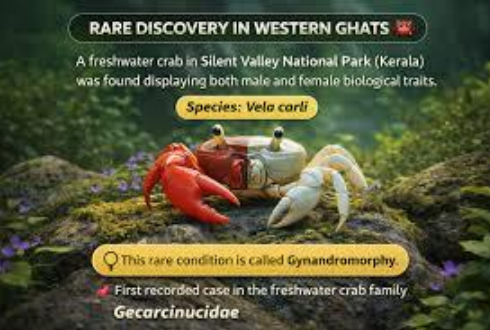
Context: Researchers from the Centre for Conservation Ecology, MES Mampad College, and the Zoological Survey of India (ZSI) have documented a rare biological phenomenon in a freshwater crab, Vela carli, within the Silent Valley National Park, Kerala. This discovery marks the first reported instance of \'gynandromorphy\' in the Gecarcinucidae family of crabs. • Rare Phenomenon of Gynandromorphy: Unlike hermaphroditism, where an organism may have functional organs of both sexes, gynandromorphy is a condition where an individual exhibits a biological mosaic—different parts of the body possess distinct male or female physical characteristics. In these specimens, researchers observed male reproductive structures alongside female features like gonopores. • Endemic Freshwater Species: Vela carli is a species endemic to the Central Western Ghats. These crabs are primarily found in the pristine streams and unique micro-habitats, such as tree holes (phytotelmata), within the evergreen forests of Silent Valley. • Taxonomic Milestone: While gynandromorphy has been recorded in some marine crab families, this is the first time it has been observed in the Gecarcinucidae family, a major group of Old World freshwater crabs. The findings were published in the international journal Crustaceana. • Intrinsic Developmental Cause: Scientists suggest that the condition in these crabs likely results from intrinsic genetic or developmental anomalies during early embryonic stages rather than external environmental stressors, as the Silent Valley ecosystem remains largely free from chemical pollutants. • Tree Hole Ecosystems: The discovery highlights the ecological importance of \'tree holes\' in tropical rainforests. These small, water-filled cavities serve as critical refugia and breeding grounds for endemic fauna, often harboring yet-to-be-discovered biological mysteries. • Collaboration in Research: The study underscores the importance of multi-institutional collaboration, involving the ZSI and local academic centers, in mapping the specialized biodiversity of India’s Western Ghats, a designated UNESCO World Heritage site. Key Definitions and Biological Concepts • Gynandromorphy: A rare genetic condition where an organism contains both male and female characteristics. It is typically a result of a mutation or error in the distribution of sex chromosomes during early cell division. • Phytotelmata: Small, water-filled cavities in terrestrial plants (like tree holes or leaf axils) that function as a habitat for various specialized aquatic and semi-aquatic organisms. • Endemic: A species that is naturally restricted to a specific geographical area and is found nowhere else in the world. • Gecarcinucidae: A family of freshwater crabs widely distributed across South and Southeast Asia, known for their high levels of endemism in the Western Ghats. Additional Key Points • Silent Valley National Park: Known as \'Sairandhrivanam,\' it is the core of the Nilgiri Biosphere Reserve. It is unique for its absence of cicadas (hence \'Silent\') and its protection of the endangered Lion-tailed Macaque. • Evolutionary Origins: The Gecarcinucidae family is believed to have originated in the Indian subcontinent during the Paleogene period, making them phylogenetically significant for studying continental drift. • Conservation Value: Rare biological traits like gynandromorphy provide insights into the resilience and developmental plasticity of species in undisturbed habitats. Conclusion The discovery of a dual-sex Vela carli in Silent Valley is a significant addition to India\'s zoological records. It reinforces the Western Ghats\' status as a \'living laboratory\' of evolution. Such findings emphasize the need for rigorous conservation of micro-habitats like tree holes, which are often overlooked in traditional large-scale forest management but are vital for endemic survival. UPSC Relevance • GS Paper III: Conservation, environmental pollution and degradation, environmental impact assessment; Science and Technology- developments and their applications and effects in everyday life. • Prelims Focus: Geography of Silent Valley (Kunthipuzha river, Nilgiri Biosphere); Species in news (Vela carli); Biological terms (Gynandromorphy vs. Hermaphroditism). • Mains Perspective: Importance of biodiversity hotspots in climate resilience; Role of specialized research in national conservation policies.


Address : 506, 3rd EYE THREE (III), Opp. Induben Khakhrawala, Girish Cold Drink Cross Road, CG Road, Navrangpura, Ahmedabad, 380009.
Mobile : 8469231587 / 9586028957
Telephone : 079-40098991
E-mail: dics.upsc@gmail.com
Address: A-306, The Landmark, Urjanagar-1, Opp. Spicy Street, Kudasan – Por Road, Kudasan, Gandhinagar – 382421
Mobile : 9723832444 / 9723932444
E-mail: dics.gnagar@gmail.com
Address: 2nd Floor, 9 Shivali Society, L&T Circle, opp. Ratri Bazar, Karelibaugh, Vadodara, 390018
Mobile : 9725692037 / 9725692054
E-mail: dics.vadodara@gmail.com
Address: 403, Raj Victoria, Opp. Pal Walkway, Near Galaxy Circle, Pal, Surat-394510
Mobile : 8401031583 / 8401031587
E-mail: dics.surat@gmail.com
Address: 303,305 K 158 Complex Above Magson, Sindhubhavan Road Ahmedabad-380059
Mobile : 9974751177 / 8469231587
E-mail: dicssbr@gmail.com
Address: 57/17, 2nd Floor, Old Rajinder Nagar Market, Bada Bazaar Marg, Delhi-60
Mobile : 9104830862 / 9104830865
E-mail: dics.newdelhi@gmail.com