






Ahmedabad
(Head Office)Address : 506, 3rd EYE THREE (III), Opp. Induben Khakhrawala, Girish Cold Drink Cross Road, CG Road, Navrangpura, Ahmedabad, 380009.
Mobile : 8469231587 / 9586028957
Telephone : 079-40098991
E-mail: dics.upsc@gmail.com

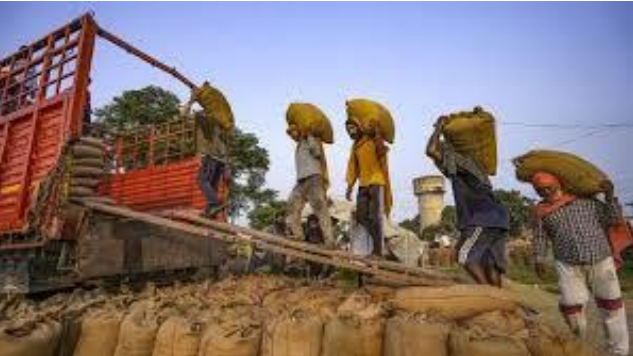
Context: The Punjab Economic Survey 2025-26 highlights a significant trend of \'brain drain\' and \'distress migration\' from the state. While the survey identifies traditional \'pull\' and \'push\' factors, experts point toward deep-seated economic stagnation, low employment elasticity, and a disconnect between the politicaladministrative system and youth aspirations as the primary drivers of this exodus. • The Aspirations-Opportunity Mismatch: A critical driver is the lack of jobs suited to the qualifications of the youth. Data from the State’s Unemployment Bureau (September 2025) shows that 42% of the 1,22,842 registered applicants are \'skilled,\' yet they remain unemployed, leading to a sense of hopelessness and a preference for developed economies like Canada, the U.S., and the U.K. • Agricultural Plateau and Rural Distress: Growth in the primary sector has reached a saturation point. With shrinking landholdings and stagnant farm incomes, the children of farmers no longer find agriculture viable or prestigious, pushing them to seek labor or professional roles abroad to ensure financial stability for their families. • Declining Capital Formation: Experts note that Punjab’s Gross Fixed Capital Formation (GFCF) as a percentage of GSDP has been on a downward trend since the mid-1980s. This lack of sustained capital investment has resulted in a sluggish industrial sector and low employment elasticity, meaning economic growth (where present) does not translate into proportional job creation. • Socio-Political Push Factors: Beyond economics, systemic issues such as corruption, a perceived failure of the politico-administrative system, social insecurity, and the pervasive fear of drug addiction act as powerful catalysts. These factors erode public confidence, making migration appear as a \'survival strategy\' rather than a choice. • Deteriorating Employment Quality: There is a notable decline in the quality of available jobs in both the public and private sectors. Precarious contracts, low wages, and a lack of social security in domestic roles contrast sharply with the perceived \'better standards of living\' and dignity of labor offered by Western nations. Key Definitions and Legal Provisions • Distress Migration: A form of migration where individuals are forced to move due to a lack of viable economic alternatives or threats to their livelihood at home, rather than being attracted primarily by better prospects elsewhere. • Employment Elasticity: A measure of how employment opportunities respond to changes in economic growth. Low elasticity indicates that even if the economy grows, it fails to generate sufficient new jobs. • Gross Fixed Capital Formation (GFCF): A statistical measure of the value of acquisitions of new or existing fixed assets by the business sector, governments, and households. It is a key indicator of future productive capacity. • Article 19(1)(g): The Constitutional right of Indian citizens to practice any profession, or to carry on any occupation, trade, or business. The state’s failure to provide an enabling environment for this right often leads to migration. • Article 41 (DPSP): Directs the State to ensure the \'Right to Work\' within the limits of its economic capacity and development. The current crisis reflects a gap in achieving this directive. Additional Key Points • Brain Drain vs. Brain Gain: While the state loses its most productive human capital (Brain Drain), the resulting remittances provide a temporary liquidity boost to the rural economy but fail to create longterm productive assets. • Demographic Dividend at Risk: Punjab risks squandering its demographic dividend as the most innovative and educated segment of its population chooses to contribute to the GDP of foreign nations. • The \'Demonstration Effect\': The social prestige associated with \'going abroad\' in Punjabi culture creates a snowball effect, where migration becomes a default life goal for youth, regardless of their local potential. Conclusion The migration crisis in Punjab is not merely an individual choice but a symptom of structural economic decay. Resolving this requires the political leadership to move beyond \'denial mode\' and focus on resurrecting growth fundamentals. Only by increasing capital investment, diversifying the economy beyond the agricultural plateau, and restoring faith in the administrative machinery can the state transform \'distress migration\' back into domestic productivity. UPSC Relevance • GS Paper I: Population and associated issues, poverty, and developmental issues. • GS Paper II: Government policies and interventions for development in various sectors and issues arising out of their design and implementation. • GS Paper III: Indian Economy and issues relating to planning, mobilization of resources, growth, development, and employment; Effects of liberalization on the economy. • Mains Perspective: Analyzing the \'Push-Pull\' model of migration in the context of regional disparities in India; The impact of the Green Revolution\'s stagnation on social mobility.


Address : 506, 3rd EYE THREE (III), Opp. Induben Khakhrawala, Girish Cold Drink Cross Road, CG Road, Navrangpura, Ahmedabad, 380009.
Mobile : 8469231587 / 9586028957
Telephone : 079-40098991
E-mail: dics.upsc@gmail.com
Address: A-306, The Landmark, Urjanagar-1, Opp. Spicy Street, Kudasan – Por Road, Kudasan, Gandhinagar – 382421
Mobile : 9723832444 / 9723932444
E-mail: dics.gnagar@gmail.com
Address: 2nd Floor, 9 Shivali Society, L&T Circle, opp. Ratri Bazar, Karelibaugh, Vadodara, 390018
Mobile : 9725692037 / 9725692054
E-mail: dics.vadodara@gmail.com
Address: 403, Raj Victoria, Opp. Pal Walkway, Near Galaxy Circle, Pal, Surat-394510
Mobile : 8401031583 / 8401031587
E-mail: dics.surat@gmail.com
Address: 303,305 K 158 Complex Above Magson, Sindhubhavan Road Ahmedabad-380059
Mobile : 9974751177 / 8469231587
E-mail: dicssbr@gmail.com
Address: 57/17, 2nd Floor, Old Rajinder Nagar Market, Bada Bazaar Marg, Delhi-60
Mobile : 9104830862 / 9104830865
E-mail: dics.newdelhi@gmail.com