






Ahmedabad
(Head Office)Address : 506, 3rd EYE THREE (III), Opp. Induben Khakhrawala, Girish Cold Drink Cross Road, CG Road, Navrangpura, Ahmedabad, 380009.
Mobile : 8469231587 / 9586028957
Telephone : 079-40098991
E-mail: dics.upsc@gmail.com

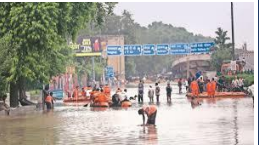
Context: In response to recurring monsoon crises, the Delhi government is deliberating a ₹21,068-crore \'Urban Flood Mitigation Program\'. The initiative seeks to transition from the obsolete 1976 drainage framework to a modern, climate-resilient system capable of handling the needs of a population that has grown fourfold over the last five decades. • Creation of Off-Channel Reservoirs: A centerpiece of the plan involves developing 2,500 acres of reservoirs along the Yamuna floodplains (Palla, Mayur Vihar, and Okhla). These facilities are designed to capture excess floodwater, which a successful pilot project showed can recharge up to 4,500 million litres of groundwater per season. • Drainage Revitalization and Desilting: The program allocates ₹1,418 crore for widening and strengthening the three primary arteries of Delhi’s drainage—the Najafgarh, Shahdara, and Barapullah drains. This is complemented by a ₹400-crore renovation of the Wazirabad Barrage to enhance its water-holding capacity and extensive desilting of the Yamuna. • Hotspot-Targeted Intervention: The Public Works Department (PWD) has identified 1,440 flood hotspots across the city based on data from 2023–2025. The mitigation strategy focuses on these vulnerable zones through \'critical infrastructure\' projects, including a specific ₹345-crore plan for the IGI Airport area. • Decentralized Water Management: Moving away from centralized discharge, the plan emphasizes \'local resilience\' by constructing recharge trenches and storage tanks in low-lying areas. It also proposes connecting stormwater drains to 125 local water bodies after treatment to rejuvenate lakes and marshes. • Six-Pronged Strategic Approach: The mitigation framework is structured into six functional verticals: Yamuna river flood mitigation, drainage revitalization, decentralized wastewater/stormwater management, low-lying area resilience, urban water body restoration, and advanced early warning systems. Key Definitions and Legal Provisions • Urban Heat Island & Runoff: Urbanization replaces permeable soil with concrete, increasing surface runoff. This plan addresses \'Urban Flooding,\' which occurs when the inflow of water exceeds the capacity of the drainage system in a built-up area. • Off-Channel Reservoir: A water storage facility located away from the main river channel, used to store excess water during high-flow periods to prevent downstream flooding and assist in groundwater recharge. • Section 33 of the Disaster Management Act, 2005: Empowers the District Authority to give directions to any local authority or government department to take measures for the prevention or mitigation of a disaster. • Master Plan for Delhi (MPD) 2041: The legal policy framework that guides the development of the city, including environmental protection and water management strategies. Additional Key Points • Obsolescence of the 1976 Plan: The current system was designed for a population of 60 lakh and a rainfall intensity of only 50mm, making it fundamentally inadequate for contemporary climate patterns and population density. • Nature-Based Solutions (NbS): By utilizing floodplains for reservoirs and recharging groundwater, the plan moves toward \'Sponge City\' concepts popularized globally for flood management. • Inter-Departmental Coordination: The involvement of the Lieutenant-Governor and the Chief Minister underscores the need for a unified command between the DDA, PWD, and Municipal Corporation to resolve jurisdictional overlaps in drain maintenance. Conclusion The proposed ₹21,068-crore program represents a critical shift from reactive crisis management to proactive infrastructure resilience. By integrating groundwater recharge with flood control, Delhi aims to solve its twin problems of seasonal flooding and depleting water tables. However, the success of this capital-intensive project will depend heavily on timely execution and the continuous desilting of secondary and tertiary drains. UPSC Relevance • GS Paper I: Geographical features and their location-changes in critical geographical features (including water-bodies and ice-caps). • GS Paper III: Disaster and disaster management (Urban Flooding); Environmental pollution and degradation; Infrastructure (Energy, Ports, Roads, Airports, Railways etc.). • Mains Perspective: Questions on the \'Sponge City\' concept, the impact of unplanned urbanization on hydrological cycles, and the effectiveness of the Disaster Management Act in urban contexts.


Address : 506, 3rd EYE THREE (III), Opp. Induben Khakhrawala, Girish Cold Drink Cross Road, CG Road, Navrangpura, Ahmedabad, 380009.
Mobile : 8469231587 / 9586028957
Telephone : 079-40098991
E-mail: dics.upsc@gmail.com
Address: A-306, The Landmark, Urjanagar-1, Opp. Spicy Street, Kudasan – Por Road, Kudasan, Gandhinagar – 382421
Mobile : 9723832444 / 9723932444
E-mail: dics.gnagar@gmail.com
Address: 2nd Floor, 9 Shivali Society, L&T Circle, opp. Ratri Bazar, Karelibaugh, Vadodara, 390018
Mobile : 9725692037 / 9725692054
E-mail: dics.vadodara@gmail.com
Address: 403, Raj Victoria, Opp. Pal Walkway, Near Galaxy Circle, Pal, Surat-394510
Mobile : 8401031583 / 8401031587
E-mail: dics.surat@gmail.com
Address: 303,305 K 158 Complex Above Magson, Sindhubhavan Road Ahmedabad-380059
Mobile : 9974751177 / 8469231587
E-mail: dicssbr@gmail.com
Address: 57/17, 2nd Floor, Old Rajinder Nagar Market, Bada Bazaar Marg, Delhi-60
Mobile : 9104830862 / 9104830865
E-mail: dics.newdelhi@gmail.com