


Ahmedabad
(Head Office)Address : 506, 3rd EYE THREE (III), Opp. Induben Khakhrawala, Girish Cold Drink Cross Road, CG Road, Navrangpura, Ahmedabad, 380009.
Mobile : 8469231587 / 9586028957
Telephone : 079-40098991
E-mail: dics.upsc@gmail.com

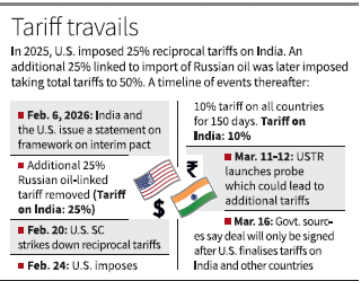
Context: India has adopted a \'wait and watch\' approach regarding a formal trade deal with the United States, prioritizing clarity on the emerging U.S. \'tariff architecture\' and the global implications of recent U.S. Executive Orders before committing to bilateral terms. • Prioritizing Comparative Advantage: India\'s stance is rooted in ensuring that any signed agreement translates into a genuine competitive edge for Indian exports. Negotiators are evaluating how potential U.S. global tariffs (approx. 10% under Section 122) might erode or alter the benefits of a bilateral deal. • Impact of Judicial Interventions: The landscape of U.S. trade policy has shifted following a February 2026 U.S. Supreme Court judgment that invalidated \'reciprocal tariffs.\' This legal reset has forced both nations to re-evaluate the baseline of their trade negotiations. • Section 122 of the Trade Act, 1974: The U.S. has invoked Section 122 to impose 10% tariffs on specific products globally. India is currently analyzing the country-wise impact of these levies to determine if a separate trade deal remains \'mutually beneficial\' under these broader protectionist measures. • Bilateral Engagement Continuity: Despite the cautious approach, the Ministry of Commerce maintains that India remains actively engaged with Washington. The focus is on resolving pending trade investigations and seeking exemptions or favorable status for Indian goods. • Strategic Tariff Architecture: The U.S. is currently attempting to recreate its global trade framework. India’s decision to delay signing is a strategic move to ensure it does not lock into an agreement that becomes obsolete or disadvantageous once the new U.S. global tariff structure is fully finalized. Key Definitions and Legal Provisions • Tariff Architecture: The comprehensive framework of customs duties, trade barriers, and preferential rates that define a country’s import-export environment. • Section 122 (U.S. Trade Act, 1974): A provision granting the U.S. President the authority to impose temporary import surcharges or quotas to deal with large and serious balance-ofpayments deficits. • Comparative Advantage: An economic principle where a country produces goods or services at a lower opportunity cost than its trade partners, forming the basis for beneficial trade. • Constitutional Provision (India): Under Article 253 of the Indian Constitution, the Parliament has the power to make any law for the whole or any part of the territory of India for implementing any treaty, agreement, or convention with any other country. Additional Key Points • Trade Investigations: The U.S. is conducting ongoing investigations into Indian trade practices, which could lead to retaliatory duties if not settled via diplomatic or trade channels. • Generalized System of Preferences (GSP): A recurring point of contention is the restoration of GSP benefits for India, which would allow duty-free entry for several thousand Indian products into the U.S. market. • Supply Chain Resilience: Both nations are looking beyond simple tariffs toward \'friend-shoring\' and securing critical mineral and technology supply chains. Conclusion India’s refusal to rush into a trade agreement reflects a shift toward \'interest-based\' diplomacy over \'sentimentbased\' deals. By seeking clarity on the U.S. internal legal shifts and global tariff hikes, New Delhi is ensuring that the final agreement safeguards domestic industries while maximizing market access in a volatile global trade environment. UPSC Relevance • GS Paper II: Bilateral, regional, and global groupings and agreements involving India and/or affecting India’s interests. • GS Paper III: Indian Economy and issues relating to planning, mobilization of resources, growth, development, and employment; Effects of liberalization on the economy. • Prelims: Concepts like Section 122, GSP, Article 253, and the impact of U.S. Supreme Court rulings on international trade dynamics.


Address : 506, 3rd EYE THREE (III), Opp. Induben Khakhrawala, Girish Cold Drink Cross Road, CG Road, Navrangpura, Ahmedabad, 380009.
Mobile : 8469231587 / 9586028957
Telephone : 079-40098991
E-mail: dics.upsc@gmail.com
Address: A-306, The Landmark, Urjanagar-1, Opp. Spicy Street, Kudasan – Por Road, Kudasan, Gandhinagar – 382421
Mobile : 9723832444 / 9723932444
E-mail: dics.gnagar@gmail.com
Address: 2nd Floor, 9 Shivali Society, L&T Circle, opp. Ratri Bazar, Karelibaugh, Vadodara, 390018
Mobile : 9725692037 / 9725692054
E-mail: dics.vadodara@gmail.com
Address: 403, Raj Victoria, Opp. Pal Walkway, Near Galaxy Circle, Pal, Surat-394510
Mobile : 8401031583 / 8401031587
E-mail: dics.surat@gmail.com
Address: 303,305 K 158 Complex Above Magson, Sindhubhavan Road Ahmedabad-380059
Mobile : 9974751177 / 8469231587
E-mail: dicssbr@gmail.com
Address: 57/17, 2nd Floor, Old Rajinder Nagar Market, Bada Bazaar Marg, Delhi-60
Mobile : 9104830862 / 9104830865
E-mail: dics.newdelhi@gmail.com