







Ahmedabad
(Head Office)Address : 506, 3rd EYE THREE (III), Opp. Induben Khakhrawala, Girish Cold Drink Cross Road, CG Road, Navrangpura, Ahmedabad, 380009.
Mobile : 8469231587 / 9586028957
Telephone : 079-40098991
E-mail: dics.upsc@gmail.com

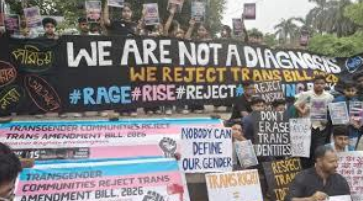
Context: The Union Government has introduced the Transgender Persons (Protection of Rights) Amendment Bill, 2026, sparked widespread protests across major Indian cities including New Delhi, Hyderabad, and Bengaluru. The bill seeks to redefine the criteria for being recognized as a transgender person and, most controversially, proposes to withdraw the right to \'self-perceived gender identity,\' a right previously upheld by the judiciary. • Challenge to Self-Identification: The core grievance of the transgender community and civil society is the removal of the right to self-perceived gender identity. Protesters argue this forces individuals back into a system of state-mandated or medical verification, which is seen as an affront to personal dignity and autonomy. • Violation of NALSA Principles: Activists highlight that the 2026 Bill contradicts the landmark 2014 NALSA vs. Union of India judgment. In that case, the Supreme Court ruled that gender identity is central to a person’s self-determination and falls under the fundamental right to liberty. • Impact on Gender-Affirming Processes: Members of the community express deep concern that redefining \'transgender person\' in the middle of their transition processes—such as gender-affirming surgeries or while holding existing transgender ID cards—will create legal limbo and social vulnerability • Widespread Civil Society Mobilization: Beyond student protests, a spontaneous coalition of doctors, lawyers, and professionals has emerged. This group is utilizing online petitions (gathering over 13,000 signatures) and direct lobbying of MPs to register opposition to the \'discriminatory and unjust\' amendments. • Legislative Intent vs. Community Rights: While the government aims to amend the 2019 Act, the community views the 2026 proposal as \'snatching back\' rights. The Ministry of Social Justice and Empowerment faces pressure to align the legislation with constitutional morality and international human rights standards regarding bodily autonomy. Key Definitions and Legal Provisions • Self-Perceived Gender Identity: The internal and individual experience of gender, which may or may not correspond with the physiology or the sex assigned at birth. • NALSA Judgement (2014): A Supreme Court of India ruling that recognized transgender persons as a \'third gender,\' affirmed their fundamental rights under the Constitution, and gave them the right to selfidentify their gender. • Article 21 of the Constitution: Protection of life and personal liberty. The Supreme Court has interpreted this to include the right to live with dignity and the right to privacy, which encompasses gender identity. • Article 14 and 15: Guarantees equality before the law and prohibits discrimination on grounds of religion, race, caste, sex, or place of birth. The judiciary has expanded \'sex\' to include gender identity. Additional Key Points • The 2019 Act Context: The original Transgender Persons (Protection of Rights) Act, 2019, was already criticized for its \'District Magistrate certification\' requirement; the 2026 amendment is seen as an even more restrictive regression. • International Standards: The Yogyakarta Principles, a global set of principles on the application of international human rights law in relation to sexual orientation and gender identity, emphasize that selfidentification is the basis for recognizing gender identity. • Social Vulnerability: Redefinition may lead to increased harassment by state authorities and exclusion from welfare schemes specifically designed for the trans community. Conclusion The friction over the 2026 Amendment Bill reflects a significant tension between executive legislative power and the judiciary\'s expansion of fundamental rights. For the transgender community, the right to self-identify is not merely a legal checkbox but a vital component of their survival and dignity. Resolving this will require the government to engage in genuine consultation with the community to ensure that \'protection of rights\' does not become a tool for \'curtailment of identity.\' UPSC Relevance • GS Paper II: Indian Constitution—historical underpinnings, evolution, features, amendments, significant provisions; Welfare schemes for vulnerable sections of the population; Issues relating to the development and management of Social Sector/Services relating to Health, Education, Human Resources. • Mains Perspective: Discussing the evolution of LGBTQ+ rights in India; The role of judicial activism in protecting minority rights; Analyzing the 2019 Act vs. the 2026 Amendment through the lens of Constitutional Morality. • Prelims: NALSA Judgment (2014); Articles 14, 15, and 21; Provisions of the Transgender Persons (Protection of Rights) Act.


Address : 506, 3rd EYE THREE (III), Opp. Induben Khakhrawala, Girish Cold Drink Cross Road, CG Road, Navrangpura, Ahmedabad, 380009.
Mobile : 8469231587 / 9586028957
Telephone : 079-40098991
E-mail: dics.upsc@gmail.com
Address: A-306, The Landmark, Urjanagar-1, Opp. Spicy Street, Kudasan – Por Road, Kudasan, Gandhinagar – 382421
Mobile : 9723832444 / 9723932444
E-mail: dics.gnagar@gmail.com
Address: 2nd Floor, 9 Shivali Society, L&T Circle, opp. Ratri Bazar, Karelibaugh, Vadodara, 390018
Mobile : 9725692037 / 9725692054
E-mail: dics.vadodara@gmail.com
Address: 403, Raj Victoria, Opp. Pal Walkway, Near Galaxy Circle, Pal, Surat-394510
Mobile : 8401031583 / 8401031587
E-mail: dics.surat@gmail.com
Address: 303,305 K 158 Complex Above Magson, Sindhubhavan Road Ahmedabad-380059
Mobile : 9974751177 / 8469231587
E-mail: dicssbr@gmail.com
Address: 57/17, 2nd Floor, Old Rajinder Nagar Market, Bada Bazaar Marg, Delhi-60
Mobile : 9104830862 / 9104830865
E-mail: dics.newdelhi@gmail.com