


Ahmedabad
(Head Office)Address : 506, 3rd EYE THREE (III), Opp. Induben Khakhrawala, Girish Cold Drink Cross Road, CG Road, Navrangpura, Ahmedabad, 380009.
Mobile : 8469231587 / 9586028957
E-mail: dics.upsc@gmail.com

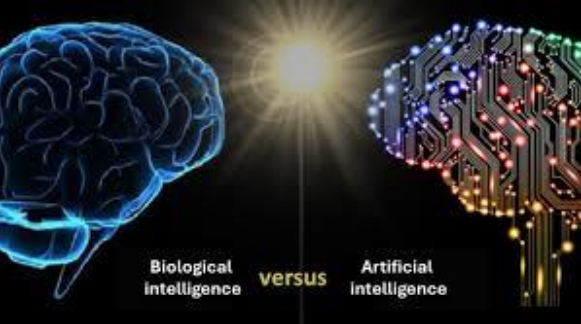
The rapid evolution of Large Language Models (LLMs) has brought artificial intelligence to a scale rivaling the human brain, yet the underlying architectural principles and energy efficiencies remain fundamentally distinct. • Conceptual Foundations: AI is built on artificial neural networks, a concept dating back to the 1943 McCulloch–Pitts neuron model. The Universal Approximation Theorem suggests that sufficient layers of these simple mathematical units can simulate any complex function, provided there is enough data and computational power. • Scale and Convergence: Modern AI models like GPT4 have parameters reaching into the trillions, approaching the estimated 100 trillion synapses in the human brain. However, while AI relies on brute-force parallel computation via GPUs, the brain utilizes dense feedback loops and event-driven signaling. • Feed-forward vs. Feedback Loops: Most LLMs operate in a strictly feed-forward manner for efficiency. In contrast, the human brain relies on continuous internal dialogue between sensory input and prior knowledge, where neurotransmitters like Dopamine and Acetylcholine dynamically modulate perception and focus. • Energy Efficiency and Sparsity: The human brain operates on a mere 20 watts of power due to \'sparsity\'—where only a fraction of neurons fire at any given time. AI systems require megawatts of electricity because they activate massive numerical matrices for every single input. • Learning Density: AI is data-intensive, requiring trillions of words to learn patterns. Humans develop flexible reasoning from a fraction of that data, as biological memory and computation are co-located at the synapses, allowing for localized learning rather than global optimization signals. • Neuromorphic Innovations: To bridge this gap, researchers are developing \'Mixture-of-Experts\' (MoE) architectures and \'neuromorphic chips\' that mimic biological modularity and spike-like operations to reduce energy consumption and improve conceptual learning. Key Definitions • Transformer Architecture: A deep learning model that uses \'attention mechanisms\' to weigh the significance of different parts of input data, enabling the model to handle long-range dependencies in text. • Parameters: The internal variables (weights) that a model learns from training data, which determine how it processes input to produce an output. • Neuromorphic Computing: A method of computer engineering in which elements of a computer are modeled after systems in the human brain and nervous system. • Mixture-of-Experts (MoE): A machine learning technique where different parts of a model (experts) are trained to handle different types of tasks, activating only the relevant \'expert\' for a given input. Constitutional and Legal Context • Article 51A(h): The Indian Constitution lists the development of \'scientific temper, humanism and the spirit of inquiry\' as a Fundamental Duty, which encompasses the ethical pursuit of advanced technologies like AI. • National Strategy on AI (NITI Aayog): India’s policy framework (\'AI for All\') focuses on leveraging AI for social inclusion and economic growth while addressing ethical concerns and data sovereignty. • Digital Personal Data Protection Act, 2023: Regulates the massive datasets required to train LLMs, ensuring that the \'data-intensive\' nature of AI does not compromise individual privacy rights. Additional Strategic Keypoints • Metabolic Constraint vs. Silicon Scaling: Biology is limited by physical size and energy; machines can scale indefinitely, potentially leading to \'Superintelligence\' that does not resemble human cognition. • Agentic AI: The transition from passive models to autonomous systems that can reason and execute tasks, moving closer to the brain\'s goal-directed behavior. • Hardware Evolution: The shift from general-purpose GPUs to specialized AI accelerators and neuromorphic hardware is essential for making AI sustainable and \'edge-compatible.\' Conclusion While AI has achieved a scale that mirrors the human brain, it remains a mathematical approximation of biological complexity. The brain’s efficiency stems from millions of years of evolutionary refinement, emphasizing feedback and energy conservation. As AI moves toward neuromorphic designs, the goal is not necessarily to replicate the brain but to achieve a level of \'general intelligence\' that can augment human capabilities. Ultimately, the divergence in design suggests that AI may become a unique form of intelligence, powerful precisely because it is not bound by biological limitations. UPSC Relevance • General Studies III: Science and Technology-developments and their applications and effects in everyday life; Awareness in the fields of IT, Computers, and Robotics. • General Studies IV: Ethics and Human Interface; Ethical implications of AI surpassing human cognitive capabilities and its impact on decision-making. • Context: This topic is vital for understanding the \'Fourth Industrial Revolution\' and the technological competition between global superpowers in the field of Artificial General Intelligence (AGI).


Address : 506, 3rd EYE THREE (III), Opp. Induben Khakhrawala, Girish Cold Drink Cross Road, CG Road, Navrangpura, Ahmedabad, 380009.
Mobile : 8469231587 / 9586028957
E-mail: dics.upsc@gmail.com
Address: A-306, The Landmark, Urjanagar-1, Opp. Spicy Street, Kudasan – Por Road, Kudasan, Gandhinagar – 382421
Mobile : 9723832444 / 9723932444
E-mail: dics.gnagar@gmail.com
Address: 2nd Floor, 9 Shivali Society, L&T Circle, opp. Ratri Bazar, Karelibaugh, Vadodara, 390018
Mobile : 9725692037 / 9725692054
E-mail: dics.vadodara@gmail.com
Address: 403, Raj Victoria, Opp. Pal Walkway, Near Galaxy Circle, Pal, Surat-394510
Mobile : 8401031583 / 8401031587
E-mail: dics.surat@gmail.com
Address: 303,305 K 158 Complex Above Magson, Sindhubhavan Road Ahmedabad-380059
Mobile : 9974751177 / 8469231587
E-mail: dicssbr@gmail.com
Address: 57/17, 2nd Floor, Old Rajinder Nagar Market, Bada Bazaar Marg, Delhi-60
Mobile : 9104830862 / 9104830865
E-mail: dics.newdelhi@gmail.com