




Ahmedabad
(Head Office)Address : 506, 3rd EYE THREE (III), Opp. Induben Khakhrawala, Girish Cold Drink Cross Road, CG Road, Navrangpura, Ahmedabad, 380009.
Mobile : 8469231587 / 9586028957
Telephone : 079-40098991
E-mail: dics.upsc@gmail.com

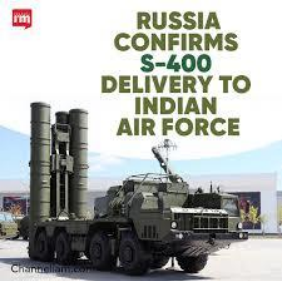
• Final Delivery Timeline: India is scheduled to receive the remaining two units of the S-400 Triumf surface-to-air missile (SAM) systems from Russia within the current calendar year. The first of these is expected by next month, with the final squadron delivery slated for November. • Strategic Induction: Out of the five squadrons contracted under a 5.43 billion dollar deal signed in 2018, three have already been deployed at strategic locations along the northern and western borders to counter aerial threats from long ranges. • Technical Superiority: The S-400 is considered one of the world’s most advanced long-range SAM systems, capable of engaging multiple targets—including stealth fighters, ballistic missiles, and cruise missiles—at distances up to 400km and altitudes of 30km. • Geopolitical Resilience: Despite the ongoing Russia-Ukraine conflict and the associated global supply chain disruptions, the Ministry of Defence has maintained close coordination with Russian counterparts to ensure the fulfillment of the contract. • Integrated Air Defence: The induction of the S-400 is a critical component of India’s multi-layered air defence grid, working in tandem with indigenous systems like Akash (short-range) and MRSAM (medium-range) to provide comprehensive airspace protection. • Sanctions Management: India has navigated complex international pressure, particularly the United States\' CAATSA (Countering America’s Adversaries Through Sanctions Act) legislation, by asserting its \'strategic autonomy\' and specific national security requirements. Key Definitions Surface-to-Air Missile (SAM): A missile designed to be launched from the ground to destroy aircraft or other missiles. Strategic Autonomy: A foreign policy doctrine where a nation makes decisions based on its own national interests without being unduly influenced by other states or alliances. Air Defence Grid: A multilayered network of sensors, radars, and interceptor missiles designed to detect and neutralize incoming aerial threats at various ranges and altitudes. Constitutional and Legal Provisions Article 51 (Directive Principles): Encourages the State to promote international peace and security and maintain just and honourable relations between nations, providing the philosophical basis for diverse defence partnerships. Union List (Schedule VII): \'Defence of India\' and \'Arms, firearms, ammunition and explosives\' fall under the exclusive legislative domain of the Parliament, empowering the Central Government to enter into international arms contracts. CAATSA (US Law): A US federal law that imposes sanctions on countries that engage in \'significant transactions\' with Russian, Iranian, or North Korean defence sectors. India has sought a waiver from this law citing its long-standing ties with Russia. Additional Keypoints The S-400 system utilizes four different types of missiles to create a tiered defence shield, effectively countering \'Anti-Access/Area Denial\' (A2/AD) strategies by adversaries. Beyond the hardware, the deal includes extensive training for Indian Air Force (IAF) personnel and the integration of the system into the Integrated Air Command and Control System (IACCS). The timely completion of this delivery is also seen as a test of the \'Rupee-Rouble\' payment mechanism, which was activated to bypass SWIFT-related sanctions on Russian financial institutions. Conclusion The completion of the S-400 deliveries by November will mark a significant milestone in India’s military modernization. By successfully balancing its relationship with Washington while maintaining its deep-rooted defence ties with Moscow, New Delhi has demonstrated a sophisticated level of diplomatic maneuvering. This acquisition ensures that India maintains a credible \'deterrence-by-denial\' capability in an increasingly volatile regional security environment. UPSC Relevance General Studies Paper II: Effect of policies and politics of developed and developing countries on India’s interests; Indian Diaspora; and Bilateral, regional, and global groupings and agreements involving India. General Studies Paper III: Indigenization of technology and developing new technology; Security challenges and their management in border areas; and various Security forces and agencies and their mandate.


Address : 506, 3rd EYE THREE (III), Opp. Induben Khakhrawala, Girish Cold Drink Cross Road, CG Road, Navrangpura, Ahmedabad, 380009.
Mobile : 8469231587 / 9586028957
Telephone : 079-40098991
E-mail: dics.upsc@gmail.com
Address: A-306, The Landmark, Urjanagar-1, Opp. Spicy Street, Kudasan – Por Road, Kudasan, Gandhinagar – 382421
Mobile : 9723832444 / 9723932444
E-mail: dics.gnagar@gmail.com
Address: 2nd Floor, 9 Shivali Society, L&T Circle, opp. Ratri Bazar, Karelibaugh, Vadodara, 390018
Mobile : 9725692037 / 9725692054
E-mail: dics.vadodara@gmail.com
Address: 403, Raj Victoria, Opp. Pal Walkway, Near Galaxy Circle, Pal, Surat-394510
Mobile : 8401031583 / 8401031587
E-mail: dics.surat@gmail.com
Address: 303,305 K 158 Complex Above Magson, Sindhubhavan Road Ahmedabad-380059
Mobile : 9974751177 / 8469231587
E-mail: dicssbr@gmail.com
Address: 57/17, 2nd Floor, Old Rajinder Nagar Market, Bada Bazaar Marg, Delhi-60
Mobile : 9104830862 / 9104830865
E-mail: dics.newdelhi@gmail.com