Ahmedabad
(Head Office)Address : 506, 3rd EYE THREE (III), Opp. Induben Khakhrawala, Girish Cold Drink Cross Road, CG Road, Navrangpura, Ahmedabad, 380009.
Mobile : 8469231587 / 9586028957
E-mail: dics.upsc@gmail.com

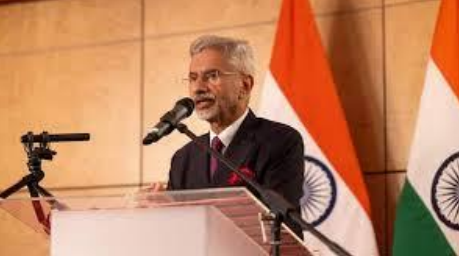
In February 2026, External Affairs Minister S. Jaishankar articulated a significant shift in India’s diplomatic posture, asserting that the nation now engages with global allies from a \'position of strength.\' Speaking at the Global Economic Cooperation conference in Mumbai, he highlighted that India’s economic resilience and a string of landmark trade agreements have transitioned the country from a cautious participant to a proactive shaper of the global order.Key Summary Points • Shift to Proactive Diplomacy: India has moved away from a \'defensive crouch\' to intensive global engagement, leveraging its status as a trusted partner in a volatile world witnessing the weaponization of production and finance. • Landmark Trade Pacts: The recent reduction of US tariffs on Indian goods (from 50% to 18%) and the conclusion of the India-EU Free Trade Agreement (FTA) in early 2026 serve as concrete evidence of India\'s growing economic clout. • Strategic De-risking: India’s policy now focuses on \'derisking\' supply chains by building national capabilities and diversifying partnerships to counter global uncertainties and tighter export controls. • Economic Security as Priority: The \'reform express\' continues to drive foreign policy, where economic interests—specifically in technology, AI, and skilled talent—are now inextricably linked to national security. • Recalibrating Energy Ties: As part of a major strategic pivot in 2026, India is balancing its traditional energy dependencies with new pacts, such as the major trade deal with the US that involves shifting energy procurement away from volatile sources. • Global Salience: India is increasingly viewed as a central pillar in the global calculus of production and services, positioning itself as a \'China-plus-one\' alternative for global manufacturing. Definitions of Key Words • Position of Strength: A diplomatic stance where a nation uses its domestic economic stability, military capability, and internal political continuity to negotiate more favorable terms in international agreements. • Weaponization of Finance: The use of financial instruments (like sanctions, access to payment gateways, or currency manipulation) as a tool of geopolitical coercion. • De-risking: A strategy used by states and businesses to reduce reliance on a single source (like China) for critical goods or services to avoid supply chain disruptions. Constitutional & Legal Provisions • Article 51 (DPSP): The constitutional directive for the State to promote international peace and security and maintain just and honorable relations between nations. • Foreign Trade (Development and Regulation) Act, 1992: The primary legal framework providing the government power to develop and regulate foreign trade by facilitating imports into and augmenting exports from India. • Section 5 of the Customs Act, 1962: Grants the government the power to adjust duties, which is critical during the implementation of new trade deals like the India-US or India-EU FTAs. Additional Important Keypoints • The \'Twilight Zone\' of Global Order: Minister Jaishankar noted that the established global order is changing, and India is preparing for a \'long twilight zone\' where economics will frequently give way to politics and security• Multi-Alignment: Unlike the Cold War-era non-alignment, India now practices \'multi-alignment\'— working with multiple power blocs (Quad, BRICS, G20) simultaneously to secure its own interests. • Domestic Linkages: The minister emphasized that \'political continuity and stability\' at home have been the bedrock allowing for bold external reforms and negotiations. Conclusion India’s engagement from a position of strength represents a maturing of its \'Strategic Autonomy.\' By securing favorable trade terms with both the West and emerging markets, India is successfully navigating a turbulent global landscape. The focus has clearly shifted from merely protecting borders to securing economic frontiers, ensuring that India’s \'reform express\' remains the engine of its global aspirations. UPSC Relevance • General Studies II: Bilateral, regional, and global groupings and agreements involving India and/or affecting India’s interests; Effect of policies and politics of developed and developing countries on India’s interests. • General Studies III: Indian Economy and issues relating to planning, mobilization of resources, growth, development, and employment; Effects of liberalization on the economy. • Mains Perspective: Analyze the transition of Indian foreign policy from \'Non-Alignment\' to \'MultiAlignment.\' Evaluate how economic strength acts as a force multiplier for a nation\'s diplomatic leverage.


Address : 506, 3rd EYE THREE (III), Opp. Induben Khakhrawala, Girish Cold Drink Cross Road, CG Road, Navrangpura, Ahmedabad, 380009.
Mobile : 8469231587 / 9586028957
E-mail: dics.upsc@gmail.com
Address: A-306, The Landmark, Urjanagar-1, Opp. Spicy Street, Kudasan – Por Road, Kudasan, Gandhinagar – 382421
Mobile : 9723832444 / 9723932444
E-mail: dics.gnagar@gmail.com
Address: Tithi Commercial Complex, 401/402 Productivity Road, Opp. Productivity House, Alkapuri, Vadodara, Gujarat – 390007
Mobile : 9725692037 / 9725692054
E-mail: dics.vadodara@gmail.com
Address: 403, Raj Victoria, Opp. Pal Walkway, Near Galaxy Circle, Pal, Surat-394510
Mobile : 8401031583 / 8401031587
E-mail: dics.surat@gmail.com
Address: 303,305 K 158 Complex Above Magson, Sindhubhavan Road Ahmedabad-380059
Mobile : 9974751177 / 8469231587
E-mail: dicssbr@gmail.com
Address: 57/17, 2nd Floor, Old Rajinder Nagar Market, Bada Bazaar Marg, Delhi-60
Mobile : 9104830862 / 9104830865
E-mail: dics.newdelhi@gmail.com