Ahmedabad
(Head Office)Address : 506, 3rd EYE THREE (III), Opp. Induben Khakhrawala, Girish Cold Drink Cross Road, CG Road, Navrangpura, Ahmedabad, 380009.
Mobile : 8469231587 / 9586028957
E-mail: dics.upsc@gmail.com

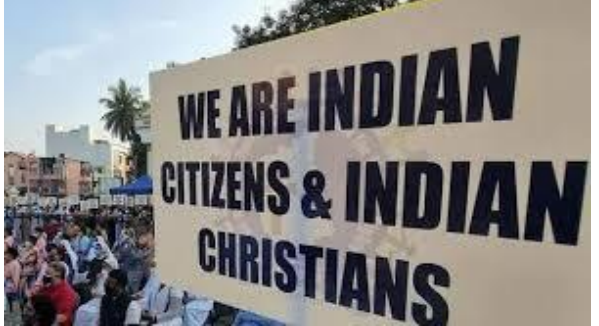
Union Minister for Minority Affairs Kiren Rijiju has stated that the Central Government will consider a request from the Syro-Malabar Church to accord Christians the status of a \'micro minority.\' The proposal aims to address concerns regarding the equitable distribution of resources and benefits among various minority groups, ensuring that numerically smaller communities receive adequate protection and developmental support. Key Highlights of the Proposal • Equitable Resource Distribution: The request is rooted in the perception that existing minority benefits and reservations are disproportionately utilized by larger religious groups, leaving smaller communities at a disadvantage. • Focus on Numerical Inferiority: With Christians constituting approximately 2.3% of India\'s population (Census 2011), the Church argues for a \'micro\' tag to distinguish its needs from more populous minority communities. • Governmental Assurance: Minister Rijiju assured that the Union Government would protect all minority communities as per the spirit of the Constitution, particularly those with smaller demographic footprints. • Institutional Representation: The Syro-Malabar Church, a major Eastern Catholic Church based in Kerala, plans to send a formal delegation to New Delhi to present the specific socio-economic grievances justifying this status. • Inter-Community Confidence: The move is seen as an effort to build confidence among \'smaller minorities\' regarding the State\'s commitment to inclusive welfare and secularism. the majority, possessing a distinct identity based on religion, language, or culture. • Micro Minority: An informal or proposed sub-category within recognized minorities, referring to groups with extremely small populations (e.g., Parsis at 0.006% or Jains at 0.4%) who face unique existential or developmental challenges. • Secularism (Indian Context): Unlike the Western \'separation\' model, Indian secularism implies Sarva Dharma Sambhava—the State maintaining an equal distance from and providing equal respect to all religions. Constitutional and Legal Provisions • Article 29: Protects the interests of minorities by allowing \'any section of the citizens\' to conserve their distinct language, script, or culture. • Article 30: Grants all minorities (religious and linguistic) the fundamental right to establish and administer educational institutions of their choice. • National Commission for Minorities (NCM) Act, 1992: Section 2(c) empowers the Central Government to notify communities as minorities. Currently, six are notified: Muslims, Christians, Sikhs, Buddhists, Jains, and Zoroastrians (Parsis). • T.M.A. Pai Foundation Case (2002): The Supreme Court ruled that for the purposes of Article 30, a minority is to be determined in relation to the population of the State, not the entire country. Additional Important Key Points • Demographic Statistics (2011 Census): * Muslims: 14.2% o Christians: 2.3% o Sikhs: 1.7% o Buddhists: 0.7% o Jains: 0.4% o Parsis: ~0.006% • Precedent of Parsis: The Jiyo Parsi scheme is an example of a policy already targeting a \'micro\' group to prevent population decline. • Sub-categorization Debate: The demand for a \'micro minority\' tag mirrors the debate on subcategorization of OBCs (Rohini Commission), aiming to prevent the \'creamy layer\' of the minority umbrella from cornering all benefits. Conclusion and UPSC Relevance The demand for a \'micro minority\' status signifies a deepening of the discourse on social justice and minority rights in India. For the UPSC Civil Services Exam, this topic is essential for General Studies Paper II (Polity and Social Justice). It highlights the \'Issues related to the development and management of Social Sector/Services relating to Minorities\' and the \'Protection of Interests of Minorities (Articles 29-30).\' Understanding the nuances of demographic-based categorization is crucial for analyzing federalism, secularism, and the evolution of affirmative action policies in India.


Address : 506, 3rd EYE THREE (III), Opp. Induben Khakhrawala, Girish Cold Drink Cross Road, CG Road, Navrangpura, Ahmedabad, 380009.
Mobile : 8469231587 / 9586028957
E-mail: dics.upsc@gmail.com
Address: A-306, The Landmark, Urjanagar-1, Opp. Spicy Street, Kudasan – Por Road, Kudasan, Gandhinagar – 382421
Mobile : 9723832444 / 9723932444
E-mail: dics.gnagar@gmail.com
Address: 2nd Floor, 9 Shivali Society, L&T Circle, opp. Ratri Bazar, Karelibaugh, Vadodara, 390018
Mobile : 9725692037 / 9725692054
E-mail: dics.vadodara@gmail.com
Address: 403, Raj Victoria, Opp. Pal Walkway, Near Galaxy Circle, Pal, Surat-394510
Mobile : 8401031583 / 8401031587
E-mail: dics.surat@gmail.com
Address: 303,305 K 158 Complex Above Magson, Sindhubhavan Road Ahmedabad-380059
Mobile : 9974751177 / 8469231587
E-mail: dicssbr@gmail.com
Address: 57/17, 2nd Floor, Old Rajinder Nagar Market, Bada Bazaar Marg, Delhi-60
Mobile : 9104830862 / 9104830865
E-mail: dics.newdelhi@gmail.com