


Ahmedabad
(Head Office)Address : 506, 3rd EYE THREE (III), Opp. Induben Khakhrawala, Girish Cold Drink Cross Road, CG Road, Navrangpura, Ahmedabad, 380009.
Mobile : 8469231587 / 9586028957
E-mail: dics.upsc@gmail.com


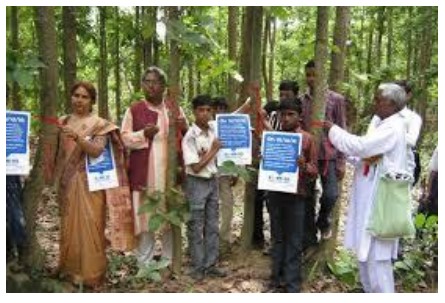
In response to the intensifying challenges of global warming and fragile Himalayan ecology, the Himachal Pradesh government has officially set a target to expand its forest cover to 31% by 2030, up from the current 29.5%. This initiative aligns the state’s developmental agenda with sustainable environmental conservation. • Target-Oriented Roadmap: Chief Minister Sukhvinder Singh Sukhu has directed the Forest Department to prepare a comprehensive, time-bound roadmap for increasing the green cover by 1.5% within the next four years. • Geographical Constraints: The planning accounts for the state’s unique topography, where approximately 16,376 sq. km. is classified as snow-covered, barren, or mountainous terrain, rendering it unsuitable for traditional plantation. • Species Diversification: The afforestation drive will prioritize native species, fruit-bearing trees, and medicinal plants, ensuring that the new forests provide both ecological stability and economic value to local residents. • Community-Led Conservation: A key pillar of this goal is the \'Rajiv Gandhi Van Samvardhan Yojana,\' which incentivizes local groups like Mahila Mandals and Self-Help Groups (SHGs) to lead plantation efforts over identified district-wise clusters. • Financial Incentives: To ensure sustainability, the state provides financial assistance of ₹2.40 lakh for plantations over two hectares, with additional annual incentives directly linked to the plant survival rate. • Dual Focus Strategy: The mandate emphasizes an equal priority on creating new forests and protecting existing ones from threats like forest fires and illegal felling, which are frequent in the sensitive Chir Pine zones. KEY DEFINITIONS AND TERMINOLOGY • Forest Cover: All lands more than one hectare in area with a tree canopy density of more than 10%, irrespective of land use and legal status. • Forest Density: A measure of the area covered by the crown of trees. Categorized by the FSI as Very Dense (>70%), Moderately Dense (40-70%), and Open Forest (10-40%). • Carbon Sink: A natural reservoir, such as a forest, that accumulates and stores some carbon-containing chemical compound for an indefinite period, lowering the concentration of $CO_2$ from the atmosphere. CONSTITUTIONAL AND LEGAL PROVISIONS • Article 48A (DPSP): The State shall endeavor to protect and improve the environment and to safeguard the forests and wildlife of the country. • Article 51A (g): Fundamental Duty of every citizen to protect and improve the natural environment including forests, lakes, rivers, and wildlife.• National Forest Policy, 1988: Recommends that 66% (two-thirds) of the total area in hilly and mountainous regions should be under forest or tree cover to prevent erosion and ensure ecosystem stability. • Himachal Pradesh Forest Act: Provides the state-specific legal framework for the management of protected and reserved forests.
COMPARATIVE ANALYSIS: HIMALAYAN STATES
CONCLUSION Himachal Pradesh’s 2030 goal is a strategic attempt to bridge the gap between its current status and the ambitious benchmarks set by the National Forest Policy for hill states. By shifting the focus from mere sapling numbers to survival-linked incentives and native biodiversity, the state is adopting a \'Quality over Quantity\' approach. If successful, this roadmap will serve as a blueprint for other Himalayan states struggling with the dual pressure of infrastructure development and climate-induced disasters like landslides and flash floods. UPSC RELEVANCE • GS Paper III (Environment): Conservation and environmental degradation; Role of forests in climate change mitigation; State-specific environmental policies. • GS Paper I (Geography): Himalayan Ecology; Distribution of natural vegetation; Impact of topography on afforestation. • Prelims Focus: Forest Survey of India (FSI) data; Rajiv Gandhi Van Samvardhan Yojana; 33% national forest cover target vs. 66% hilly area target; medicinal and native flora of the Western Himalayas.


Address : 506, 3rd EYE THREE (III), Opp. Induben Khakhrawala, Girish Cold Drink Cross Road, CG Road, Navrangpura, Ahmedabad, 380009.
Mobile : 8469231587 / 9586028957
E-mail: dics.upsc@gmail.com
Address: A-306, The Landmark, Urjanagar-1, Opp. Spicy Street, Kudasan – Por Road, Kudasan, Gandhinagar – 382421
Mobile : 9723832444 / 9723932444
E-mail: dics.gnagar@gmail.com
Address: 2nd Floor, 9 Shivali Society, L&T Circle, opp. Ratri Bazar, Karelibaugh, Vadodara, 390018
Mobile : 9725692037 / 9725692054
E-mail: dics.vadodara@gmail.com
Address: 403, Raj Victoria, Opp. Pal Walkway, Near Galaxy Circle, Pal, Surat-394510
Mobile : 8401031583 / 8401031587
E-mail: dics.surat@gmail.com
Address: 303,305 K 158 Complex Above Magson, Sindhubhavan Road Ahmedabad-380059
Mobile : 9974751177 / 8469231587
E-mail: dicssbr@gmail.com
Address: 57/17, 2nd Floor, Old Rajinder Nagar Market, Bada Bazaar Marg, Delhi-60
Mobile : 9104830862 / 9104830865
E-mail: dics.newdelhi@gmail.com