



Ahmedabad
(Head Office)Address : 506, 3rd EYE THREE (III), Opp. Induben Khakhrawala, Girish Cold Drink Cross Road, CG Road, Navrangpura, Ahmedabad, 380009.
Mobile : 8469231587 / 9586028957
Telephone : 079-40098991
E-mail: dics.upsc@gmail.com

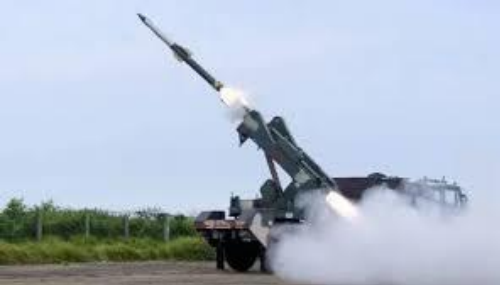
The Defence Research & Development Organisation (DRDO) successfully conducted three consecutive flighttrials of the Very Short-Range Air Defence System (VSHORADS) from the Integrated Test Range (ITR), Chandipur. These trials, conducted in a final deployment configuration, revalidated the system\'s ability to intercept high-speed aerial threats at varying altitudes and ranges, marking a significant step toward its induction into the Indian Armed Forces. Core Summary of the VSHORADS Mission • Indigenous Development: VSHORADS is a Man-Portable Air Defence System (MANPADS) designed and developed by the Research Centre Imarat (RCI), Hyderabad, in collaboration with other DRDO laboratories and industry partners. • Versatile Interception: The system is specifically engineered to neutralise low-altitude aerial threats such as enemy aircraft, helicopters, and unmanned aerial vehicles (UAVs) flying at high speeds. • Joint Forces Capability: Designed as a common platform, the missile system is intended to meet the tactical air defence requirements of all three wings: the Indian Army, Navy, and Air Force. • Testing Precision: The trials utilized high-speed targets mimicking actual combat scenarios, with data validated through Telemetry, Electro-Optical Tracking Systems (EOTS), and Radars at the ITR. • Field Operator Validation: Unlike laboratory tests, these trials involved target acquisition and firing by actual field operators, ensuring the system’s reliability in real-world combat conditions. • Atmanirbhar Bharat in Defence: The success of these trials reduces India\'s dependence on foreign MANPADS (like the Russian Igla or US Stinger), bolstering the domestic defence manufacturing ecosystem. Key Definitions • MANPADS: Man-Portable Air Defence Systems; these are lightweight, surface-to-air missiles that can be carried and fired by a single infantry soldier or a small team. • ITR Chandipur: The Integrated Test Range located in Odisha, which serves as India\'s primary facility for testing various missiles and flight vehicles. • Research Centre Imarat (RCI): A premier DRDO laboratory responsible for the design, development, and delivery of avionics systems and guided missiles. Constitutional and Legal Provisions • Article 51(A): Fundamental Duties; specifically, to \'defend the country and render national service when called upon to do so.\' Technological indigenization supports the state\'s capacity to fulfill this duty. • Union List (Seventh Schedule): Entry 1 (Defence of India) and Entry 2 (Naval, military and air forces) grant the Parliament exclusive power to legislate on matters of national security and advanced weaponry. • Defence Acquisition Procedure (DAP) 2020: The policy framework that prioritizes \'Buy (IndianIDDM)\' (Indigenously Designed, Developed and Manufactured) categories, under which VSHORADS falls. Additional Key Points • Technological Edge: The missile incorporates a miniaturized Reaction Control System (RCS) to increase maneuverability and an integrated tripod for stable firing. • Propulsion: It is powered by a dual-thrust solid motor, providing the necessary acceleration to intercept fast-moving targets within seconds of launch. • Replacement Strategy: VSHORADS is expected to replace the older, imported shoulder-fired missile systems currently in use along India\'s mountainous borders (LAC and LoC). • Strategic Deployment: Its portability makes it ideal for deployment in difficult terrains like the Himalayas, where heavy air defence machinery cannot reach. Conclusion: The successful validation of VSHORADS represents a critical milestone in India\'s pursuit of a multi-layered air defence umbrella. By mastering the technology for short-range, man-portable interception, DRDO has provided the Armed Forces with a flexible and potent tool to counter modern \'gray-zone\' threats like swarming drones and low-flying jets. UPSC Relevance: • GS Paper III: Science and Technology; Indigenization of technology and developing new technology; Awareness in the fields of IT, Space, and Computers. • GS Paper III: Internal Security; Security challenges and their management in border areas; Various Security forces and agencies and their mandate. • Prelims: Specific technical terms (MANPADS, ITR, RCI), name of the missile system, and its indigenous nature.


Address : 506, 3rd EYE THREE (III), Opp. Induben Khakhrawala, Girish Cold Drink Cross Road, CG Road, Navrangpura, Ahmedabad, 380009.
Mobile : 8469231587 / 9586028957
Telephone : 079-40098991
E-mail: dics.upsc@gmail.com
Address: A-306, The Landmark, Urjanagar-1, Opp. Spicy Street, Kudasan – Por Road, Kudasan, Gandhinagar – 382421
Mobile : 9723832444 / 9723932444
E-mail: dics.gnagar@gmail.com
Address: 2nd Floor, 9 Shivali Society, L&T Circle, opp. Ratri Bazar, Karelibaugh, Vadodara, 390018
Mobile : 9725692037 / 9725692054
E-mail: dics.vadodara@gmail.com
Address: 403, Raj Victoria, Opp. Pal Walkway, Near Galaxy Circle, Pal, Surat-394510
Mobile : 8401031583 / 8401031587
E-mail: dics.surat@gmail.com
Address: 303,305 K 158 Complex Above Magson, Sindhubhavan Road Ahmedabad-380059
Mobile : 9974751177 / 8469231587
E-mail: dicssbr@gmail.com
Address: 57/17, 2nd Floor, Old Rajinder Nagar Market, Bada Bazaar Marg, Delhi-60
Mobile : 9104830862 / 9104830865
E-mail: dics.newdelhi@gmail.com