
Ahmedabad
(Head Office)Address : 506, 3rd EYE THREE (III), Opp. Induben Khakhrawala, Girish Cold Drink Cross Road, CG Road, Navrangpura, Ahmedabad, 380009.
Mobile : 8469231587 / 9586028957
Telephone : 079-40098991
E-mail: dics.upsc@gmail.com

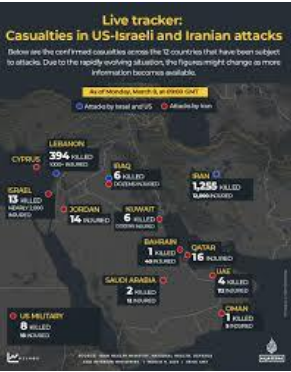
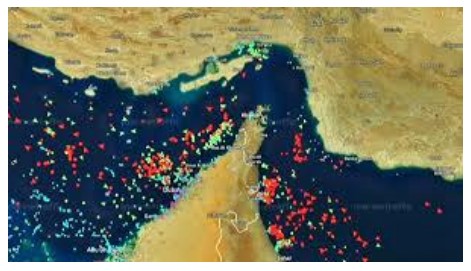
• Strategic Stalemate vs. Tactical Success: Despite the U.S. and Israel securing tactical victories by degrading Iran’s military and industrial infrastructure, the broader strategic goal of \'regime change\' remains elusive. President Trump’s recent address suggests a shift from unconditional surrender to a containment strategy, targeting power grids while abandoning previous goals like the liberation of the Strait of Hormuz. • Iranian Regime Resilience: Contrary to Western intelligence assessments suggesting a popular uprising would follow a \'decapitation strike,\' the Islamic Revolutionary Guard Corps (IRGC) has consolidated power. The assassination of moderates has inadvertently empowered hardliners, ensuring the regime’s political survival through a decentralized command structure. • Horizontal Escalation and Economic Leverage: Tehran has successfully \'regionalized\' the conflict, targeting U.S.-aligned Arab states and leveraging its control over the Strait of Hormuz. By threatening 25% of the global oil and gas supply, Iran has triggered inflationary pressures, placing significant economic strain on energy-dependent Asian economies, including India. • Intelligence Miscalculation in Washington: Internal friction within the Trump administration, evidenced by reports of a tense exchange between Vice-President J.D. Vance and PM Netanyahu, suggests that the U.S. may have been maneuvered into a conflict based on flawed intelligence that overestimated air power and underestimated Iranian endurance. • Erosion of Alliances: The U.S. faces growing isolation as NATO allies distance themselves from the conflict. Regional partners in the Gulf, feeling exposed to Iranian retaliation, are exploring alternative diplomatic pathways such as the \'Islamabad Quadrilateral Dialogue\' (Pakistan, Türkiye, Saudi Arabia, and Egypt) to bypass Washington’s influence. • Outcome of Attrition: While Iran suffers immense physical and human loss, it gains \'strategic respect\' across the Global South. If the regime survives this period of sustained pressure, it will likely claim a strategic victory, as the U.S. has failed to achieve its stated primary objective of total regime collapse. Constitutional & Legal Context • Article 51 of the Indian Constitution: Mandates that India strive to promote international peace and security and maintain just relations between nations—explaining New Delhi’s balanced diplomatic stance in the Middle East. • War Powers Act (U.S. Context): Relevant for understanding the domestic constraints on the U.S. President regarding prolonged military engagements without formal Congressional declarations of war. • UN Charter (Article 2(4) & 51): The legal framework governing the \'use of force\' and the \'right to self-defense,\' which both sides cite to justify military actions in the current conflict. • Maritime Law (UNCLOS): Regulations concerning the \'Innocent Passage\' through the Strait of Hormuz, which is being challenged by Iran\'s blockade tactics. Key Definitions • Horizontal Escalation: A strategic move to expand a conflict to new geographic areas or involve different actors/sectors (like the economy) to pressure an adversary. • Decapitation Strategy: A military strategy aimed at removing the top leadership of an enemy state or organization to cause a total collapse of command and control. • Islamabad Quadrilateral Dialogue: A regional diplomatic initiative involving Pakistan, Türkiye, Saudi Arabia, and Egypt aimed at finding regional solutions to Middle Eastern instability. Conclusion: The conflict underscores a significant shift in 21st-century warfare where military superiority does not automatically translate into political victory. Iran’s ability to endure \'maximum pressure\' and retaliate through asymmetric and economic means has created a high-stakes war of attrition. For the global community, the prolonged instability in the Persian Gulf remains a primary threat to energy security and post-pandemic economic recovery. UPSC Relevance • GS Paper II (International Relations): Effect of policies and politics of developed and developing countries on India’s interests; Indian Diaspora (safety of Indians in the Gulf). • GS Paper III (Economy & Security): Impact of global wars on supply chains and inflation; Energy security and diversification of oil imports.


Address : 506, 3rd EYE THREE (III), Opp. Induben Khakhrawala, Girish Cold Drink Cross Road, CG Road, Navrangpura, Ahmedabad, 380009.
Mobile : 8469231587 / 9586028957
Telephone : 079-40098991
E-mail: dics.upsc@gmail.com
Address: A-306, The Landmark, Urjanagar-1, Opp. Spicy Street, Kudasan – Por Road, Kudasan, Gandhinagar – 382421
Mobile : 9723832444 / 9723932444
E-mail: dics.gnagar@gmail.com
Address: 2nd Floor, 9 Shivali Society, L&T Circle, opp. Ratri Bazar, Karelibaugh, Vadodara, 390018
Mobile : 9725692037 / 9725692054
E-mail: dics.vadodara@gmail.com
Address: 403, Raj Victoria, Opp. Pal Walkway, Near Galaxy Circle, Pal, Surat-394510
Mobile : 8401031583 / 8401031587
E-mail: dics.surat@gmail.com
Address: 303,305 K 158 Complex Above Magson, Sindhubhavan Road Ahmedabad-380059
Mobile : 9974751177 / 8469231587
E-mail: dicssbr@gmail.com
Address: 57/17, 2nd Floor, Old Rajinder Nagar Market, Bada Bazaar Marg, Delhi-60
Mobile : 9104830862 / 9104830865
E-mail: dics.newdelhi@gmail.com