
Ahmedabad
(Head Office)Address : 506, 3rd EYE THREE (III), Opp. Induben Khakhrawala, Girish Cold Drink Cross Road, CG Road, Navrangpura, Ahmedabad, 380009.
Mobile : 8469231587 / 9586028957
Telephone : 079-40098991
E-mail: dics.upsc@gmail.com

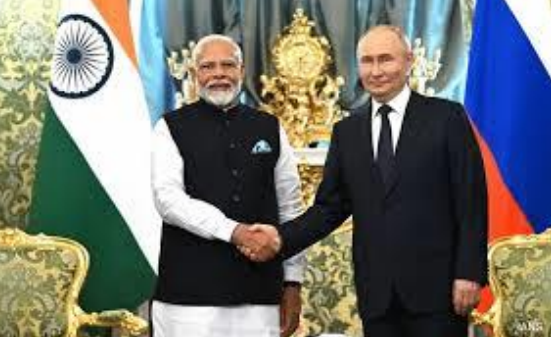
Amidst intensifying global geopolitical realignments, the recent meeting between Indian Ambassador Vinay Kumar and Russian Deputy Foreign Minister Andrei Rudenko in Moscow underscores the resilience of the \'Special and Privileged Strategic Partnership.\' This engagement is particularly significant following the 2026 India-US trade understanding, as New Delhi seeks to balance its burgeoning ties with Washington against its deep-rooted security and energy dependencies on Moscow. Key Summary Points • Strategic Rebalancing: The dialogue addressed the \'Asia-Pacific\' region (Russia\'s preferred terminology for the Indo-Pacific), signaling a mutual interest in preventing any single power\'s hegemony while navigating India\'s participation in the Quad. • The \'Oil Commitment\' Controversy: The meeting served as a vital channel to manage friction caused by US claims that India has agreed to halt Russian crude imports in exchange for tariff rollbacks (from 50% to 18%). • Energy Security vs. Market Access: While the US tracks India\'s imports via executive orders, India continues to maintain that \'National Interest\' is the sole guiding factor for its energy procurement, balancing discounted Russian Ural crude with high-tech US trade benefits. • Connectivity and Logistics: Discussions emphasized the operationalization of the Chennai-Vladivostok Eastern Maritime Corridor and the International North-South Transport Corridor (INSTC) to reduce reliance on the Suez Canal. • Defense Sustainment: A primary bilateral \'pressing issue\' remains the steady supply of spares and the delivery of the remaining S-400 missile squadrons, crucial for India’s two-front deterrence strategy.• Bilateral Trade Trajectory: Both nations reaffirmed their commitment to reaching $100 billion in annual trade by 2030, even as India faces a significant trade deficit due to massive energy imports (approx. $63.8 billion in FY25). Definitions of Key Terms • Strategic Autonomy: A foundational pillar of Indian foreign policy that allows New Delhi to make independent decisions based on national interest without being forced into alliances. • Asia-Pacific vs. Indo-Pacific: While India uses \'Indo-Pacific\' to include the Indian Ocean, Russia uses \'Asia-Pacific\' to emphasize a continental and Pacific focus, often viewing the \'Indo-Pacific\' concept as a Western-led containment strategy. • Refining Loophole: A term used by Western critics to describe the process where India imports Russian crude, refines it, and exports the finished petroleum products to Europe and the US. Constitutional and Legal Provisions • Article 51 (DPSP): Mandates that the State shall endeavor to promote international peace and security and maintain just and honorable relations between nations. • Reciprocal Exchange of Logistics Support (RELOS): A landmark 2025 agreement that allows the Indian Navy access to Russian Arctic and Pacific bases, mirroring the LEMOA agreement with the US. • Intergovernmental Commission (IRIGC): The highest institutionalized mechanism for bilateral review, split into the Military-Technical (M&MTC) and Trade-Economic (TEC) divisions. Additional Important Keypoints • The Arctic Frontier: India is increasingly looking at the Northern Sea Route (NSR) for year-round access to Russian minerals and LNG, seeking \'icebreaker priority\' for Indian vessels. • Payment Mechanisms: To bypass SWIFT sanctions, both nations are working on integrating the Structured Financial Messaging System (SFMS) with Russia’s SPFS for Rupee-Ruble trade. • Joint Ventures: Shift from buyer-seller to co-production, exemplified by the BrahMos missile and the manufacturing of AK-203 rifles in Amethi. Conclusion The India-Russia relationship in 2026 is no longer just a \'time-tested\' legacy but a complex, transactional necessity. While India’s economic future is increasingly tethered to the West (US/EU), its immediate security and energy stability remain dependent on Moscow. The Moscow meeting highlights India\'s \'multi-aligned\' approach—securing US market access while ensuring Russia does not pivot entirely toward a China-centric axis. UPSC Relevance • General Studies II: India and its neighborhood relations; Bilateral, regional, and global groupings involving India and affecting India\'s interests (Balancing US-Russia relations). • General Studies III: Energy Security; Growth and Development (Impact of trade deals on Indian economy); Science & Technology (Defense indigenization and co-production).• Mains Perspective: Discuss the challenges to India’s \'Strategic Autonomy\' in the face of the USRussia-China triangle. Evaluate the significance of the Eastern Maritime Corridor for India’s \'Act East\' policy.


Address : 506, 3rd EYE THREE (III), Opp. Induben Khakhrawala, Girish Cold Drink Cross Road, CG Road, Navrangpura, Ahmedabad, 380009.
Mobile : 8469231587 / 9586028957
Telephone : 079-40098991
E-mail: dics.upsc@gmail.com
Address: A-306, The Landmark, Urjanagar-1, Opp. Spicy Street, Kudasan – Por Road, Kudasan, Gandhinagar – 382421
Mobile : 9723832444 / 9723932444
E-mail: dics.gnagar@gmail.com
Address: 2nd Floor, 9 Shivali Society, L&T Circle, opp. Ratri Bazar, Karelibaugh, Vadodara, 390018
Mobile : 9725692037 / 9725692054
E-mail: dics.vadodara@gmail.com
Address: 403, Raj Victoria, Opp. Pal Walkway, Near Galaxy Circle, Pal, Surat-394510
Mobile : 8401031583 / 8401031587
E-mail: dics.surat@gmail.com
Address: 303,305 K 158 Complex Above Magson, Sindhubhavan Road Ahmedabad-380059
Mobile : 9974751177 / 8469231587
E-mail: dicssbr@gmail.com
Address: 57/17, 2nd Floor, Old Rajinder Nagar Market, Bada Bazaar Marg, Delhi-60
Mobile : 9104830862 / 9104830865
E-mail: dics.newdelhi@gmail.com