
Ahmedabad
(Head Office)Address : 506, 3rd EYE THREE (III), Opp. Induben Khakhrawala, Girish Cold Drink Cross Road, CG Road, Navrangpura, Ahmedabad, 380009.
Mobile : 8469231587 / 9586028957
E-mail: dics.upsc@gmail.com

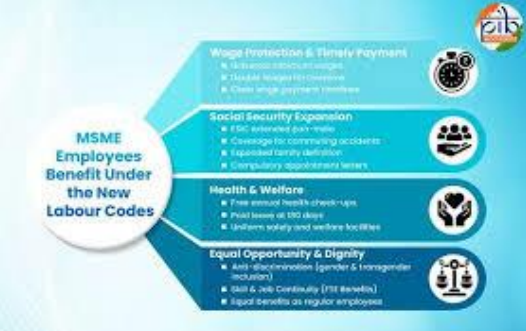
The implementation of the four Labour Codes—the Code on Wages, the Industrial Relations Code, the Social Security Code, and the Occupational Safety, Health and Working Conditions Code—represents a paradigm shift in Indian labour jurisprudence. By consolidating 29 central laws, these reforms aim to bridge the gap between formal and informal employment, ensuring that financial security becomes a central pillar of the employment contract in the modern economy. Key Summary Points for UPSC • Standardization of the \'Wage\' Definition: To prevent firms from structuring pay to minimize social security dues, the new definition mandates that \'wages\' (Basic Pay, DA, and Retaining Allowance) must constitute at least 50% of total remuneration. This automatically boosts contributions to Provident Fund (PF), pension, and gratuity. • Gratuity for Fixed-Term Employment: The codes abolish the traditional five-year threshold for gratuity for fixed-term employees, entitling them to pro-rata gratuity after just one year of service. This recognizes the rise of short-term contracting in the modern market. • Inclusion of the \'Missing Middle\': For the first time, gig workers, platform workers, and unorganized sector workers are formally recognized. The codes provide a legal framework for their social security, including disability, maternity, and old-age benefits. • Portability and Digital Inclusion: The reforms emphasize the portability of benefits across state lines, which is crucial for India’s massive migrant workforce. This is supported by digital platforms like the eShram portal to ensure seamless access. • Universal Minimum Wage: The Code on Wages extends the right to minimum wages and timely payment of wages to all employees across both organized and unorganized sectors, moving away from the previous \'scheduled employment\' limitation. • Macroeconomic Multiplier Effect: By redistributing economic value from capital to labour, the codes enhance the purchasing power and savings of the workforce, driving domestic consumption-led growth and reducing vulnerability to economic shocks. Constitutional and Legal Provisions • Article 39(d): Directive Principle of State Policy (DPSP) ensuring \'equal pay for equal work for both men and women.\'• Article 41: Right to work, to education and to public assistance in certain cases including old age, sickness and disablement. • Article 42: Provision for just and humane conditions of work and maternity relief. • Article 43: Mandates the state to secure a \'living wage\' and a decent standard of life for all workers. • Concurrent List (Entry 22, 23, 24): Labour is a subject in the Concurrent List of the Seventh Schedule, allowing both Centre and States to legislate, though Central Codes aim for national uniformity. Important Definitions • Fixed-Term Employment (FTE): A contract of employment for a specific period where the worker is entitled to all statutory benefits available to a permanent worker in proportion to the period of service. • Gig Worker: A person who performs work or participates in a work arrangement and earns from such activities outside of traditional employer-employee relationships. • Social Security: Measures to ensure access to health care and income security, particularly in cases of old age, unemployment, sickness, invalidity, work injury, maternity, or loss of a breadwinner. • Wage Ceiling: The threshold of monthly income used to determine the eligibility or the extent of contribution towards social security schemes like EPFO or ESIC. Key Impact Areas
Conclusion The transition to the new Labour Codes is a structural intervention aimed at aligning economic growth with social justice. While the increased financial liability on corporations is significant, it is an investment in human capital that stabilizes the domestic economy. The success of these codes hinges on effective implementation by States and the digital integration of the informal workforce, ensuring that \'financial inclusion\' moves from a policy goal to a lived reality for every Indian worker. UPSC Relevance • GS Paper II: Government policies and interventions for development in various sectors; Issues arising out of their design and implementation. • GS Paper III: Indian Economy and issues relating to employment, inclusive growth, and social security. • Essay: The role of labour reforms in achieving a $5 trillion economy; Balancing Ease of Doing Business with Ease of Living for workers.


Address : 506, 3rd EYE THREE (III), Opp. Induben Khakhrawala, Girish Cold Drink Cross Road, CG Road, Navrangpura, Ahmedabad, 380009.
Mobile : 8469231587 / 9586028957
E-mail: dics.upsc@gmail.com
Address: A-306, The Landmark, Urjanagar-1, Opp. Spicy Street, Kudasan – Por Road, Kudasan, Gandhinagar – 382421
Mobile : 9723832444 / 9723932444
E-mail: dics.gnagar@gmail.com
Address: 2nd Floor, 9 Shivali Society, L&T Circle, opp. Ratri Bazar, Karelibaugh, Vadodara, 390018
Mobile : 9725692037 / 9725692054
E-mail: dics.vadodara@gmail.com
Address: 403, Raj Victoria, Opp. Pal Walkway, Near Galaxy Circle, Pal, Surat-394510
Mobile : 8401031583 / 8401031587
E-mail: dics.surat@gmail.com
Address: 303,305 K 158 Complex Above Magson, Sindhubhavan Road Ahmedabad-380059
Mobile : 9974751177 / 8469231587
E-mail: dicssbr@gmail.com
Address: 57/17, 2nd Floor, Old Rajinder Nagar Market, Bada Bazaar Marg, Delhi-60
Mobile : 9104830862 / 9104830865
E-mail: dics.newdelhi@gmail.com