





Ahmedabad
(Head Office)Address : 506, 3rd EYE THREE (III), Opp. Induben Khakhrawala, Girish Cold Drink Cross Road, CG Road, Navrangpura, Ahmedabad, 380009.
Mobile : 8469231587 / 9586028957
Telephone : 079-40098991
E-mail: dics.upsc@gmail.com

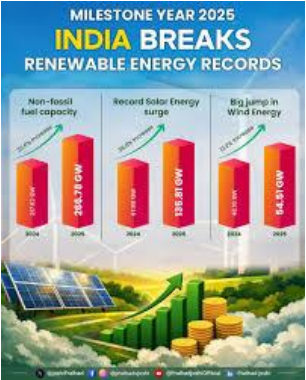
• Historic Deceleration: According to an analysis by the Centre for Research on Energy and Clean Air (CREA), India’s carbon dioxide (CO2) emissions grew by just 0.7% in 2025, marking the slowest growth rate in over two decades. • Mid-Year Stability: The report highlights that in the second half of 2025, emission growth further dipped to a mere 0.5%, signaling a potential peaking or significant stabilization of carbon output despite continued economic expansion. • Decoupling Growth from Emissions: This trend indicates a successful \'decoupling\' where India’s GDP continues to rise while the carbon intensity of its energy mix decreases, a critical requirement for sustainable development. • Renewable Energy Integration: The slowdown is largely attributed to the massive scale-up of non-fossil fuel power capacity, particularly solar and wind, which has started to displace coal’s dominance in the incremental power demand. • Energy Efficiency Gains: Sustained efforts under the Perform, Achieve and Trade (PAT) scheme and the adoption of green hydrogen in heavy industries have contributed to lower emission trajectories across the manufacturing sector. • Global Climate Leadership: By curbing emission growth to sub-1% levels, India strengthens its position in international climate negotiations, demonstrating that large developing economies can transition toward low-carbon pathways effectively. Key Definitions Carbon Intensity: The amount of carbon by weight emitted per unit of energy consumed or per unit of GDP; reducing this is central to India\'s climate strategy. Decoupling: An economic phenomenon where the growth of a country’s economy (GDP) occurs without a corresponding increase in environmental pressure or carbon emissions. Carbon Peaking: The point at which a country’s greenhouse gas emissions reach their maximum level before starting a permanent decline. Constitutional and Legal Provisions Article 48A (DPSP): Mandates that the State shall endeavor to protect and improve the environment and safeguard the forests and wildlife of the country. Article 51A(g) (Fundamental Duties): It is the duty of every citizen of India to protect and improve the natural environment including forests, lakes, rivers, and wildlife. Energy Conservation Act, 2001 (Amended 2022): Provides the legal framework for the carbon credit trading scheme and mandates the use of non-fossil energy sources for designated consumers. Environment Protection Act (1986): Serves as the \'umbrella\' legislation for coordinating the activities of various central and state authorities established under previous laws. Additional Keypoints The CREA report underscores that while power sector emissions are stabilizing, the transport and agricultural sectors remain areas requiring deeper structural reforms. The 0.7% growth rate is significantly lower than the pre-pandemic average of 5% to 6%, suggesting that the \'National Action Plan on Climate Change (NAPCC)\' is yielding tangible results. Furthermore, the rapid electrification of the railway network (approaching 100%) and the proliferation of electric vehicles (EVs) have played a secondary but vital role in this emission slowdown. Conclusion The 2025 emission data represents a watershed moment for India’s energy transition. Achieving the slowest growth in twenty years confirms that the shift toward renewables is no longer just a policy goal but a functional reality. However, maintaining this momentum will require continued investment in battery storage and grid modernization to manage the intermittency of clean energy as coal\'s share continues to plateau. UPSC Relevance General Studies Paper III: Conservation, environmental pollution and degradation, environmental impact assessment, and the link between economic growth and energy security. General Studies Paper II: Government policies and interventions for development in various sectors and issues arising out of their design and implementation. Preliminary Examination: Focus on the \'Centre for Research on Energy and Clean Air (CREA),\' emission growth percentages (0.7%), and specific constitutional articles related to the environment.


Address : 506, 3rd EYE THREE (III), Opp. Induben Khakhrawala, Girish Cold Drink Cross Road, CG Road, Navrangpura, Ahmedabad, 380009.
Mobile : 8469231587 / 9586028957
Telephone : 079-40098991
E-mail: dics.upsc@gmail.com
Address: A-306, The Landmark, Urjanagar-1, Opp. Spicy Street, Kudasan – Por Road, Kudasan, Gandhinagar – 382421
Mobile : 9723832444 / 9723932444
E-mail: dics.gnagar@gmail.com
Address: 2nd Floor, 9 Shivali Society, L&T Circle, opp. Ratri Bazar, Karelibaugh, Vadodara, 390018
Mobile : 9725692037 / 9725692054
E-mail: dics.vadodara@gmail.com
Address: 403, Raj Victoria, Opp. Pal Walkway, Near Galaxy Circle, Pal, Surat-394510
Mobile : 8401031583 / 8401031587
E-mail: dics.surat@gmail.com
Address: 303,305 K 158 Complex Above Magson, Sindhubhavan Road Ahmedabad-380059
Mobile : 9974751177 / 8469231587
E-mail: dicssbr@gmail.com
Address: 57/17, 2nd Floor, Old Rajinder Nagar Market, Bada Bazaar Marg, Delhi-60
Mobile : 9104830862 / 9104830865
E-mail: dics.newdelhi@gmail.com