





Ahmedabad
(Head Office)Address : 506, 3rd EYE THREE (III), Opp. Induben Khakhrawala, Girish Cold Drink Cross Road, CG Road, Navrangpura, Ahmedabad, 380009.
Mobile : 8469231587 / 9586028957
Telephone : 079-40098991
E-mail: dics.upsc@gmail.com

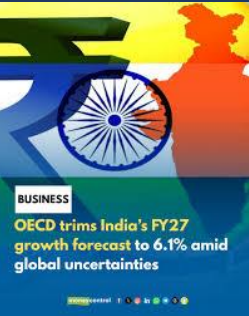
• Growth Projections: The Organisation for Economic Co-operation and Development (OECD), in its latest interim Economic Outlook report, has projected India’s Gross Domestic Product (GDP) to expand by 7.6% in the current fiscal year (2025-26), making it the fastest-growing major economy globally. • Future Moderation: For the subsequent fiscal year (2026-27), the growth rate is expected to moderate to 6.1%, reflecting a normalization of base effects and the lingering impact of global monetary tightening and geopolitical uncertainties. • West Asian Conflict Impact: The OECD highlights that the escalating conflict in West Asia poses significant \'human and economic costs,\' specifically testing the resilience of the global economy through potential energy price volatility and maritime trade disruptions. • Domestic Drivers: India’s robust performance is attributed to strong domestic demand, sustained government emphasis on infrastructure capital expenditure (Capex), and a resilient financial sector, which have helped decouple the nation from some global slowdown trends. • Global Resilience Under Pressure: While the global economy has shown surprising durability, the OECD warns that persistent geopolitical tensions could trigger inflationary shocks, forcing central banks to maintain higher interest rates for longer periods. • Strategic Risk Assessment: The report underscores the necessity for emerging economies like India to maintain fiscal buffers and diversify supply chains to mitigate the external shocks emanating from the Persian Gulf and Red Sea corridors. Key Definitions • Gross Domestic Product (GDP): The total monetary value of all finished goods and services produced within a country\'s borders in a specific time period, serving as a comprehensive scorecard of a country’s economic health. • OECD (Organisation for Economic Co-operation and Development): An intergovernmental economic organization with 38 member countries, founded in 1961 to stimulate economic progress and world trade. India is a \'Key Partner\' of the OECD, not a full member. • Interim Economic Outlook: A periodic assessment by the OECD that provides high-level updates on the global economic environment and growth forecasts for G20 economies between full report cycles. Constitutional and Legal Provisions • Article 280 (Finance Commission): While the OECD provides external projections, the Finance Commission of India uses such growth data to recommend the distribution of net proceeds of taxes between the Union and the States. • Fiscal Responsibility and Budget Management (FRBM) Act, 2003: High growth projections like 7.6% provide the government with the fiscal space necessary to adhere to the glide path of reducing the fiscal deficit toward the target of 4.5% of GDP. • Article 112 (Annual Financial Statement): External benchmarks from organizations like the OECD serve as vital inputs for the Ministry of Finance when drafting the Union Budget and estimating revenue receipts based on nominal GDP growth. Additional Keypoints • Inflationary Pressures: Despite high growth, the OECD notes that food and energy inflation remains a sensitivity for India, requiring vigilant \'calibrated\' monetary policy from the Reserve Bank of India (RBI). • Investment Climate: The 7.6% projection is expected to bolster investor confidence, potentially increasing Foreign Direct Investment (FDI) inflows in the manufacturing and green energy sectors. • Global Trade Dynamics: The report suggests that as global growth remains uneven, India’s focus on bilateral trade agreements and \'Local Currency Settlement\' systems will be crucial for maintaining export momentum. Conclusion The OECD’s projection of 7.6% growth reaffirms India’s position as a relative \'bright spot\' in a fragmented global landscape. However, the anticipated slowdown to 6.1% in the following year and the looming shadow of West Asian instability suggest that India must continue its structural reforms—particularly in land, labor, and logistics—to ensure long-term sustainable growth above the 7% threshold. UPSC Relevance • Prelims: Specific growth percentages (7.6% vs 6.1%), reports and indices published by the OECD (e.g., PISA, Revenue Statistics, Services Trade Restrictiveness Index), and the status of India’s membership in international economic blocks. • Mains (GS Paper III): Indian Economy and issues relating to planning, mobilization of resources, growth, development, and employment. The impact of external geopolitical shocks on domestic macroeconomic stability and the role of international organizations in economic forecasting.


Address : 506, 3rd EYE THREE (III), Opp. Induben Khakhrawala, Girish Cold Drink Cross Road, CG Road, Navrangpura, Ahmedabad, 380009.
Mobile : 8469231587 / 9586028957
Telephone : 079-40098991
E-mail: dics.upsc@gmail.com
Address: A-306, The Landmark, Urjanagar-1, Opp. Spicy Street, Kudasan – Por Road, Kudasan, Gandhinagar – 382421
Mobile : 9723832444 / 9723932444
E-mail: dics.gnagar@gmail.com
Address: 2nd Floor, 9 Shivali Society, L&T Circle, opp. Ratri Bazar, Karelibaugh, Vadodara, 390018
Mobile : 9725692037 / 9725692054
E-mail: dics.vadodara@gmail.com
Address: 403, Raj Victoria, Opp. Pal Walkway, Near Galaxy Circle, Pal, Surat-394510
Mobile : 8401031583 / 8401031587
E-mail: dics.surat@gmail.com
Address: 303,305 K 158 Complex Above Magson, Sindhubhavan Road Ahmedabad-380059
Mobile : 9974751177 / 8469231587
E-mail: dicssbr@gmail.com
Address: 57/17, 2nd Floor, Old Rajinder Nagar Market, Bada Bazaar Marg, Delhi-60
Mobile : 9104830862 / 9104830865
E-mail: dics.newdelhi@gmail.com