

Ahmedabad
(Head Office)Address : 506, 3rd EYE THREE (III), Opp. Induben Khakhrawala, Girish Cold Drink Cross Road, CG Road, Navrangpura, Ahmedabad, 380009.
Mobile : 8469231587 / 9586028957
E-mail: dics.upsc@gmail.com

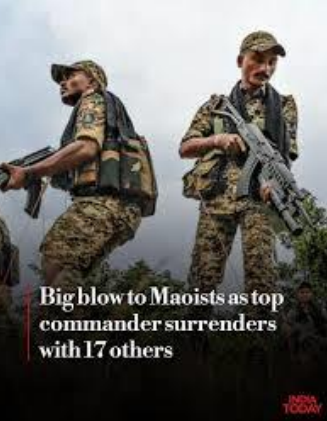
The surrender of high-ranking cadres, including the General Secretary of the CPI (Maoist), marks a watershed moment in India’s internal security landscape, signaling the structural disintegration of the Maoist insurgency. • Collapse of Leadership Hierarchy: The surrender of Tippiri Tirupati (alias Devji), who succeeded as General Secretary after the 2025 encounter of Nambala Keshav Rao, represents a terminal blow to the command-andcontrol structure of the Maoist movement. • Dilution of Ideological Patronage: Senior leaders like Malla Raji Reddy and Mallojula Venugopal Rao have publicly acknowledged the lack ofgrassroots support and \'patronage\' for militant struggle in the current socio-economic climate, advising remaining cadres to lay down arms. • Success of Modern Counter-Insurgency: The development highlights the efficacy of the \'Surrender and Rehabilitation\' policies, shifting the focus from purely kinetic operations to incentivized mainstreaming of senior leaders. • National Deadline for Elimination: These surrenders align with the Union Government’s strategic objective to completely eliminate armed Maoist struggle from the country by March 2026, showcasing a coordinated approach between State and Central forces. • Operational Pedigree of Surrendered Cadres: Devji was a pivotal figure in creating the People’s Liberation Guerrilla Army (PLGA) and held positions in the Central Committee and Politburo, making his exit a significant intelligence and psychological victory for the state. • Regional Shift in Surrender Trends: Historically, Telangana-origin Maoists surrendered in neighboring Maharashtra or Chhattisgarh; however, the recent surrenders in Asifabad indicate the Telangana Police\'s successful revival of local intelligence networks and \'pursuit\' strategies. Key Definitions • Left-Wing Extremism (LWE): Also known as Maoism or Naxalism, it is an armed insurgency based on the ideology of Mao Zedong, aiming to overthrow the state through \'Protracted People\'s War.\' • Politburo: The highest policy-making body within the CPI (Maoist) organization, responsible for strategic decisions and ideological direction. • People’s Liberation Guerrilla Army (PLGA): The armed wing of the CPI (Maoist), established in 2000, responsible for carrying out tactical operations against security forces. Constitutional and Legal Context • Seventh Schedule: \'Public Order\' and \'Police\' are State subjects. However, the Central Government assists states through the CAPFs (Central Armed Police Forces) and funding for modernization. • Unlawful Activities (Prevention) Act (UAPA), 1967: The CPI (Maoist) is a banned organization under this Act, which provides the legal framework for prosecuting individuals associated with terrorist activities. • Article 21: The \'Right to Life\' extends even to insurgents; hence, the state prioritizes surrender over encounters to uphold democratic values while maintaining security. Additional Strategic Keypoints • SAMADHAN Doctrine: The Ministry of Home Affairs\' (MHA) comprehensive strategy—Smart leadership, Aggressive strategy, Motivation, Actionable intelligence, Dashboard-based KPIs, Harnessing technology, Action plan for each theatre, and No access to financing. • Developmental Interventions: Targeted schemes like the Special Central Assistance (SCA) and the construction of Eklavya Model Residential Schools in LWE-affected districts have eroded the insurgents\' recruitment base. • Vacuum of Second-Line Leadership: With the \'old guard\' surrendering or being neutralized, the movement faces a crisis of succession, as the younger generation shows a diminishing interest in junglebased guerrilla warfare.Conclusion The surrender of the top Maoist brass in Telangana reflects the \'endgame\' of a decades-old insurgency. It proves that a combination of relentless security pressure, attractive rehabilitation packages, and the deepening reach of democratic developmental processes can effectively neutralize even the most entrenched ideological movements. The focus must now shift to ensuring the safe reintegration of these individuals to prevent any resurgence or \'splintering\' of the movement. UPSC Relevance • General Studies III: Internal Security; Challenges to internal security through non-state actors; Linkages between development and spread of extremism. • General Studies II: Governance; Government policies and interventions for development in various sectors. • Context: This is a high-priority topic for the Personality Test (Interview) and Mains, specifically regarding the \'National Policy and Action Plan to address LWE.\'


Address : 506, 3rd EYE THREE (III), Opp. Induben Khakhrawala, Girish Cold Drink Cross Road, CG Road, Navrangpura, Ahmedabad, 380009.
Mobile : 8469231587 / 9586028957
E-mail: dics.upsc@gmail.com
Address: A-306, The Landmark, Urjanagar-1, Opp. Spicy Street, Kudasan – Por Road, Kudasan, Gandhinagar – 382421
Mobile : 9723832444 / 9723932444
E-mail: dics.gnagar@gmail.com
Address: 2nd Floor, 9 Shivali Society, L&T Circle, opp. Ratri Bazar, Karelibaugh, Vadodara, 390018
Mobile : 9725692037 / 9725692054
E-mail: dics.vadodara@gmail.com
Address: 403, Raj Victoria, Opp. Pal Walkway, Near Galaxy Circle, Pal, Surat-394510
Mobile : 8401031583 / 8401031587
E-mail: dics.surat@gmail.com
Address: 303,305 K 158 Complex Above Magson, Sindhubhavan Road Ahmedabad-380059
Mobile : 9974751177 / 8469231587
E-mail: dicssbr@gmail.com
Address: 57/17, 2nd Floor, Old Rajinder Nagar Market, Bada Bazaar Marg, Delhi-60
Mobile : 9104830862 / 9104830865
E-mail: dics.newdelhi@gmail.com