

Ahmedabad
(Head Office)Address : 506, 3rd EYE THREE (III), Opp. Induben Khakhrawala, Girish Cold Drink Cross Road, CG Road, Navrangpura, Ahmedabad, 380009.
Mobile : 8469231587 / 9586028957
E-mail: dics.upsc@gmail.com

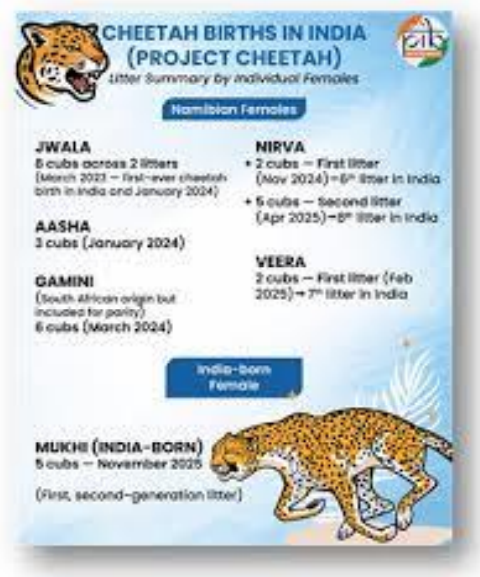
The Union government’s ambitious Project Cheetah is entering a consolidation phase with the scheduled translocation of eight more cheetahs from Botswana to Madhya Pradesh’s Kuno National Park (KNP) on February 28, 2026. This move highlights India\'s commitment to restoring its grassland ecosystems and marks the third African nation to partner in this world-first intercontinental reintroduction program. Key Highlights of the Translocation • Population Growth: The arrival of 8 new cheetahs will bring India’s total cheetah population to 46, significantly bolstered by the birth of 8 cubs at KNP in early February 2026. • International Cooperation: Botswana joins Namibia and South Africa as the third source nation, reflecting successful conservation diplomacy and a broadening of the genetic pool for the Indian population. • Logistical Operation: The Indian Air Force (IAF) will transport the cheetahs to Gwalior via large aircraft, followed by a helicopter transfer to Kuno to minimize transit stress. • Quarantine Protocol: Following international norms, the new arrivals will undergo a mandatory 30-day quarantine to monitor health and facilitate acclimatization to the northern hemisphere\'s climate. • Breeding Success: The project has moved beyond mere survival; the birth of second-generation cubs indicates that the habitat, prey base, and monitoring protocols are stabilizing. • Landscape Expansion: While KNP remains the primary site, the project is expanding to Gandhi Sagar Wildlife Sanctuary (MP) to prevent overcrowding and create a \'metapopulation\' across the central Indian landscape. Definitions of Key Terms • Translocation: The deliberate movement of wild individuals or populations from one part of their range to another for conservation purposes. • Metapopulation: A group of spatially separated populations of the same species which interact at some level, helping to prevent local extinctions. • Flagship Species: A species chosen to raise support for biodiversity conservation in a given place or social context (e.g., Cheetah for Indian grasslands). • Bomas: Specialized enclosures used for the soft release and acclimatization of wild animals during translocation projects. Constitutional and Legal Provisions • Article 48A (DPSP): Mandates the State to protect and improve the environment and safeguard the forests and wildlife of the country. • Article 51A(g): Establishes a fundamental duty for citizens to protect and improve the natural environment, including forests, lakes, rivers, and wildlife.• Wildlife (Protection) Act, 1972: Provides the legal framework for the protection of wild animals; Project Cheetah is overseen by the National Tiger Conservation Authority (NTCA), a statutory body under this Act. • CITES (Appendix I): The Cheetah (Acinonyx jubatus) is listed under Appendix I, necessitating strict international regulations and permits for its intercontinental movement. Additional Important Key Points • Ecological Role: As a top predator, the cheetah helps regulate herbivore populations (like Chinkara and Chital), preventing overgrazing and promoting the health of \'wasteland\' classified grasslands. • Conservation Challenges: Despite success, the project has faced hurdles including a total of 21 deaths (9 adults and 12 cubs) since 2022 due to causes like infection, heat stress, and natural conflict. • Economic Impact: Tourism at Kuno has reportedly doubled in the last two years, fostering local employment and community engagement through \'Cheetah Mitras.\' Conclusion and UPSC Relevance The successful transition of Project Cheetah from a pilot reintroduction to a breeding metapopulation signifies a landmark in global conservation biology. For the UPSC Civil Services Exam, this topic is vital for General Studies Paper III (Environment and Biodiversity). It links to themes of \'Species Reintroduction,\' \'International Conservation Agreements,\' and \'Habitat Restoration.\' Candidates should be prepared to discuss the scientific, ethical, and administrative complexities of translocating large carnivores and the importance of restoring the grassland-savanna biome in India.


Address : 506, 3rd EYE THREE (III), Opp. Induben Khakhrawala, Girish Cold Drink Cross Road, CG Road, Navrangpura, Ahmedabad, 380009.
Mobile : 8469231587 / 9586028957
E-mail: dics.upsc@gmail.com
Address: A-306, The Landmark, Urjanagar-1, Opp. Spicy Street, Kudasan – Por Road, Kudasan, Gandhinagar – 382421
Mobile : 9723832444 / 9723932444
E-mail: dics.gnagar@gmail.com
Address: 2nd Floor, 9 Shivali Society, L&T Circle, opp. Ratri Bazar, Karelibaugh, Vadodara, 390018
Mobile : 9725692037 / 9725692054
E-mail: dics.vadodara@gmail.com
Address: 403, Raj Victoria, Opp. Pal Walkway, Near Galaxy Circle, Pal, Surat-394510
Mobile : 8401031583 / 8401031587
E-mail: dics.surat@gmail.com
Address: 303,305 K 158 Complex Above Magson, Sindhubhavan Road Ahmedabad-380059
Mobile : 9974751177 / 8469231587
E-mail: dicssbr@gmail.com
Address: 57/17, 2nd Floor, Old Rajinder Nagar Market, Bada Bazaar Marg, Delhi-60
Mobile : 9104830862 / 9104830865
E-mail: dics.newdelhi@gmail.com