







Ahmedabad
(Head Office)Address : 506, 3rd EYE THREE (III), Opp. Induben Khakhrawala, Girish Cold Drink Cross Road, CG Road, Navrangpura, Ahmedabad, 380009.
Mobile : 8469231587 / 9586028957
Telephone : 079-40098991
E-mail: dics.upsc@gmail.com

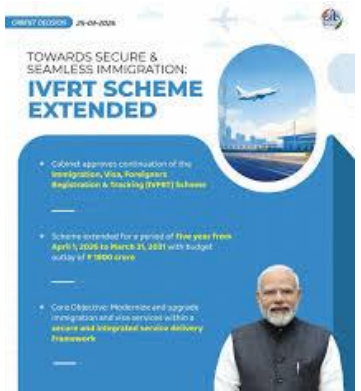
• Extended Timeline and Outlay: The Union Cabinet has approved the continuation of the IVFRT scheme for a five-year period from April 1, 2026, to March 31, 2031, with a dedicated budget outlay of Rs.1800 crore. • Core Objective: The scheme seeks to modernize and interlink functions related to immigration, visa issuance, and the registration of foreigners to facilitate legitimate travel while simultaneously bolstering national security and immigration control. • Technological Transformation: The next phase emphasizes \'strategic transformation\' through the adoption of emerging technologies like mobile-based services, self-service kiosks, and automated egates to reduce human intervention. • Operational Efficiency: IVFRT has achieved a 100% contactless and faceless visa process; notably, over 91% of e-Visa applications are now cleared within 72 hours, and average manual clearance time at airports has been halved to 2.5-3 minutes. • Trusted Traveller Programme (FTI-TTP): The scheme integrates the Fast Track Immigration-Trusted Traveller Programme at 13 major airports, utilizing automated e-gates to reduce immigration clearance time to a mere 30 seconds for Indian nationals and OCI cardholders. • Legal and Strategic Alignment: The extension is tailored to meet the requirements of the newly enacted Immigration and Foreigners Act, 2025, ensuring the system can effectively manage modern challenges like illegal migration and evolving global travel demands. Key Definitions • IVFRT Platform: An integrated digital ecosystem designed to track the movement of foreigners from the point of visa application to their exit from the country. • e-Visa: A digital travel authorization that allows foreign nationals to apply for and receive a visa online without visiting an Indian embassy or consulate. • FRRO/FRO: Foreigners Regional Registration Officer / Foreigners Registration Officer; the primary authorities responsible for regulating the registration, movement, and stay of foreigners within India. Constitutional and Legal Provisions • Entry 17, List I (Seventh Schedule): The Constitution places \'Admission into, and emigration and expulsion from, India; passports and visas\' under the Union List, giving the Central Government exclusive power. • Article 11: Grants Parliament the power to regulate the right of citizenship and matters relating to the entry and exit of individuals. • Immigration and Foreigners Act, 2025: The primary legislative framework (replacing/updating older acts like the Foreigners Act, 1946) that governs the legal entry, stay, and departure of foreigners in India. • Passport (Entry into India) Act, 1920: Requires persons entering India to be in possession of passports and empowers the government to make rules regarding the same. Additional Key Points • Economic Impact: By streamlining entry processes, the scheme provides a significant boost to the \'Medical Value Travel\' (medical tourism), business, and hospitality sectors, contributing to the \'Ease of Doing Business.\' • Security Architecture: The system enables real-time tracking and data sharing between Indian Missions abroad, Immigration Check Posts (ICPs), and FRROs to identify and intercept security threats. • Infrastructure Expansion: The scheme currently covers 117 Immigration Posts, 15 FRROs, and 854 Foreigners Registration Offices (FROs) across various districts, ensuring a pan-India digital grid. Conclusion The continuation of the IVFRT scheme marks a transition from simple digitization to a sophisticated, techdriven immigration governance model. By balancing the \'security-facilitation\' trade-off through automation and AI-ready infrastructure, India is positioning itself as a global destination for tourism and commerce while ensuring robust border integrity. This initiative is a vital component of the broader Digital India mission, reflecting a proactive approach to international mobility and internal security. UPSC Relevance GS Paper II: Governance, Government Policies and Interventions for Development in various sectors; Issues arising out of their design and implementation. GS Paper III: Internal Security; Challenges to internal security through communication networks; Role of media and social networking sites in internal security challenges. Prelims: Budgetary outlays of major schemes, names of regulatory bodies (FRRO/FRO), and specific initiatives like FTI-TTP and the Immigration and Foreigners Act, 2025.


Address : 506, 3rd EYE THREE (III), Opp. Induben Khakhrawala, Girish Cold Drink Cross Road, CG Road, Navrangpura, Ahmedabad, 380009.
Mobile : 8469231587 / 9586028957
Telephone : 079-40098991
E-mail: dics.upsc@gmail.com
Address: A-306, The Landmark, Urjanagar-1, Opp. Spicy Street, Kudasan – Por Road, Kudasan, Gandhinagar – 382421
Mobile : 9723832444 / 9723932444
E-mail: dics.gnagar@gmail.com
Address: 2nd Floor, 9 Shivali Society, L&T Circle, opp. Ratri Bazar, Karelibaugh, Vadodara, 390018
Mobile : 9725692037 / 9725692054
E-mail: dics.vadodara@gmail.com
Address: 403, Raj Victoria, Opp. Pal Walkway, Near Galaxy Circle, Pal, Surat-394510
Mobile : 8401031583 / 8401031587
E-mail: dics.surat@gmail.com
Address: 303,305 K 158 Complex Above Magson, Sindhubhavan Road Ahmedabad-380059
Mobile : 9974751177 / 8469231587
E-mail: dicssbr@gmail.com
Address: 57/17, 2nd Floor, Old Rajinder Nagar Market, Bada Bazaar Marg, Delhi-60
Mobile : 9104830862 / 9104830865
E-mail: dics.newdelhi@gmail.com