


Ahmedabad
(Head Office)Address : 506, 3rd EYE THREE (III), Opp. Induben Khakhrawala, Girish Cold Drink Cross Road, CG Road, Navrangpura, Ahmedabad, 380009.
Mobile : 8469231587 / 9586028957
Telephone : 079-40098991
E-mail: dics.upsc@gmail.com

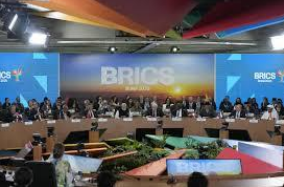
Key Summary Points • STI as a Strategic Pillar: Formally recognized in 2011 and codified in a 2015 MoU, Science, Technology, and Innovation has evolved into a core pillar of BRICS, moving from basic research toward innovation-driven and technology-transfer ecosystems. • Shift to Social Relevance: Joint research priorities have transitioned from fundamental sciences to socially relevant domains such as public health (vaccine research/biosecurity), energy, water, and climate tech, accelerated by the COVID-19 pandemic. • Leadership in Emerging Tech: The \'2025 Declaration on AI\' elevated Artificial Intelligence to a central pillar of multilateral governance, focusing on equitable and development-oriented AI frameworks to challenge Western technological hegemony. • Institutional Framework: Cooperation is managed through annual ministerial meetings and lead agencies (such as CSIR and DBT in India), supported by initiatives like the BRICS Technology Transfer Centre (TTC) and the BRICS Institute of Future Networks. • Expansion to BRICS+: The inclusion of new members (Saudi Arabia, UAE, Egypt, Ethiopia, Iran, etc.) has diversified the grouping\'s scientific capacity but introduced challenges in reconciling heterogeneous economic and technical interests. • India’s 2026 Presidency: Under the theme \'Building for Resilience, Innovation, Cooperation and Sustainability,\' India aims to address the digital divide and scale projects in biotechnology and industrial innovation. Constitutional & Legal Provisions • Article 51 (DPSP): Directs the State to promote international peace and security and maintain just and honorable relations between nations, providing the constitutional basis for BRICS engagement. • Entry 10 & 13 (Union List): Grants the Parliament exclusive power over \'Foreign Affairs\' and \'Participation in international conferences, associations and other bodies and implementing of decisions made thereat.\' • Intergovernmental Agreement on Space Cooperation (2021): A specific legal framework within BRICS for the exchange of remote sensing satellite data and joint space applications. • 2015 MoU on STI: The primary administrative legal instrument that institutionalized scientific cooperation among the member nations. Key Definitions • Techno-nationalism: The linking of technological innovation and capabilities directly to a nation\'s national security, economic prosperity, and social stability. • GERD (Gross Domestic Expenditure on R&D): A key indicator of a country\'s innovative capacity, measuring total spending on research and development performed within the national territory. • New Quality Productive Forces: A concept (promoted via the China-BRICS Research Centre) focusing on innovation-led growth that breaks away from traditional economic growth modes. • Multipolarity: A distribution of power in which more than two nation-states have nearly equal amounts of military, cultural, and economic influence. Additional Strategic Observations Despite significant progress, BRICS STI cooperation faces \'structural bottlenecks.\' The lack of a permanent Secretariat leads to a loss of institutional memory as the leadership rotates annually. Furthermore, funding remains modest compared to Western frameworks like the EU’s Horizon Program. There is an urgent need for \'Mega-science Projects\' involving heavy infrastructure to transition BRICS from a networking platform to a tangible scientific powerhouse. Conclusion BRICS has successfully moved beyond being a mere economic talk-shop to a collaborative scientific force. However, to remain credible, the grouping must bridge the \'Innovation Gap\' between China and other members and establish a permanent administrative mechanism. India’s 2026 presidency offers a window to transform this \'ad-hoc\' cooperation into a structured, agile, and data-driven scientific alliance that can effectively address Global South challenges. UPSC Relevance • GS Paper II: Bilateral, regional and global groupings and agreements involving India and/or affecting India’s interests (BRICS/BRICS+ evolution). • GS Paper III: Science and Technology—developments and their applications; indigenization of technology; issues relating to intellectual property rights and AI governance. • Prelims: BRICS member countries, New Development Bank (NDB), iBRICS, and specific declarations like the 2025 AI Declaration.


Address : 506, 3rd EYE THREE (III), Opp. Induben Khakhrawala, Girish Cold Drink Cross Road, CG Road, Navrangpura, Ahmedabad, 380009.
Mobile : 8469231587 / 9586028957
Telephone : 079-40098991
E-mail: dics.upsc@gmail.com
Address: A-306, The Landmark, Urjanagar-1, Opp. Spicy Street, Kudasan – Por Road, Kudasan, Gandhinagar – 382421
Mobile : 9723832444 / 9723932444
E-mail: dics.gnagar@gmail.com
Address: 2nd Floor, 9 Shivali Society, L&T Circle, opp. Ratri Bazar, Karelibaugh, Vadodara, 390018
Mobile : 9725692037 / 9725692054
E-mail: dics.vadodara@gmail.com
Address: 403, Raj Victoria, Opp. Pal Walkway, Near Galaxy Circle, Pal, Surat-394510
Mobile : 8401031583 / 8401031587
E-mail: dics.surat@gmail.com
Address: 303,305 K 158 Complex Above Magson, Sindhubhavan Road Ahmedabad-380059
Mobile : 9974751177 / 8469231587
E-mail: dicssbr@gmail.com
Address: 57/17, 2nd Floor, Old Rajinder Nagar Market, Bada Bazaar Marg, Delhi-60
Mobile : 9104830862 / 9104830865
E-mail: dics.newdelhi@gmail.com