






Ahmedabad
(Head Office)Address : 506, 3rd EYE THREE (III), Opp. Induben Khakhrawala, Girish Cold Drink Cross Road, CG Road, Navrangpura, Ahmedabad, 380009.
Mobile : 8469231587 / 9586028957
Telephone : 079-40098991
E-mail: dics.upsc@gmail.com

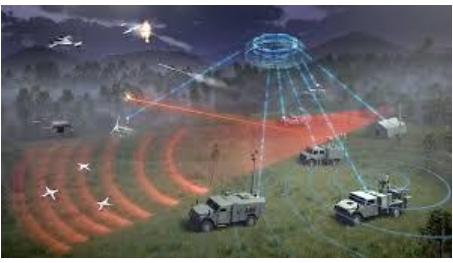
• Integrated Regional Network: The 2026 hostilities have seen the emergence of a newly integrated air defense network involving the U.S., Israel, and the UAE. Unlike the June 2025 \'12-Day War,\' this system relies on enhanced interoperability, combining U.S. Terminal High Altitude Area Defense (THAAD) and Patriot batteries with the UAE’s South Korean-origin Cheongung II and Israel’s multilayered shield. • The \'Cheongung II\' Advantage: The UAE’s activation of the Cheongung II system marks a shift toward 360° situational awareness. Unlike older Patriot versions with a 120° radar cone, Cheongung II uses a Vertical Launch System (VLS) and a rotating multi-function radar, allowing it to engage threats—including low-flying \'sea-skimmer\' cruise missiles—from any direction without repositioning. • Economics of \'Saturation Attacks\': Iran’s strategy involves \'saturation attacks\'—launching vast swarms of low-cost drones and missiles to deplete expensive interceptor stockpiles. To counter this, the coalition is \'rationing\' high-end interceptors (like the PAC-3 MSE costing $4 million per shot) and deploying cost-effective alternatives like the Indirect Fire Protection Capability (IFPC) and highenergy lasers. • Debut of Directed Energy: Israel has operationalized the \'Iron Beam\' laser system to handle drone swarms and mortars. By neutralizing threats at a cost of \'a few shekels\' per shot, it preserves the inventory of expensive Tamir (Iron Dome) and Stunner (David’s Sling) missiles for more complex ballistic threats. • Iran’s Defensive Resilience: Iran has deployed its indigenous Bavar-373 (using Sayyad-4B missiles) and the Arman BMD system, which boasts 360° radar coverage. While designed to rival the S-400, these systems face challenges from the sheer volume of U.S.- Israeli precision strikes and the \'reload gap,\' where batteries remain vulnerable while being replenished. • Logistical Bottlenecks: A critical concern for the U.S.- led coalition is the \'production-to-consumption\' mismatch. Industrial manufacturing of advanced interceptors like THAAD and Patriot currently lags behind the high-tempo expenditure seen in active combat, with replenishment estimated to take over 1.5 years at current capacities. Key Definitions • Interceptor: A missile or kinetic projectile designed to find and destroy an incoming threat (missile, drone, or aircraft) before it reaches its target. • Hit-to-Kill Technology: A modern interception method where the interceptor destroys the target through pure kinetic energy (physical collision) rather than an explosive blast. • Saturation Attack: A military tactic of overwhelming a defense system by firing more projectiles than the system\'s sensors can track or its launchers can engage simultaneously. • Endo-atmospheric vs. Exo-atmospheric: Systems that intercept targets within the Earth\'s atmosphere (e.g., THAAD, Patriot) versus those that engage them in space (e.g., Arrow 3). Constitutional & Legal Provisions • Article 51 of the UN Charter: Recognizes the inherent right of individual or collective self-defense if an armed attack occurs against a Member of the United Nations. • Customary International Law (Necessity & Proportionality): Legal principles requiring that any military response, including the use of missile defenses, must be necessary to repel an attack and proportionate to the threat. • The Hague Conventions: Regulate the methods of warfare, including the requirement to distinguish between military targets and civilian objects, a principle central to the deployment of precision missile defenses. Comparison of Key Defense Systems (2026)

Conclusion The ongoing conflict represents a paradigm shift in aerial warfare, where the \'cost-per-kill\' ratio has become as strategic as the technology itself. While integrated networks and laser defenses provide a formidable shield, the sustainability of this protection is threatened by industrial supply chain constraints and the strategic use of \'saturation\' by adversaries. For regional security, the focus has moved beyond individual \'batteries\' to a seamless, automated, and multi-national \'grid\' of sensors and shooters. UPSC Relevance • GS Paper III: Science and Technology- developments and their applications; Indigenization of technology; Security challenges and their management in border areas. • GS Paper II: Effect of policies and politics of developed and developing countries on India\'s interests (West Asia conflict impact on energy security). • Prelims: Technical specifications of S-400, THAAD, Iron Dome; Major defense partners of India (S. Korea, Israel, USA).


Address : 506, 3rd EYE THREE (III), Opp. Induben Khakhrawala, Girish Cold Drink Cross Road, CG Road, Navrangpura, Ahmedabad, 380009.
Mobile : 8469231587 / 9586028957
Telephone : 079-40098991
E-mail: dics.upsc@gmail.com
Address: A-306, The Landmark, Urjanagar-1, Opp. Spicy Street, Kudasan – Por Road, Kudasan, Gandhinagar – 382421
Mobile : 9723832444 / 9723932444
E-mail: dics.gnagar@gmail.com
Address: 2nd Floor, 9 Shivali Society, L&T Circle, opp. Ratri Bazar, Karelibaugh, Vadodara, 390018
Mobile : 9725692037 / 9725692054
E-mail: dics.vadodara@gmail.com
Address: 403, Raj Victoria, Opp. Pal Walkway, Near Galaxy Circle, Pal, Surat-394510
Mobile : 8401031583 / 8401031587
E-mail: dics.surat@gmail.com
Address: 303,305 K 158 Complex Above Magson, Sindhubhavan Road Ahmedabad-380059
Mobile : 9974751177 / 8469231587
E-mail: dicssbr@gmail.com
Address: 57/17, 2nd Floor, Old Rajinder Nagar Market, Bada Bazaar Marg, Delhi-60
Mobile : 9104830862 / 9104830865
E-mail: dics.newdelhi@gmail.com