







Ahmedabad
(Head Office)Address : 506, 3rd EYE THREE (III), Opp. Induben Khakhrawala, Girish Cold Drink Cross Road, CG Road, Navrangpura, Ahmedabad, 380009.
Mobile : 8469231587 / 9586028957
E-mail: dics.upsc@gmail.com

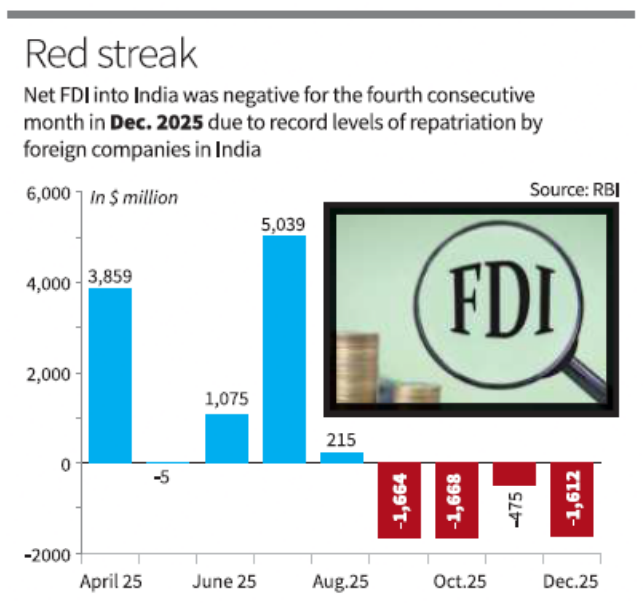
The latest data from the Reserve Bank of India (RBI) reveals a complex picture of India\'s investment landscape. While gross inflows hit a five-month high in December 2025, the net FDI remained negative for the fourth consecutive month. This trend highlights the impact of global trade uncertainties and the aggressive repatriation of capital by foreign entities. • Negative Net FDI Trend: Net FDI stood at -$1.6 billion in December 2025. This negative balance occurs when the sum of capital repatriation by foreign firms and outward investments by Indian companies exceeds the gross inward FDI. • Surge in Gross Inflows: Despite the negative net figure, gross inward FDI was robust at $8.6 billion (a 17.2% year-on-year increase). Major contributing nations included Singapore, the Netherlands, and Mauritius, accounting for over 80% of the total inflows. • Sectoral Performance: Investment was primarily concentrated in the transport, manufacturing, computer services, and energy sectors (generation and distribution), indicating continued interest in India’s infrastructure and tech capabilities. • Record Repatriation: Disinvestments and repatriation by foreign companies reached a multi-year high of $7.5 billion. This surge is attributed to profit booking and strategic shifts by global firms amidst highinterest rates and trade tensions. • Impact of Trade Diplomacy: The RBI noted that prior investor hesitation was linked to uncertainties over India-U.S. trade relations and high tariff regimes. However, the subsequent announcement of the India-EU FTA and the India-U.S. Interim Agreement has already begun to stabilize portfolio investments (FPIs). • Indian Global Footprint: Outward FDI by Indian companies rose to $2.7 billion, focusing on financial services and retail in markets like the U.S., UAE, and the U.K., reflecting the global expansion of Indian multinationals. Constitutional & Legal Provisions • Article 246 (Seventh Schedule): Foreign Exchange and Foreign Loans fall under the Union List (Entries 36 and 37), giving the Central Government exclusive power to regulate FDI. • Foreign Exchange Management Act (FEMA), 1999: The primary legal framework governing FDI in India. It empowers the RBI and the Government to regulate capital account transactions. • FDI Policy (DPIIT): The Department for Promotion of Industry and Internal Trade (DPIIT) issues the Consolidated FDI Policy, which specifies the caps and entry routes (Automatic vs. Government) for various sectors. • Bilateral Investment Treaties (BITs): Legal agreements between India and other nations to protect foreign investments. The recent shift towards a \'New Model BIT\' aims to balance investor protection with the state\'s right to regulate.• Gross Inward FDI: The total amount of direct investment coming into the country during a specific period without accounting for outflows. • Net FDI: Calculated as (Gross Inward FDI) minus (Repatriation/Disinvestment by foreigners + Outward FDI by residents). A negative value indicates more capital left the country than entered. • Repatriation of Capital: The process of moving foreign-earned profits or invested capital back to the investor\'s home country. • FPI (Foreign Portfolio Investment): Investment in financial assets like stocks and bonds. Unlike FDI, FPI does not involve direct management or long-term interest in a company and is often referred to as \'hot money.\' Conclusion The divergence between robust gross inflows and negative net FDI suggests that while India remains an attractive destination for new capital, existing investors are liquidating stakes or moving profits due to external geopolitical pressures and trade uncertainties. The recent breakthroughs in FTA negotiations with the EU and the U.S. are expected to act as a significant \'sentiment booster,\' potentially reversing the negative net trend in the coming quarters of 2026. UPSC Relevance • GS Paper III (Economy): Investment models; mobilization of resources; growth and development; and the effects of liberalization on the economy. • GS Paper II (International Relations): Impact of Free Trade Agreements (FTAs) and bilateral trade deals on the domestic economy. • Prelims Factor: Understanding the difference between Net and Gross FDI, and the major sectors/countries contributing to India’s FDI profile.


Address : 506, 3rd EYE THREE (III), Opp. Induben Khakhrawala, Girish Cold Drink Cross Road, CG Road, Navrangpura, Ahmedabad, 380009.
Mobile : 8469231587 / 9586028957
E-mail: dics.upsc@gmail.com
Address: A-306, The Landmark, Urjanagar-1, Opp. Spicy Street, Kudasan – Por Road, Kudasan, Gandhinagar – 382421
Mobile : 9723832444 / 9723932444
E-mail: dics.gnagar@gmail.com
Address: 2nd Floor, 9 Shivali Society, L&T Circle, opp. Ratri Bazar, Karelibaugh, Vadodara, 390018
Mobile : 9725692037 / 9725692054
E-mail: dics.vadodara@gmail.com
Address: 403, Raj Victoria, Opp. Pal Walkway, Near Galaxy Circle, Pal, Surat-394510
Mobile : 8401031583 / 8401031587
E-mail: dics.surat@gmail.com
Address: 303,305 K 158 Complex Above Magson, Sindhubhavan Road Ahmedabad-380059
Mobile : 9974751177 / 8469231587
E-mail: dicssbr@gmail.com
Address: 57/17, 2nd Floor, Old Rajinder Nagar Market, Bada Bazaar Marg, Delhi-60
Mobile : 9104830862 / 9104830865
E-mail: dics.newdelhi@gmail.com