



Ahmedabad
(Head Office)Address : 506, 3rd EYE THREE (III), Opp. Induben Khakhrawala, Girish Cold Drink Cross Road, CG Road, Navrangpura, Ahmedabad, 380009.
Mobile : 8469231587 / 9586028957
Telephone : 079-40098991
E-mail: dics.upsc@gmail.com

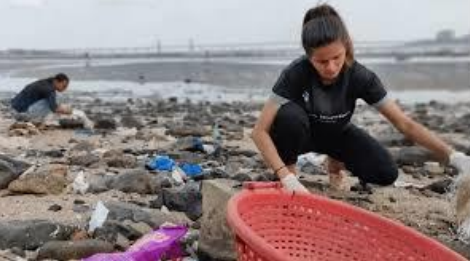
• Abundance vs. Risk Paradox: New research from V.O. Chidambaram College indicates that while microplastic counts in Chennai\'s beach sediments are lower than global averages, the ecological risk remains high due to the nature of the polymers found. • Predominance of Nylon Fibres: The study identifies nylon fibres (mostly under 1000 μm) as the dominant pollutant; these are considered more hazardous than other plastics due to their chemical additives and high capacity to adsorb pollutants. • Benthic Ecosystem Impact: Fibre-shaped microplastics alter sediment structures, affecting benthic (bottom-layer) organisms such as worms, crabs, and shellfish, which ingest these particles, leading to digestive blockages or toxic poisoning. • Anthropogenic Sources: Primary contributors include the shedding of synthetic fibres from laundry, degraded fishing nets and ropes, urban stormwater runoff, and tourism-related plastic waste. • Trophic Transfer: Microplastics enter the human food chain through contaminated seafood, potentially causing tissue inflammation and disrupting hormonal and immune systems over long-term exposure. • Policy Imperatives: The study advocates for a shift from simple \'abundance-based\' monitoring to \'risk-based\' evaluations that consider polymer type, shape, and aging characteristics for effective coastal management. Key Definitions • Microplastics: Plastic particles less than 5mm in diameter, categorized as primary (manufactured small, like microbeads) or secondary (resulting from the breakdown of larger plastic items). • Benthic Zone: The lowest ecological region of a body of water, including the sediment surface and some subsurface layers, home to organisms critical for nutrient cycling. • Adsorption: The process by which liquid or gas molecules adhere to the surface of a solid; microplastics \'adsorb\' persistent organic pollutants (POPs) from seawater, becoming highly toxic. Constitutional and Legal Provisions • Article 48A (DPSP): The State shall endeavour to protect and improve the environment and to safeguard the forests and wildlife of the country. • Article 51A(g) (Fundamental Duties): It shall be the duty of every citizen to protect and improve the natural environment including forests, lakes, rivers, and wildlife. • Plastic Waste Management Rules, 2016 (Amended 2022): Provides the statutory framework for managing plastic waste, including the ban on identified single-use plastics and the implementation of Extended Producer Responsibility (EPR). • Environment Protection Act, 1986: An umbrella legislation that empowers the Central Government to coordinate actions of State Governments and authorities for environmental protection. Additional Key Points • Transboundary Nature: Microplastics are subject to long-distance transport via ocean currents, making coastal pollution a regional and international issue rather than a localized one. • Biological Impacts: Beyond physical injury, microplastics serve as \'rafts\' for disease-causing bacteria and invasive species, facilitating their spread across marine ecosystems. • The \'Viksit Bharat\' Link: Sustainable coastal management is essential for India’s \'Blue Economy\' goals, ensuring that economic growth from marine resources does not compromise ecological health. Conclusion The Chennai beach study highlights a critical gap in traditional environmental monitoring: low quantity does not equate to safety. As microplastics become a permanent feature of the geological record, the focus must move toward \'polymer-specific\' regulations and the promotion of biodegradable alternatives in the textile and fishing industries. Early intervention through improved urban drainage and fishing gear recycling can still prevent these \'sparse\' pollutants from escalating into an irreversible ecological crisis. UPSC Relevance GS Paper III: Conservation, environmental pollution and degradation, environmental impact assessment; Science and Technology- developments and their applications and effects in everyday life. GS Paper I: Changes in critical geographical features (including water-bodies and ice-caps) and in flora and fauna and the effects of such changes. Prelims: Definition of microplastics; Plastic Waste Management Rules; Blue Economy initiatives; and Marine Heatwaves/Coastal Ecology.


Address : 506, 3rd EYE THREE (III), Opp. Induben Khakhrawala, Girish Cold Drink Cross Road, CG Road, Navrangpura, Ahmedabad, 380009.
Mobile : 8469231587 / 9586028957
Telephone : 079-40098991
E-mail: dics.upsc@gmail.com
Address: A-306, The Landmark, Urjanagar-1, Opp. Spicy Street, Kudasan – Por Road, Kudasan, Gandhinagar – 382421
Mobile : 9723832444 / 9723932444
E-mail: dics.gnagar@gmail.com
Address: 2nd Floor, 9 Shivali Society, L&T Circle, opp. Ratri Bazar, Karelibaugh, Vadodara, 390018
Mobile : 9725692037 / 9725692054
E-mail: dics.vadodara@gmail.com
Address: 403, Raj Victoria, Opp. Pal Walkway, Near Galaxy Circle, Pal, Surat-394510
Mobile : 8401031583 / 8401031587
E-mail: dics.surat@gmail.com
Address: 303,305 K 158 Complex Above Magson, Sindhubhavan Road Ahmedabad-380059
Mobile : 9974751177 / 8469231587
E-mail: dicssbr@gmail.com
Address: 57/17, 2nd Floor, Old Rajinder Nagar Market, Bada Bazaar Marg, Delhi-60
Mobile : 9104830862 / 9104830865
E-mail: dics.newdelhi@gmail.com