






Ahmedabad
(Head Office)Address : 506, 3rd EYE THREE (III), Opp. Induben Khakhrawala, Girish Cold Drink Cross Road, CG Road, Navrangpura, Ahmedabad, 380009.
Mobile : 8469231587 / 9586028957
Telephone : 079-40098991
E-mail: dics.upsc@gmail.com

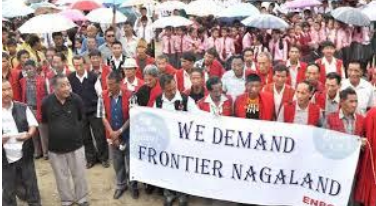
• Legislative Introduction: Nagaland Deputy Chief Minister Yanthungo Patton has introduced a landmark Bill in the State Assembly to establish the Frontier Nagaland Territorial Authority (FNTA), a specialized administrative body for the state’s eastern districts. • Interim Administrative Structure: The FNTA is designed as an interim administrative authority aimed at providing greater autonomy and targeted governance to address the long-standing developmental and political grievances of the eastern region. • Memorandum of Agreement (MoA): The Bill follows a historic tripartite agreement involving the Union Government, the Nagaland State Government, and eastern Nagaland stakeholders, reflecting a consensus-based approach to regional aspirations. • Commitment to Decentralization: Chief Minister Neiphiu Rio highlighted that the FNTA reflects the government’s commitment to increasing local participation in governance and ensuring measurable developmental outcomes for the people of the eastern districts. • Role of ENPO: The Eastern Nagaland People’s Organisation (ENPO), which has long spearheaded the demand for a separate entity, has urged the State Government to ensure that the final legislation strictly adheres to the provisions of the signed MoA. • Socio-Political Significance: The formation of the FNTA is seen as a strategic move to maintain the territorial integrity of Nagaland while satisfying the demands for administrative self-determination within the existing state framework. Key Definitions Frontier Nagaland Territorial Authority (FNTA): A proposed administrative body with specific executive and legislative powers carved out to manage the affairs of the eastern districts of Nagaland. Eastern Nagaland People’s Organisation (ENPO): The apex tribal body representing the six eastern districts of Nagaland, which has been the primary advocate for the \'Frontier Nagaland\' demand. Territorial Authority: A decentralized governance model that allows a specific sub-region to manage its local affairs, often used in tribal or ethnically distinct areas to provide autonomy without full statehood. Constitutional and Legal Provisions Article 371A: A special provision in the Indian Constitution for Nagaland which mandates that no Act of Parliament regarding religious or social practices, customary law, or ownership of land shall apply to the state unless the Legislative Assembly so decides. Sixth Schedule: Though Nagaland is not a Sixth Schedule state, the FNTA model draws inspiration from Autonomous District Councils (ADCs) which provide for self-governance in tribal areas of the Northeast. Article 3: Grants Parliament the power to form new states and alter areas, boundaries, or names of existing states; the FNTA acts as a middle-path solution to prevent the invocation of Article 3 for a separate state. Entry 5, State List (Schedule VII): Local government, that is to say, the constitution and powers of municipal corporations, improvement trusts, and district councils. Additional Important Keypoints The demand for Frontier Nagaland is rooted in perceived \'developmental negligence\' and \'political underrepresentation\' of the eastern tribes compared to the central and western parts of the state. The FNTA is expected to have its own budget head and administrative control over certain subjects, reducing its dependence on the state capital, Kohima. This move is also a significant step toward resolving internal friction within the Naga peace process, as it addresses the \'internal\' Naga issue while the \'external\' talks with groups like the NSCN-IM continue at the central level. Conclusion The tabling of the FNTA Bill marks a pivotal moment in Nagaland’s political history. By opting for a \'Territorial Authority\' instead of a full-fledged separate state, the government has attempted to balance regional aspirations with administrative cohesion. The success of this interim body will depend on the degree of financial and legislative power actually devolved to the FNTA and how effectively it can bridge the developmental divide in the state. UPSC Relevance General Studies Paper II: Federalism and challenges to the federal structure; Devolution of powers and finances up to local levels; Government policies for the development of sensitive border states. General Studies Paper III: Internal security challenges in Northeast India; Role of non-state actors in demanding regional autonomy. Preliminary Examination: Features of Article 371A, the geography of Eastern Nagaland districts, and the functions of Territorial/District Councils in the Northeast.


Address : 506, 3rd EYE THREE (III), Opp. Induben Khakhrawala, Girish Cold Drink Cross Road, CG Road, Navrangpura, Ahmedabad, 380009.
Mobile : 8469231587 / 9586028957
Telephone : 079-40098991
E-mail: dics.upsc@gmail.com
Address: A-306, The Landmark, Urjanagar-1, Opp. Spicy Street, Kudasan – Por Road, Kudasan, Gandhinagar – 382421
Mobile : 9723832444 / 9723932444
E-mail: dics.gnagar@gmail.com
Address: 2nd Floor, 9 Shivali Society, L&T Circle, opp. Ratri Bazar, Karelibaugh, Vadodara, 390018
Mobile : 9725692037 / 9725692054
E-mail: dics.vadodara@gmail.com
Address: 403, Raj Victoria, Opp. Pal Walkway, Near Galaxy Circle, Pal, Surat-394510
Mobile : 8401031583 / 8401031587
E-mail: dics.surat@gmail.com
Address: 303,305 K 158 Complex Above Magson, Sindhubhavan Road Ahmedabad-380059
Mobile : 9974751177 / 8469231587
E-mail: dicssbr@gmail.com
Address: 57/17, 2nd Floor, Old Rajinder Nagar Market, Bada Bazaar Marg, Delhi-60
Mobile : 9104830862 / 9104830865
E-mail: dics.newdelhi@gmail.com