







Ahmedabad
(Head Office)Address : 506, 3rd EYE THREE (III), Opp. Induben Khakhrawala, Girish Cold Drink Cross Road, CG Road, Navrangpura, Ahmedabad, 380009.
Mobile : 8469231587 / 9586028957
E-mail: dics.upsc@gmail.com

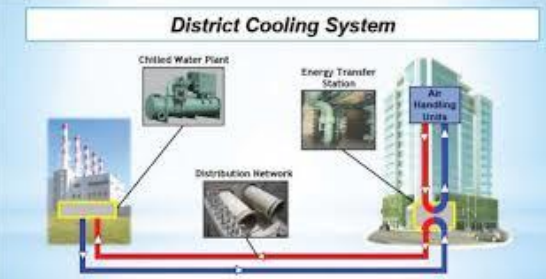
Summary of Key Highlights• Centralized Efficiency: District Cooling System (DCS) acts as a \'shared utility\' where a central plant produces chilled water and distributes it to a cluster of buildings via underground pipes, replacing inefficient individual air-conditioning units. • Energy and Peak Load Management: DCS can be 30-50% more energy-efficient than standalone systems. By using thermal storage to produce ice or chilled water at night, it reduces peak afternoon electricity demand by 20-30%, easing the burden on DISCOMs. • Climate Change Mitigation: Implementation can reduce greenhouse gas emissions by 15-40%. It also mitigates the \'Urban Heat Island\' effect by eliminating thousands of small outdoor AC units that vent heat into city streets. • Resource Optimization: DCS centralizes refrigerant management, reducing potential leakage volumes by up to 80%. Furthermore, these plants can utilize treated sewage water for cooling, preserving fresh water in stressed urban centers. • Economic Incentives: Real estate developers can save 5-10% on capital costs and unlock 1-2% more saleable area by removing rooftop chillers. For consumers, it offers \'cooling as a service\' with 99.9% utility-grade reliability. • Strategic Candidate Areas: High-density zones like Ahmedabad’s GIFT City (already operational), Navi Mumbai, and Hyderabad’s Financial District are prime candidates due to predictable, dense cooling loads. Key Definitions • District Cooling System (DCS): A centralized cooling network that provides air conditioning to multiple buildings within a district from a single energy plant. • Thermal Energy Storage (TES): A technology that allows a cooling plant to produce and store chilled water or ice during off-peak hours (night) for use during peak demand periods (day). • Urban Heat Island (UHI) Effect: A phenomenon where urban areas experience much higher temperatures than surrounding rural areas due to human activities, concrete surfaces, and heat rejected by AC units. Constitutional & Legal Provisions • Article 243W (12th Schedule): Empowers Municipalities to perform functions related to urban planning and \'Public Amenities,\' which can include district-level utility infrastructure like DCS. • Energy Conservation Act, 2001: Provides the legal framework for the Bureau of Energy Efficiency (BEE) to mandate energy-efficient cooling standards. • Kigali Amendment to the Montreal Protocol: India is committed to phasing down Hydrofluorocarbons (HFCs) by 85% by 2047; DCS supports this by concentrating and reducing refrigerant use. • India Cooling Action Plan (ICAP), 2019: A flagship policy targeting a 20-25% reduction in cooling demand and a 25-40% reduction in cooling energy requirements by 2037-38.Comparative Advantage of District Cooling
Important Keypoints for UPSC • National Cooling Action Plan (ICAP): DCS is a core technological intervention suggested to achieve ICAP’s goal of reducing energy consumption while providing \'Thermal Comfort for All.\' • Urban Planning Integration: Experts suggest that Master Plans must demarcate \'District Cooling Zones\' similar to water or sewage zones to ensure the feasibility of underground pipe corridors. • Financial Model: Works on a tripartite tariff—one-time connection fee, fixed demand charge (for reserved capacity), and variable consumption charge. • Synergy with Smart Cities: DCS aligns with the Smart Cities Mission by providing sustainable, technology-driven public infrastructure that enhances city livability and energy security. Conclusion District cooling transforms cooling from a private luxury into a public utility. As India faces intensifying heatwaves, shifting to a centralized cooling architecture is no longer just an environmental choice but a necessity for urban survival. By integrating DCS into the fabric of New India’s cities, planners can simultaneously tackle energy poverty, peak-load crises, and climate commitments, turning a vulnerability into a resilient infrastructure asset. UPSC Relevance • GS Paper II: Statutory, regulatory and various quasi-judicial bodies; Government policies and interventions for development in various sectors. • GS Paper III: Infrastructure: Energy; Conservation, environmental pollution and degradation; Disaster and disaster management (Heatwaves). • Mains Focus: \'Discuss the role of District Cooling in achieving India\'s targets under the India Cooling Action Plan and the Kigali Amendment.\'


Address : 506, 3rd EYE THREE (III), Opp. Induben Khakhrawala, Girish Cold Drink Cross Road, CG Road, Navrangpura, Ahmedabad, 380009.
Mobile : 8469231587 / 9586028957
E-mail: dics.upsc@gmail.com
Address: A-306, The Landmark, Urjanagar-1, Opp. Spicy Street, Kudasan – Por Road, Kudasan, Gandhinagar – 382421
Mobile : 9723832444 / 9723932444
E-mail: dics.gnagar@gmail.com
Address: 2nd Floor, 9 Shivali Society, L&T Circle, opp. Ratri Bazar, Karelibaugh, Vadodara, 390018
Mobile : 9725692037 / 9725692054
E-mail: dics.vadodara@gmail.com
Address: 403, Raj Victoria, Opp. Pal Walkway, Near Galaxy Circle, Pal, Surat-394510
Mobile : 8401031583 / 8401031587
E-mail: dics.surat@gmail.com
Address: 303,305 K 158 Complex Above Magson, Sindhubhavan Road Ahmedabad-380059
Mobile : 9974751177 / 8469231587
E-mail: dicssbr@gmail.com
Address: 57/17, 2nd Floor, Old Rajinder Nagar Market, Bada Bazaar Marg, Delhi-60
Mobile : 9104830862 / 9104830865
E-mail: dics.newdelhi@gmail.com