



Ahmedabad
(Head Office)Address : 506, 3rd EYE THREE (III), Opp. Induben Khakhrawala, Girish Cold Drink Cross Road, CG Road, Navrangpura, Ahmedabad, 380009.
Mobile : 8469231587 / 9586028957
E-mail: dics.upsc@gmail.com

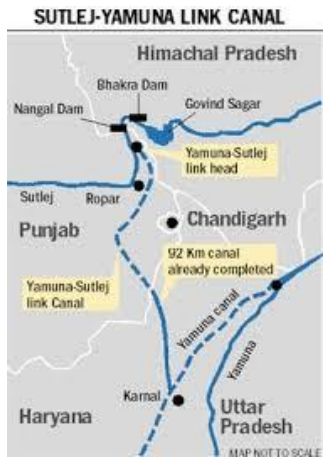
The long-standing water sharing dispute between Punjab and Rajasthan has entered a new phase of escalation. Punjab Chief Minister Bhagwant Mann has demanded that Rajasthan pay ₹1.44 lakh-crore as \'usage charges\' for water drawn since 1960. This demand challenges the historical allocation frameworks, specifically targeting the 1920 tripartite agreement and the post-reorganization water distribution under the Punjab Reorganisation Act, 1966. • Fiscal Demand for Water: Punjab has quantified its claim at ₹1.44 lakh-crore, asserting that Rajasthan has been drawing water without adequate compensation or a valid contemporary riparian right, especially given Punjab’s own shrinking groundwater levels. • Historical Agreement Review: The Punjab government has called for a formal review of the 1920 tripartite agreement involving the British Government, the State of Bahawalpur (now in Pakistan), and the erstwhile Maharaja of Bikaner, arguing it is outdated in the post-independence federal structure. • Riparian vs. Non-Riparian Rights: The core of the legal debate rests on the \'Riparian Principle,\' where Punjab claims exclusive rights as a basin state, while Rajasthan relies on \'Appropriative Rights\' and historical allocations made during the construction of the Indira Gandhi Canal. • Groundwater Crisis Context: Punjab’s aggressive stance is driven by the fact that over 75% of its blocks are \'dark zones\' (over-exploited groundwater), making the diversion of river water to other states a sensitive socio-political and economic issue. • The SYL Linkage: This demand is intrinsically linked to the SutlejYamuna Link (SYL) canal dispute. Punjab refuses to construct its portion of the canal, citing the \'Riparian Principle\' and decreased water flow in the Ravi-Beas system compared to 1920 or 1981 estimates. • Impact on Federalism: The dispute highlights the limitations of the Inter-State River Water Disputes Act, 1956, and the role of the Apex Court in resolving conflicts where states use fiscal demands as a leverage in water-sharing negotiations. Key Definitions • Riparian State: A state through which a river flows, giving it a natural legal right to use the water. • Tripartite Agreement: A legal contract involving three parties; in this context, the 1920 agreement settled water rights for the Sutlej Valley Project. • Dark Zones: Areas where the rate of groundwater extraction exceeds the rate of recharge, leading to a critical decline in the water table. • Vesting of Rights: The legal transfer of rights or claims. Punjab argues that water rights vested in the British era cannot be treated as permanent in a modern democratic union without periodic review. Constitutional & Legal Provisions • Article 262: Empowering Parliament to provide for the adjudication of any dispute or complaint with respect to the use, distribution, or control of the waters of any inter-state river or river valley. • Entry 17 (State List): Water, including water supplies, irrigation, and canals, drainage and embankments, water storage, and water power, subject to Entry 56 of the Union List. • Entry 56 (Union List): Regulation and development of inter-state rivers and river valleys to the extent to which such regulation and development under the control of the Union is declared by Parliament by law to be expedient in the public interest. • Inter-State River Water Disputes Act, 1956: Enacted under Article 262, it provides for the establishment of tribunals (like the Ravi-Beas Tribunal) whose decisions have the force of a Supreme Court decree. • Section 78 of the Punjab Reorganisation Act, 1966: Provides for the Central Government to determine the rights and liabilities of successor states (Punjab and Haryana) regarding the Bhakra-Nangal and Beas Projects. Additional Strategic Keypoints • Changing Hydrology: Punjab argues that the total water available in the Ravi-Beas system has dwindled from 17.17 MAF (Million Acre Feet) in 1981 to less than 13 MAF currently, rendering old awards obsolete. • Indira Gandhi Canal (IGNP): This is the primary lifeline for Rajasthan\'s Thar Desert. Any stoppage of water as threatened would lead to a massive humanitarian and agricultural crisis in North-Western Rajasthan. • The Role of the Supreme Court: While the SC has ordered Punjab to complete the SYL canal in the past, Punjab has used the \'Termination of Agreements Act, 2004\' (later declared unconstitutional) and current fiscal claims to delay implementation. Conclusion The demand for ₹1.44 lakh-crore marks a shift from purely legal/hydrological arguments to a \'compensatory federalism\' approach. While legally the demand may face hurdles due to existing central awards and tribunal rulings, it serves to highlight the acute water distress in the breadbasket of India. A permanent solution requires a scientific reassessment of water flows and a shift toward water-efficient cropping patterns in both Punjab and Rajasthan. UPSC Relevance • GS Paper II: Federalism (Inter-state disputes and the role of the Centre); Statutory bodies (Water Tribunals); Governance issues. • GS Paper III: Infrastructure (Water/Irrigation); Environmental issues (Groundwater depletion); Disaster Management (Drought). • Prelims: Article 262, Entry 17 vs Entry 56, rivers of the Indus system, and the geography of the Indira Gandhi Canal.


Address : 506, 3rd EYE THREE (III), Opp. Induben Khakhrawala, Girish Cold Drink Cross Road, CG Road, Navrangpura, Ahmedabad, 380009.
Mobile : 8469231587 / 9586028957
E-mail: dics.upsc@gmail.com
Address: A-306, The Landmark, Urjanagar-1, Opp. Spicy Street, Kudasan – Por Road, Kudasan, Gandhinagar – 382421
Mobile : 9723832444 / 9723932444
E-mail: dics.gnagar@gmail.com
Address: 2nd Floor, 9 Shivali Society, L&T Circle, opp. Ratri Bazar, Karelibaugh, Vadodara, 390018
Mobile : 9725692037 / 9725692054
E-mail: dics.vadodara@gmail.com
Address: 403, Raj Victoria, Opp. Pal Walkway, Near Galaxy Circle, Pal, Surat-394510
Mobile : 8401031583 / 8401031587
E-mail: dics.surat@gmail.com
Address: 303,305 K 158 Complex Above Magson, Sindhubhavan Road Ahmedabad-380059
Mobile : 9974751177 / 8469231587
E-mail: dicssbr@gmail.com
Address: 57/17, 2nd Floor, Old Rajinder Nagar Market, Bada Bazaar Marg, Delhi-60
Mobile : 9104830862 / 9104830865
E-mail: dics.newdelhi@gmail.com